P62139
Gene name |
PPP1CA (PPP1A) |
Protein name |
Serine/threonine-protein phosphatase PP1-alpha catalytic subunit |
Names |
PP-1A |
Species |
Oryctolagus cuniculus (Rabbit) |
KEGG Pathway |
ocu:100009298 |
EC number |
3.1.3.16: Phosphoric monoester hydrolases |
Protein Class |
|
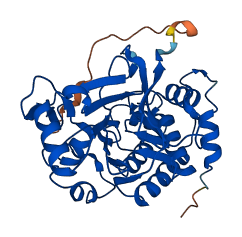
Descriptions
The autoinhibited protein was predicted that may have potential autoinhibitory elements via cis-regPred.
Autoinhibitory domains (AIDs)
Target domain |
|
Relief mechanism |
|
Assay |
cis-regPred |
Accessory elements
No accessory elements
Autoinhibited structure

Activated structure
3 structures for P62139
| Entry ID | Method | Resolution | Chain | Position | Source |
|---|---|---|---|---|---|
| 1FJM | X-ray | 210 A | A/B | 1-330 | PDB |
| 7NZM | EM | 396 A | B | 7-300 | PDB |
| AF-P62139-F1 | Predicted | AlphaFoldDB |
No variants for P62139
| Variant ID(s) | Position | Change | Description | Diseaes Association | Provenance |
|---|---|---|---|---|---|
| No variants for P62139 | |||||
No associated diseases with P62139
3 regional properties for P62139
Functions
| Description | ||
|---|---|---|
| EC Number | 3.1.3.16 | Phosphoric monoester hydrolases |
| Subcellular Localization |
|
|
| PANTHER Family | ||
| PANTHER Subfamily | ||
| PANTHER Protein Class | ||
| PANTHER Pathway Category | No pathway information available | |
4 GO annotations of cellular component
| Name | Definition |
|---|---|
| nucleolus | A small, dense body one or more of which are present in the nucleus of eukaryotic cells. It is rich in RNA and protein, is not bounded by a limiting membrane, and is not seen during mitosis. Its prime function is the transcription of the nucleolar DNA into 45S ribosomal-precursor RNA, the processing of this RNA into 5.8S, 18S, and 28S components of ribosomal RNA, and the association of these components with 5S RNA and proteins synthesized outside the nucleolus. This association results in the formation of ribonucleoprotein precursors; these pass into the cytoplasm and mature into the 40S and 60S subunits of the ribosome. |
| nucleoplasm | That part of the nuclear content other than the chromosomes or the nucleolus. |
| protein phosphatase type 1 complex | A protein complex that possesses magnesium-dependent protein serine/threonine phosphatase (AMD phosphatase) activity, and consists of a catalytic subunit and one or more regulatory subunits that dictates the phosphatase's substrate specificity, function, and activity. |
| PTW/PP1 phosphatase complex | A protein serine/threonine phosphatase complex that contains a catalytic subunit (PPP1CA, PPP1CB or PPP1CC) and the regulatory subunits PPP1R10 (PNUTS), TOX4 and WDR82, and plays a role in the control of chromatin structure and cell cycle progression during the transition from mitosis into interphase. |
7 GO annotations of molecular function
| Name | Definition |
|---|---|
| fatty acid derivative binding | Binding to fatty acid derivative. |
| metal ion binding | Binding to a metal ion. |
| myosin phosphatase activity | Catalysis of the reaction: phosphomyosin + H2O = myosin + phosphate. |
| phosphatase activity | Catalysis of the hydrolysis of phosphoric monoesters, releasing inorganic phosphate. |
| phosphoprotein phosphatase activity | Catalysis of the reaction: a phosphoprotein + H2O = a protein + phosphate. Together with protein kinases, these enzymes control the state of phosphorylation of cellular proteins and thereby provide an important mechanism for regulating cellular activity. |
| protein phosphatase activator activity | Binds to and increases the activity of a protein phosphatase, an enzyme which catalyzes of the removal of a phosphate group from a protein substrate molecule. |
| protein serine/threonine phosphatase activity | Catalysis of the reaction: protein serine phosphate + H2O = protein serine + phosphate, and protein threonine phosphate + H2O = protein threonine + phosphate. |
12 GO annotations of biological process
| Name | Definition |
|---|---|
| beta-catenin destruction complex disassembly | The disaggregation of a beta-catenin destruction complex into its constituent components. |
| cell cycle | The progression of biochemical and morphological phases and events that occur in a cell during successive cell replication or nuclear replication events. Canonically, the cell cycle comprises the replication and segregation of genetic material followed by the division of the cell, but in endocycles or syncytial cells nuclear replication or nuclear division may not be followed by cell division. |
| cell division | The process resulting in division and partitioning of components of a cell to form more cells; may or may not be accompanied by the physical separation of a cell into distinct, individually membrane-bounded daughter cells. |
| circadian regulation of gene expression | Any process that modulates the frequency, rate or extent of gene expression such that an expression pattern recurs with a regularity of approximately 24 hours. |
| entrainment of circadian clock by photoperiod | The synchronization of a circadian rhythm to photoperiod, the intermittent cycle of light (day) and dark (night). |
| glycogen metabolic process | The chemical reactions and pathways involving glycogen, a polydisperse, highly branched glucan composed of chains of D-glucose residues in alpha-(1->4) glycosidic linkage, joined together by alpha-(1->6) glycosidic linkages. |
| negative regulation of protein binding | Any process that stops, prevents, or reduces the frequency, rate or extent of protein binding. |
| peptidyl-serine dephosphorylation | The removal of phosphoric residues from peptidyl-O-phospho-L-serine to form peptidyl-serine. |
| positive regulation of canonical Wnt signaling pathway | Any process that increases the rate, frequency, or extent of the Wnt signaling pathway through beta-catenin, the series of molecular signals initiated by binding of a Wnt protein to a frizzled family receptor on the surface of the target cell, followed by propagation of the signal via beta-catenin, and ending with a change in transcription of target genes. |
| protein dephosphorylation | The process of removing one or more phosphoric residues from a protein. |
| regulation of circadian rhythm | Any process that modulates the frequency, rate or extent of a circadian rhythm. A circadian rhythm is a biological process in an organism that recurs with a regularity of approximately 24 hours. |
| regulation of translational initiation by eIF2 alpha dephosphorylation | Any process that modulates the frequency, rate or extent of translation initiation in response to stress by the dephosphorylation of eIF2 alpha. |
No homologous proteins in AiPD
| UniProt AC | Gene Name | Protein Name | Species | Evidence Code |
|---|---|---|---|---|
| No homologous proteins | ||||
| 10 | 20 | 30 | 40 | 50 | 60 |
| MSDSEKLNLD | SIIGRLLEVQ | GSRPGKNVQL | TENEIRGLCL | KSREIFLSQP | ILLELEAPLK |
| 70 | 80 | 90 | 100 | 110 | 120 |
| ICGDIHGQYY | DLLRLFEYGG | FPPESNYLFL | GDYVDRGKQS | LETICLLLAY | KIKYPENFFL |
| 130 | 140 | 150 | 160 | 170 | 180 |
| LRGNHECASI | NRIYGFYDEC | KRRYNIKLWK | TFTDCFNCLP | IAAIVDEKIF | CCHGGLSPDL |
| 190 | 200 | 210 | 220 | 230 | 240 |
| QSMEQIRRIM | RPTDVPDQGL | LCDLLWSDPD | KDVQGWGEND | RGVSFTFGAE | VVAKFLHKHD |
| 250 | 260 | 270 | 280 | 290 | 300 |
| LDLICRAHQV | VEDGYEFFAK | RQLVTLFSAP | NYCGEFDNAG | AMMSVDETLM | CSFQILKPAD |
| 310 | 320 | ||||
| KNKGKYGQFS | GLNPGGRPIT | PPRNSAKAKK |