P59481
Gene name |
Lman2l (Vipl) |
Protein name |
VIP36-like protein |
Names |
Lectin mannose-binding 2-like, LMAN2-like protein |
Species |
Mus musculus (Mouse) |
KEGG Pathway |
mmu:214895 |
EC number |
|
Protein Class |
|
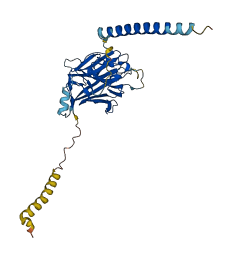
Descriptions
The autoinhibited protein was predicted that may have potential autoinhibitory elements via cis-regPred.
Autoinhibitory domains (AIDs)
Target domain |
|
Relief mechanism |
|
Assay |
cis-regPred |
Accessory elements
No accessory elements
Autoinhibited structure

Activated structure
1 structures for P59481
| Entry ID | Method | Resolution | Chain | Position | Source |
|---|---|---|---|---|---|
| AF-P59481-F1 | Predicted | AlphaFoldDB |
14 variants for P59481
| Variant ID(s) | Position | Change | Description | Diseaes Association | Provenance |
|---|---|---|---|---|---|
| rs6382061 | 16 | R>H | No | EVA | |
| rs3388464656 | 77 | A>T | No | EVA | |
| rs3388463964 | 86 | L>I | No | EVA | |
| rs3388463896 | 128 | G>R | No | EVA | |
| rs3388463448 | 155 | V>M | No | EVA | |
| rs3388463881 | 184 | S>G | No | EVA | |
| rs3388463937 | 187 | H>Y | No | EVA | |
| rs3388463944 | 199 | C>R | No | EVA | |
| rs3388463180 | 237 | I>F | No | EVA | |
| rs3388463917 | 256 | T>I | No | EVA | |
| rs3388464505 | 301 | M>I | No | EVA | |
| rs3388464127 | 302 | T>I | No | EVA | |
| rs3388463638 | 323 | F>L | No | EVA | |
| rs3388463682 | 326 | F>V | No | EVA |
No associated diseases with P59481
1 regional properties for P59481
| Type | Name | Position | InterPro Accession |
|---|---|---|---|
| domain | Legume-like lectin | 48 - 274 | IPR005052 |
Functions
6 GO annotations of cellular component
| Name | Definition |
|---|---|
| COPII-coated ER to Golgi transport vesicle | A vesicle with a coat formed of the COPII coat complex proteins. The COPII coat complex is formed by the Sec23p/Sec24p and the Sec13p/Sec31p heterodimers. COPII-associated vesicles transport proteins from the rough endoplasmic reticulum to the Golgi apparatus (anterograde transport). |
| endoplasmic reticulum membrane | The lipid bilayer surrounding the endoplasmic reticulum. |
| endoplasmic reticulum-Golgi intermediate compartment | A complex system of membrane-bounded compartments located between endoplasmic reticulum (ER) and the Golgi complex, with a distinctive membrane protein composition; involved in ER-to-Golgi and Golgi-to-ER transport. |
| Golgi apparatus | A membrane-bound cytoplasmic organelle of the endomembrane system that further processes the core oligosaccharides (e.g. N-glycans) added to proteins in the endoplasmic reticulum and packages them into membrane-bound vesicles. The Golgi apparatus operates at the intersection of the secretory, lysosomal, and endocytic pathways. |
| Golgi membrane | The lipid bilayer surrounding any of the compartments of the Golgi apparatus. |
| integral component of membrane | The component of a membrane consisting of the gene products and protein complexes having at least some part of their peptide sequence embedded in the hydrophobic region of the membrane. |
2 GO annotations of molecular function
| Name | Definition |
|---|---|
| mannose binding | Binding to mannose, a monosaccharide hexose, stereoisomeric with glucose, that occurs naturally only in polymerized forms called mannans. |
| metal ion binding | Binding to a metal ion. |
4 GO annotations of biological process
| Name | Definition |
|---|---|
| endoplasmic reticulum organization | A process that is carried out at the cellular level which results in the assembly, arrangement of constituent parts, or disassembly of the endoplasmic reticulum. |
| endoplasmic reticulum to Golgi vesicle-mediated transport | The directed movement of substances from the endoplasmic reticulum (ER) to the Golgi, mediated by COP II vesicles. Small COP II coated vesicles form from the ER and then fuse directly with the cis-Golgi. Larger structures are transported along microtubules to the cis-Golgi. |
| Golgi organization | A process that is carried out at the cellular level which results in the assembly, arrangement of constituent parts, or disassembly of the Golgi apparatus. |
| protein transport | The directed movement of proteins into, out of or within a cell, or between cells, by means of some agent such as a transporter or pore. |
| 10 | 20 | 30 | 40 | 50 | 60 |
| MAAASRPSWW | QRWRRRAWAR | DGAKLLLFLL | LLGSGPGPRH | VRAGQAVEYL | KREHSLSKPY |
| 70 | 80 | 90 | 100 | 110 | 120 |
| QGVGTSSSSL | WNLMGNAMVM | TQYIRLTPDM | QSKQGALWNR | VPCFLKDWEL | QVHFKIHGQG |
| 130 | 140 | 150 | 160 | 170 | 180 |
| KKNLHGDGLA | IWYTKDRMQP | GPVFGNMDKF | VGLGVFVDTY | PNEEKQHERV | FPYISAMVNN |
| 190 | 200 | 210 | 220 | 230 | 240 |
| GSLSYDHERD | GRPTELGGCT | AIVRNIRYDT | FLVIRYVKRH | LTIMMDIDGK | HEWRDCIEMP |
| 250 | 260 | 270 | 280 | 290 | 300 |
| GVRLPRGYYF | GTSSITGDLS | DNHDVISLKL | FELTGVRTPE | EEKLHRDVFL | PSVDNLKLPE |
| 310 | 320 | 330 | 340 | ||
| MTVPPTPLSG | LALFLIVFFS | LVFSVFAIVI | GIILYNKWQD | QSRKRFY |