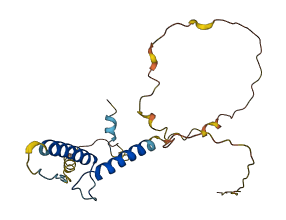
Descriptions
The autoinhibited protein was predicted that may have potential autoinhibitory elements via cis-regPred.
Autoinhibitory domains (AIDs)
Target domain |
|
Relief mechanism |
|
Assay |
cis-regPred |
Accessory elements
No accessory elements
Autoinhibited structure

Activated structure
1 structures for P57100
| Entry ID | Method | Resolution | Chain | Position | Source |
|---|---|---|---|---|---|
| AF-P57100-F1 | Predicted | AlphaFoldDB |
No variants for P57100
| Variant ID(s) | Position | Change | Description | Diseaes Association | Provenance |
|---|---|---|---|---|---|
| No variants for P57100 | |||||
No associated diseases with P57100
1 regional properties for P57100
| Type | Name | Position | InterPro Accession |
|---|---|---|---|
| domain | Myc-type, basic helix-loop-helix (bHLH) domain | 94 - 152 | IPR011598 |
Functions
2 GO annotations of cellular component
| Name | Definition |
|---|---|
| nucleolus | A small, dense body one or more of which are present in the nucleus of eukaryotic cells. It is rich in RNA and protein, is not bounded by a limiting membrane, and is not seen during mitosis. Its prime function is the transcription of the nucleolar DNA into 45S ribosomal-precursor RNA, the processing of this RNA into 5.8S, 18S, and 28S components of ribosomal RNA, and the association of these components with 5S RNA and proteins synthesized outside the nucleolus. This association results in the formation of ribonucleoprotein precursors; these pass into the cytoplasm and mature into the 40S and 60S subunits of the ribosome. |
| nucleoplasm | That part of the nuclear content other than the chromosomes or the nucleolus. |
2 GO annotations of molecular function
| Name | Definition |
|---|---|
| DNA binding | Any molecular function by which a gene product interacts selectively and non-covalently with DNA (deoxyribonucleic acid). |
| protein dimerization activity | The formation of a protein dimer, a macromolecular structure consists of two noncovalently associated identical or nonidentical subunits. |
1 GO annotations of biological process
| Name | Definition |
|---|---|
| trophoblast giant cell differentiation | The process in which a relatively unspecialized cell acquires specialized features of a trophoblast giant cell of the placenta. Trophoblast giant cells are the cell of the placenta that line the maternal decidua. |
No homologous proteins in AiPD
| UniProt AC | Gene Name | Protein Name | Species | Evidence Code |
|---|---|---|---|---|
| No homologous proteins | ||||
| 10 | 20 | 30 | 40 | 50 | 60 |
| MNLVGSYAHH | HHHHHPHPAH | PMLHEPFLFG | PASRCHQERP | YFQSWLLSPA | DAAPDFPTGG |
| 70 | 80 | 90 | 100 | 110 | 120 |
| PPPTAAAAAA | TYGPDTRPGQ | SPGRLEALGG | RLGRRKGSGP | KKERRRTESI | NSAFAELREC |
| 130 | 140 | 150 | 160 | 170 | 180 |
| IPNVPADTKL | SKIKTLRLAT | SYIAYLMDVL | AKDAQAGDPE | AFKAELKKVD | GGRESKRKRE |
| 190 | 200 | 210 | |||
| LQQHEGFPPA | LGPGEKRIKG | RTGWPQQVWA | LELNQ |