P56888
Gene name |
cbbA (Smed_3923) |
Protein name |
Fructose-bisphosphate aldolase |
Names |
FBP aldolase, FBPA, Fructose-1,6-bisphosphate aldolase |
Species |
Sinorhizobium medicae (strain WSM419) (Ensifer medicae) |
KEGG Pathway |
smd:Smed_3923 |
EC number |
4.1.2.13: Aldehyde-lyases |
Protein Class |
|
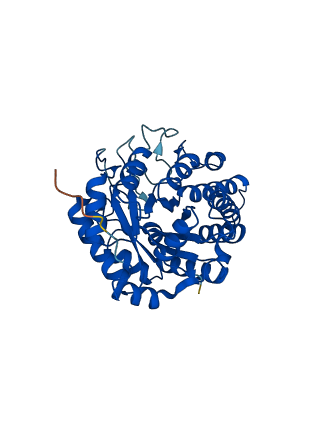
Descriptions
The autoinhibited protein was predicted that may have potential autoinhibitory elements via cis-regPred.
Autoinhibitory domains (AIDs)
Target domain |
|
Relief mechanism |
|
Assay |
cis-regPred |
Accessory elements
No accessory elements
Autoinhibited structure

Activated structure
1 structures for P56888
| Entry ID | Method | Resolution | Chain | Position | Source |
|---|---|---|---|---|---|
| AF-P56888-F1 | Predicted | AlphaFoldDB |
No variants for P56888
| Variant ID(s) | Position | Change | Description | Diseaes Association | Provenance |
|---|---|---|---|---|---|
| No variants for P56888 | |||||
No associated diseases with P56888
No regional properties for P56888
| Type | Name | Position | InterPro Accession |
|---|---|---|---|
| No domain, repeats, and functional sites for P56888 | |||
Functions
| Description | ||
|---|---|---|
| EC Number | 4.1.2.13 | Aldehyde-lyases |
| Subcellular Localization |
|
|
| PANTHER Family | ||
| PANTHER Subfamily | ||
| PANTHER Protein Class | ||
| PANTHER Pathway Category | No pathway information available | |
No GO annotations of cellular component
| Name | Definition |
|---|---|
| No GO annotations for cellular component |
2 GO annotations of molecular function
| Name | Definition |
|---|---|
| fructose-bisphosphate aldolase activity | Catalysis of the reaction: D-fructose 1,6-bisphosphate = glycerone phosphate + D-glyceraldehyde-3-phosphate. |
| zinc ion binding | Binding to a zinc ion (Zn). |
2 GO annotations of biological process
| Name | Definition |
|---|---|
| glycolytic process | The chemical reactions and pathways resulting in the breakdown of a carbohydrate into pyruvate, with the concomitant production of a small amount of ATP and the reduction of NAD(P) to NAD(P)H. Glycolysis begins with the metabolism of a carbohydrate to generate products that can enter the pathway and ends with the production of pyruvate. Pyruvate may be converted to acetyl-coenzyme A, ethanol, lactate, or other small molecules. |
| reductive pentose-phosphate cycle | The fixation of carbon dioxide (CO2) as glucose in the chloroplasts of C3 plants; uses ATP and NADPH formed in the light reactions of photosynthesis; carbon dioxide reacts with ribulose 1,5-bisphosphate (catalyzed by the function of ribulose-bisphosphate carboxylase) to yield two molecules of 3-phosphoglycerate; these are then phosphorylated by ATP to 1,3-bisphosphateglyceraldehyde which, in turn, is then reduced by NADPH to glyceraldehyde 3-phosphate. The glyceraldehyde 3-phosphate is converted to fructose 5-phosphate and ribulose 5-phosphate by aldolase and other enzymes; the ribulose 5-phosphate is phosphorylated by ATP to ribulose 1,5-bisphosphate. |
No homologous proteins in AiPD
| UniProt AC | Gene Name | Protein Name | Species | Evidence Code |
|---|---|---|---|---|
| No homologous proteins | ||||
| 10 | 20 | 30 | 40 | 50 | 60 |
| MARITLRQLL | DHAAERSYGV | PAFNINNMEQ | GLAIMEAARA | CDAPVILQVS | RGARSYANDI |
| 70 | 80 | 90 | 100 | 110 | 120 |
| MLAKMMEALE | VMYPDIPLCI | HQDHGNNVAT | CLTAIQHGFT | SVMMDGSLKE | DAKTPADYAY |
| 130 | 140 | 150 | 160 | 170 | 180 |
| NAMITTEVSR | LAHMVGASVE | GELGCLGSLE | TGHGEAEDGH | GFEGALDRSQ | LLTDPDEAAR |
| 190 | 200 | 210 | 220 | 230 | 240 |
| FVAETGVDAL | AVAIGTSHGA | YKFTRKPTGE | VLAMDVIEKI | HERLPDTHIV | MHGSSSVPQE |
| 250 | 260 | 270 | 280 | 290 | 300 |
| WQDVFNAHGG | EMRETYGVPV | EEIVRGIRFG | VRKVNIDTDL | RLAAAAAFRR | VADTSRTEFD |
| 310 | 320 | 330 | 340 | 350 | |
| PRKFLKPAMD | AMSAVCKARF | EAFGTAGNAS | RIKVVPMAEM | ARRYASGSLK | PQAKRAEAA |