Descriptions
The autoinhibited protein was predicted that may have potential autoinhibitory elements via cis-regPred.
Autoinhibitory domains (AIDs)
Target domain |
|
Relief mechanism |
|
Assay |
cis-regPred |
Accessory elements
No accessory elements
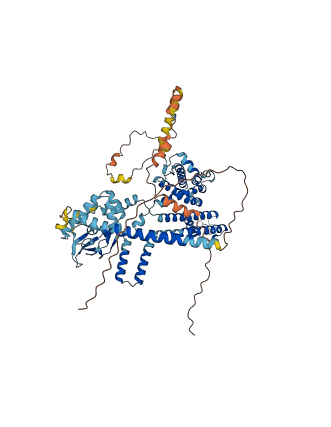
Autoinhibited structure

Activated structure
1 structures for P55934
| Entry ID | Method | Resolution | Chain | Position | Source |
|---|---|---|---|---|---|
| AF-P55934-F1 | Predicted | AlphaFoldDB |
No variants for P55934
| Variant ID(s) | Position | Change | Description | Diseaes Association | Provenance |
|---|---|---|---|---|---|
| No variants for P55934 | |||||
No associated diseases with P55934
No regional properties for P55934
| Type | Name | Position | InterPro Accession |
|---|---|---|---|
| No domain, repeats, and functional sites for P55934 | |||
1 GO annotations of cellular component
| Name | Definition |
|---|---|
| integral component of membrane | The component of a membrane consisting of the gene products and protein complexes having at least some part of their peptide sequence embedded in the hydrophobic region of the membrane. |
3 GO annotations of molecular function
| Name | Definition |
|---|---|
| cAMP binding | Binding to cAMP, the nucleotide cyclic AMP (adenosine 3',5'-cyclophosphate). |
| cGMP binding | Binding to cGMP, the nucleotide cyclic GMP (guanosine 3',5'-cyclophosphate). |
| ion channel activity | Enables the facilitated diffusion of an ion (by an energy-independent process) by passage through a transmembrane aqueous pore or channel without evidence for a carrier-mediated mechanism. May be either selective (it enables passage of a specific ion only) or non-selective (it enables passage of two or more ions of same charge but different size). |
2 GO annotations of biological process
| Name | Definition |
|---|---|
| response to stimulus | Any process that results in a change in state or activity of a cell or an organism (in terms of movement, secretion, enzyme production, gene expression, etc.) as a result of a stimulus. The process begins with detection of the stimulus and ends with a change in state or activity or the cell or organism. |
| sensory perception of smell | The series of events required for an organism to receive an olfactory stimulus, convert it to a molecular signal, and recognize and characterize the signal. Olfaction involves the detection of chemical composition of an organism's ambient medium by chemoreceptors. This is a neurological process. |
No homologous proteins in AiPD
| UniProt AC | Gene Name | Protein Name | Species | Evidence Code |
|---|---|---|---|---|
| No homologous proteins | ||||
| 10 | 20 | 30 | 40 | 50 | 60 |
| MTGQAALERS | VSSHRLSVRS | RLEGEAERAE | SAISRTDGDD | DTCSELQRVT | ALELPSAEML |
| 70 | 80 | 90 | 100 | 110 | 120 |
| EAFTQRRPLA | RLVNLVLSLR | EWAHKSLVET | EQRPDSFLER | FRGPQAANDQ | SAAPADAPKK |
| 130 | 140 | 150 | 160 | 170 | 180 |
| TFKERWEGFV | VSQSDDIYYY | WLFFIALASL | YNWIMLVARA | CFDQLQDENF | FLWVGLDYLC |
| 190 | 200 | 210 | 220 | 230 | 240 |
| DVIYILDTCI | RLRTGYLEQG | LLVKDLAKLR | DNYIRTLQFK | LDFLSILPTE | LLFFVTGYVP |
| 250 | 260 | 270 | 280 | 290 | 300 |
| QLRFNRLLRF | SRMFEFFDRT | ETRTNYPNAF | RICNLILYIL | VIIHWNACIY | YAISKALGLS |
| 310 | 320 | 330 | 340 | 350 | 360 |
| SDTWVYSGQN | KTLSFCYVYC | FYWSTLTLTT | IGEMPPPVKD | EEYVFVVFDF | LVGVLIFATI |
| 370 | 380 | 390 | 400 | 410 | 420 |
| VGNVGSMIAN | MNATRAEFQT | RIDAIKHYMH | FRKVNRTLET | RVIKWFDYLW | TNKKTVDEQE |
| 430 | 440 | 450 | 460 | 470 | 480 |
| VLKNLPDKLR | AEIAINVHLD | TLKKVRIFQD | CEAGLLVELV | LKLRPQVYSP | GDYICRKGDI |
| 490 | 500 | 510 | 520 | 530 | 540 |
| GKEMYIIKEG | QLAVVADDGV | TQFALLTAGG | CFGEISILNI | QGSKMGNRRT | ANIRSIGYSD |
| 550 | 560 | 570 | 580 | 590 | 600 |
| LFCLSKDDLM | EAVAEYPDAQ | KVLEERGREI | LRKQGLLDES | VAAGGLGVID | TEEKVERLDA |
| 610 | 620 | 630 | 640 | 650 | 660 |
| SLDILQTRFA | RLLGEFTSTQ | RRLKQRITAL | ERQLCHTGLG | LLSDNEAEGE | HAGVPTHTHA |
| 670 | 680 | ||||
| DIHAQPETHT | RTSAETNSEE | ET |