P55806
Gene name |
|
Protein name |
NAD(P)(+)--arginine ADP-ribosyltransferase 1 |
Names |
Mono(ADP-ribosyl)transferase 1, AT1 |
Species |
Gallus gallus (Chicken) |
KEGG Pathway |
|
EC number |
2.4.2.31: Pentosyltransferases |
Protein Class |
|
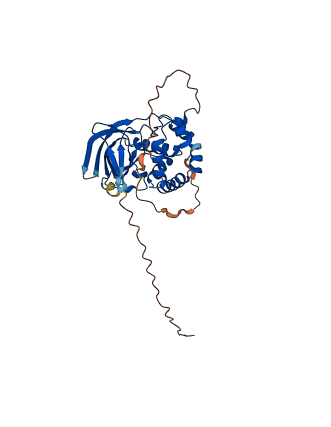
Descriptions
The autoinhibited protein was predicted that may have potential autoinhibitory elements via cis-regPred.
Autoinhibitory domains (AIDs)
Target domain |
|
Relief mechanism |
|
Assay |
cis-regPred |
Accessory elements
No accessory elements
Autoinhibited structure

Activated structure
1 structures for P55806
| Entry ID | Method | Resolution | Chain | Position | Source |
|---|---|---|---|---|---|
| AF-P55806-F1 | Predicted | AlphaFoldDB |
No variants for P55806
| Variant ID(s) | Position | Change | Description | Diseaes Association | Provenance |
|---|---|---|---|---|---|
| No variants for P55806 | |||||
No associated diseases with P55806
No regional properties for P55806
| Type | Name | Position | InterPro Accession |
|---|---|---|---|
| No domain, repeats, and functional sites for P55806 | |||
Functions
| Description | ||
|---|---|---|
| EC Number | 2.4.2.31 | Pentosyltransferases |
| Subcellular Localization |
|
|
| PANTHER Family | ||
| PANTHER Subfamily | ||
| PANTHER Protein Class | ||
| PANTHER Pathway Category | No pathway information available | |
2 GO annotations of cellular component
| Name | Definition |
|---|---|
| cytolytic granule | A specialized secretory lysosome that is present in cells with cytolytic capability such as cytotoxic T lymphocytes and natural killer cells. Cytolytic granules mediate the storage and regulated excretion of lytic molecules for killing of target cells. |
| extracellular space | That part of a multicellular organism outside the cells proper, usually taken to be outside the plasma membranes, and occupied by fluid. |
2 GO annotations of molecular function
| Name | Definition |
|---|---|
| NAD+ ADP-ribosyltransferase activity | Catalysis of the reaction: NAD+ + (ADP-D-ribosyl)(n)-acceptor = nicotinamide + (ADP-D-ribosyl)(n+1)-acceptor. |
| NAD+-protein-arginine ADP-ribosyltransferase activity | Catalysis of the reaction: L-arginyl- + NAD+ = H+ + (ADP-D-ribosyl)-L-arginyl- |
2 GO annotations of biological process
| Name | Definition |
|---|---|
| peptidyl-arginine ADP-ribosylation | The transfer, from NAD, of ADP-ribose to peptidyl-arginine to form omega-N-(ADP-ribosyl)-L-arginine. |
| response to antibiotic | Any process that results in a change in state or activity of a cell or an organism (in terms of movement, secretion, enzyme production, gene expression, etc.) as a result of an antibiotic stimulus. An antibiotic is a chemical substance produced by a microorganism which has the capacity to inhibit the growth of or to kill other microorganisms. |
No homologous proteins in AiPD
| UniProt AC | Gene Name | Protein Name | Species | Evidence Code |
|---|---|---|---|---|
| No homologous proteins | ||||
| 10 | 20 | 30 | 40 | 50 | 60 |
| MELLALRWVL | LAGTLLSTSA | ASSALQEGDL | GSITVIMDMA | LNSFDDQYLL | CEDRMRARLQ |
| 70 | 80 | 90 | 100 | 110 | 120 |
| MENITEFSTN | IAYAVTWRQA | AAEWQKRWGH | LARPMQLIRE | QAIALLAYSA | SSRMCTLFNE |
| 130 | 140 | 150 | 160 | 170 | 180 |
| ATRQGGRSHQ | DYIHSYHFKT | LHFFLTQALF | ALRASQPRCY | YVYRGVRGIR | FMTQRGKSVR |
| 190 | 200 | 210 | 220 | 230 | 240 |
| FGQFTSTSLR | KEATVNFGQD | TLFVVKTCYG | VPIKQFSFFP | SEDEVLIPPF | EVFEVINFSN |
| 250 | 260 | 270 | 280 | 290 | 300 |
| DRGSVKIQLH | SKGKMSTHNC | ELLKPQGGQW | GRGHQEVGLG | LSPGLSLPVL | PCRRRVWEGL |
| 310 | |||||
| GHREGDPIPA | AV |