P55659
Gene name |
NGR_a01540 (y4tE) |
Protein name |
Probable amino-acid ABC transporter periplasmic-binding protein y4tE |
Names |
|
Species |
Sinorhizobium fredii (strain NBRC 101917 / NGR234) |
KEGG Pathway |
rhi:NGR_a01540 |
EC number |
|
Protein Class |
|
Descriptions
The autoinhibited protein was predicted that may have potential autoinhibitory elements via cis-regPred.
Autoinhibitory domains (AIDs)
Target domain |
|
Relief mechanism |
|
Assay |
cis-regPred |
Accessory elements
No accessory elements
Autoinhibited structure

Activated structure
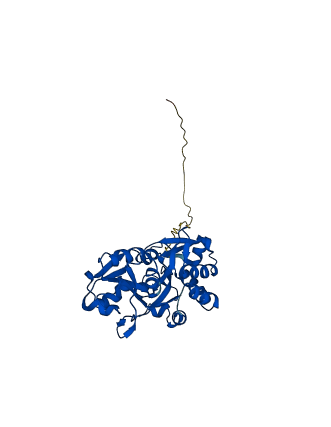
1 structures for P55659
| Entry ID | Method | Resolution | Chain | Position | Source |
|---|---|---|---|---|---|
| AF-P55659-F1 | Predicted | AlphaFoldDB |
No variants for P55659
| Variant ID(s) | Position | Change | Description | Diseaes Association | Provenance |
|---|---|---|---|---|---|
| No variants for P55659 | |||||
No associated diseases with P55659
1 regional properties for P55659
| Type | Name | Position | InterPro Accession |
|---|---|---|---|
| domain | Solute-binding protein family 3/N-terminal domain of MltF | 51 - 283 | IPR001638 |
1 GO annotations of cellular component
| Name | Definition |
|---|---|
| periplasmic space | The region between the inner (cytoplasmic) and outer membrane (Gram-negative Bacteria) or cytoplasmic membrane and cell wall (Fungi and Gram-positive Bacteria). |
1 GO annotations of molecular function
| Name | Definition |
|---|---|
| ectoine binding | Binding to ectoine, 1,4,5,6-tetrahydro-2-methyl-4-pyrimidinecarboxylic acid. |
2 GO annotations of biological process
| Name | Definition |
|---|---|
| amino acid transport | The directed movement of amino acids, organic acids containing one or more amino substituents, into, out of or within a cell, or between cells, by means of some agent such as a transporter or pore. |
| ectoine transport | The directed movement of ectoine into, out of or within a cell, or between cells, by means of some agent such as a transporter or pore. Ectoine (1,4,5,6-tetrahydro-2-methyl-4-pyrimidinecarboxylic acid) is a tetrahydropyrimidine commonly synthesized by halophilic bacteria. |
No homologous proteins in AiPD
| UniProt AC | Gene Name | Protein Name | Species | Evidence Code |
|---|---|---|---|---|
| No homologous proteins | ||||
| 10 | 20 | 30 | 40 | 50 | 60 |
| MTHLKISKTA | PAVARFLPAG | RIASVAAALS | LFLSAQLAGA | VTLEEVKARG | YITIAIANEM |
| 70 | 80 | 90 | 100 | 110 | 120 |
| PGSYTDPNGE | VKGSEADVAR | RVLEKLGIKP | ENIQWVVTTF | GSLIPGLQAN | RFDMTAAGMA |
| 130 | 140 | 150 | 160 | 170 | 180 |
| IRPERCEKVI | YSEPNSSYGE | GMLVIKGNPR | NFHSYEDVAQ | QGKIAIMAGA | DQLRMMQALG |
| 190 | 200 | 210 | 220 | 230 | 240 |
| VPNENIITIA | ANADAISAVA | TGRADAYAAA | ASTAADLAKK | SDKVELATPF | QDPVIDGKIQ |
| 250 | 260 | 270 | 280 | 290 | |
| RSWGAFSFNK | ESADLRDKFN | EALLEFRKTD | EFKQLLLGYG | YLPESIAAIP | DKTTKELCSN |