P54822
Gene name |
Adsl (Adl) |
Protein name |
Adenylosuccinate lyase |
Names |
ASL, Adenylosuccinase, ASase |
Species |
Mus musculus (Mouse) |
KEGG Pathway |
mmu:11564 |
EC number |
4.3.2.2: Lyases acting on amides, amidines, etc |
Protein Class |
|
Descriptions
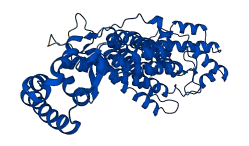
The autoinhibited protein was predicted that may have potential autoinhibitory elements via cis-regPred.
Autoinhibitory domains (AIDs)
Target domain |
|
Relief mechanism |
|
Assay |
cis-regPred |
Accessory elements
No accessory elements
Autoinhibited structure

Activated structure
1 structures for P54822
| Entry ID | Method | Resolution | Chain | Position | Source |
|---|---|---|---|---|---|
| AF-P54822-F1 | Predicted | AlphaFoldDB |
28 variants for P54822
| Variant ID(s) | Position | Change | Description | Diseaes Association | Provenance |
|---|---|---|---|---|---|
| rs3389354940 | 2 | A>T | No | EVA | |
| rs249386877 | 4 | S>A | No | EVA | |
| rs3389380547 | 23 | S>N | No | EVA | |
| rs217152533 | 28 | F>L | No | EVA | |
| rs3406374703 | 54 | G>D | No | EVA | |
| rs3406374653 | 62 | I>T | No | EVA | |
| rs3406416840 | 116 | G>* | No | EVA | |
| rs3406298395 | 116 | G>A | No | EVA | |
| rs3389337738 | 178 | D>E | No | EVA | |
| rs3389337797 | 223 | D>G | No | EVA | |
| rs3389378220 | 224 | K>M | No | EVA | |
| rs3389344607 | 236 | F>I | No | EVA | |
| rs3389294700 | 249 | I>F | No | EVA | |
| rs3389294700 | 249 | I>V | No | EVA | |
| rs3389378213 | 255 | L>V | No | EVA | |
| rs3389369425 | 281 | P>S | No | EVA | |
| rs3389369760 | 294 | Y>* | No | EVA | |
| rs3389385541 | 330 | T>I | No | EVA | |
| rs3389369749 | 344 | A>E | No | EVA | |
| rs3389337718 | 393 | G>R | No | EVA | |
| rs3389337711 | 406 | L>F | No | EVA | |
| rs3389327599 | 416 | Q>* | No | EVA | |
| rs3389365409 | 425 | E>D | No | EVA | |
| rs212437112 | 428 | R>Q | No | EVA | |
| rs3389344643 | 434 | S>T | No | EVA | |
| rs3389385555 | 448 | S>F | No | EVA | |
| rs3389354884 | 452 | R>* | No | EVA | |
| rs3389369440 | 457 | V>L | No | EVA |
No associated diseases with P54822
Functions
| Description | ||
|---|---|---|
| EC Number | 4.3.2.2 | Lyases acting on amides, amidines, etc |
| Subcellular Localization |
|
|
| PANTHER Family | ||
| PANTHER Subfamily | ||
| PANTHER Protein Class | ||
| PANTHER Pathway Category | No pathway information available | |
3 GO annotations of cellular component
| Name | Definition |
|---|---|
| cytosol | The part of the cytoplasm that does not contain organelles but which does contain other particulate matter, such as protein complexes. |
| mitochondrion | A semiautonomous, self replicating organelle that occurs in varying numbers, shapes, and sizes in the cytoplasm of virtually all eukaryotic cells. It is notably the site of tissue respiration. |
| protein-containing complex | A stable assembly of two or more macromolecules, i.e. proteins, nucleic acids, carbohydrates or lipids, in which at least one component is a protein and the constituent parts function together. |
3 GO annotations of molecular function
| Name | Definition |
|---|---|
| (S)-2-(5-amino-1-(5-phospho-D-ribosyl)imidazole-4-carboxamido) succinate lyase (fumarate-forming) activity | Catalysis of the reaction: (S)-2-(5-amino-1-(5-phospho-D-ribosyl)imidazole-4-carboxamido)succinate = fumarate + 5-amino-1-(5-phospho-D-ribosyl)imidazole-4-carboxamide. |
| identical protein binding | Binding to an identical protein or proteins. |
| N6-(1,2-dicarboxyethyl)AMP AMP-lyase (fumarate-forming) activity | Catalysis of the reaction: N6-(1,2-dicarboxyethyl)AMP = fumarate + AMP. |
13 GO annotations of biological process
| Name | Definition |
|---|---|
| 'de novo' AMP biosynthetic process | The chemical reactions and pathways resulting in the formation of adenosine monophosphate (AMP) from inosine 5'-monophosphate (IMP). |
| 'de novo' IMP biosynthetic process | The chemical reactions and pathways resulting in the formation of IMP, inosine monophosphate, by the stepwise assembly of a purine ring on ribose 5-phosphate. |
| 'de novo' XMP biosynthetic process | The chemical reactions and pathways resulting in the formation of XMP, xanthosine monophosphate, from simpler precursors. |
| aerobic respiration | The enzymatic release of energy from inorganic and organic compounds (especially carbohydrates and fats) which requires oxygen as the terminal electron acceptor. |
| AMP biosynthetic process | The chemical reactions and pathways resulting in the formation of AMP, adenosine monophosphate. |
| AMP salvage | The chemical reactions and pathways resulting in the formation of adenosine monophosphate (AMP) from derivatives of it (either adenine, ADP or adenosine 3',5'-bisphosphate) without de novo synthesis. |
| GMP biosynthetic process | The chemical reactions and pathways resulting in the formation of GMP, guanosine monophosphate. |
| purine nucleotide metabolic process | The chemical reactions and pathways involving a purine nucleotide, a compound consisting of nucleoside (a purine base linked to a deoxyribose or ribose sugar) esterified with a phosphate group at either the 3' or 5'-hydroxyl group of the sugar. |
| response to hypoxia | Any process that results in a change in state or activity of a cell or an organism (in terms of movement, secretion, enzyme production, gene expression, etc.) as a result of a stimulus indicating lowered oxygen tension. Hypoxia, defined as a decline in O2 levels below normoxic levels of 20.8 - 20.95%, results in metabolic adaptation at both the cellular and organismal level. |
| response to muscle activity | Any process that results in a change in state or activity of a cell or an organism (in terms of movement, secretion, enzyme production, gene expression, etc.) as a result of a muscle activity stimulus. |
| response to nutrient | Any process that results in a change in state or activity of a cell or an organism (in terms of movement, secretion, enzyme production, gene expression, etc.) as a result of a nutrient stimulus. |
| response to starvation | Any process that results in a change in state or activity of a cell or an organism (in terms of movement, secretion, enzyme production, gene expression, etc.) as a result of a starvation stimulus, deprivation of nourishment. |
| ribonucleoside monophosphate biosynthetic process | The chemical reactions and pathways resulting in the formation of a ribonucleoside monophosphate, a compound consisting of a nucleobase linked to a ribose sugar esterified with phosphate on the sugar. |
3 homologous proteins in AiPD
| 10 | 20 | 30 | 40 | 50 | 60 |
| MAASGDPGSA | ESYRSPLAAR | YASREMCFLF | SDRYKFQTWR | QLWLWLAEAE | QTLGLPITDE |
| 70 | 80 | 90 | 100 | 110 | 120 |
| QIQEMKSNLN | NIDFQMAAEE | EKRLRHDVMA | HVHTFGHCCP | KAAGIIHLGA | TSCYVGDNTD |
| 130 | 140 | 150 | 160 | 170 | 180 |
| LIILRNAFDL | LLPKLARVIS | RLADFAKDRA | DLPTLGFTHF | QPAQLTTVGK | RCCLWIQDLC |
| 190 | 200 | 210 | 220 | 230 | 240 |
| MDLQNLKRVR | DELRFRGVKG | TTGTQASFLQ | LFEGDHQKVE | QLDKMVTEKA | GFKRAFIITG |
| 250 | 260 | 270 | 280 | 290 | 300 |
| QTYTRKVDIE | VLSVLASLGA | SVHKICTDIR | LLANLKEMEE | PFEKQQIGSS | AMPYKRNPMR |
| 310 | 320 | 330 | 340 | 350 | 360 |
| SERCCSLARH | LMALTMDPLQ | TASVQWFERT | LDDSANRRIC | LAEAFLTADT | ILNTLQNISE |
| 370 | 380 | 390 | 400 | 410 | 420 |
| GLVVYPKVIE | RRIRQELPFM | ATENIIMAMV | KAGGSRQDCH | EKIRVLSQQA | AAVVKQEGGD |
| 430 | 440 | 450 | 460 | 470 | 480 |
| NDLIERIRAD | AYFSPIHSQL | EHLLDPSSFT | GRAPQQVHRF | LEEEVRPLLK | PYGNEMAVKA |
| ELCL |