P54703
Gene name |
dicA (DDB_G0280849) |
Protein name |
Cytoplasmic dynein 1 intermediate chain |
Names |
DH IC, Dynein intermediate chain, cytosolic |
Species |
Dictyostelium discoideum (Slime mold) |
KEGG Pathway |
ddi:DDB_G0280849 |
EC number |
|
Protein Class |
|
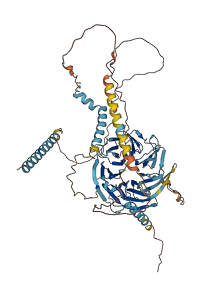
Descriptions
The autoinhibited protein was predicted that may have potential autoinhibitory elements via cis-regPred.
Autoinhibitory domains (AIDs)
Target domain |
|
Relief mechanism |
|
Assay |
cis-regPred |
Accessory elements
No accessory elements
Autoinhibited structure

Activated structure
1 structures for P54703
| Entry ID | Method | Resolution | Chain | Position | Source |
|---|---|---|---|---|---|
| AF-P54703-F1 | Predicted | AlphaFoldDB |
No variants for P54703
| Variant ID(s) | Position | Change | Description | Diseaes Association | Provenance |
|---|---|---|---|---|---|
| No variants for P54703 | |||||
No associated diseases with P54703
5 regional properties for P54703
| Type | Name | Position | InterPro Accession |
|---|---|---|---|
| repeat | WD40 repeat | 264 - 308 | IPR001680-1 |
| repeat | WD40 repeat | 322 - 361 | IPR001680-2 |
| repeat | WD40 repeat | 370 - 410 | IPR001680-3 |
| repeat | WD40 repeat | 481 - 569 | IPR001680-4 |
| repeat | WD40 repeat | 574 - 613 | IPR001680-5 |
5 GO annotations of cellular component
| Name | Definition |
|---|---|
| centrosome | A structure comprised of a core structure (in most organisms, a pair of centrioles) and peripheral material from which a microtubule-based structure, such as a spindle apparatus, is organized. Centrosomes occur close to the nucleus during interphase in many eukaryotic cells, though in animal cells it changes continually during the cell-division cycle. |
| cytoplasmic dynein complex | Any dynein complex with a homodimeric dynein heavy chain core that catalyzes movement along a microtubule. Cytoplasmic dynein complexes participate in many cytoplasmic transport activities in eukaryotes, such as mRNA localization, intermediate filament transport, nuclear envelope breakdown, apoptosis, transport of centrosomal proteins, mitotic spindle assembly, virus transport, kinetochore functions, and movement of signaling and spindle checkpoint proteins. Some complexes participate in intraflagellar transport. Subunits associated with the dynein heavy chain mediate association between dynein heavy chain and cargoes, and may include light chains and light intermediate chains. |
| early phagosome membrane | The lipid bilayer surrounding an early phagosome. |
| microtubule | Any of the long, generally straight, hollow tubes of internal diameter 12-15 nm and external diameter 24 nm found in a wide variety of eukaryotic cells; each consists (usually) of 13 protofilaments of polymeric tubulin, staggered in such a manner that the tubulin monomers are arranged in a helical pattern on the microtubular surface, and with the alpha/beta axes of the tubulin subunits parallel to the long axis of the tubule; exist in equilibrium with pool of tubulin monomers and can be rapidly assembled or disassembled in response to physiological stimuli; concerned with force generation, e.g. in the spindle. |
| phagolysosome membrane | The lipid bilayer surrounding a phagolysosome. |
4 GO annotations of molecular function
| Name | Definition |
|---|---|
| dynactin binding | Binding to a dynactin complex; a large protein complex that activates dynein-based motor activity. |
| dynein heavy chain binding | Binding to a heavy chain of the dynein complex. |
| dynein light chain binding | Binding to a light chain of the dynein complex. |
| minus-end-directed microtubule motor activity | A motor activity that generates movement along a microtubule toward the minus end, driven by ATP hydrolysis. |
7 GO annotations of biological process
| Name | Definition |
|---|---|
| centrosome duplication | The replication of a centrosome, a structure comprised of a pair of centrioles and peri-centriolar material from which a microtubule spindle apparatus is organized. |
| centrosome separation | The process in which duplicated centrosome components move away from each other. The centriole pair within each centrosome becomes part of a separate microtubule organizing center that nucleates a radial array of microtubules called an aster. The two asters move to opposite sides of the nucleus to form the two poles of the mitotic spindle. |
| Golgi localization | Any process in which the Golgi is transported to, and/or maintained in, a specific location within the cell. |
| microtubule cytoskeleton organization | A process that is carried out at the cellular level which results in the assembly, arrangement of constituent parts, or disassembly of cytoskeletal structures comprising microtubules and their associated proteins. |
| microtubule-based movement | A microtubule-based process that results in the movement of organelles, other microtubules, or other cellular components. Examples include motor-driven movement along microtubules and movement driven by polymerization or depolymerization of microtubules. |
| minus-end-directed vesicle transport along microtubule | The directed movement of a vesicle towards the minus end of a microtubule, mediated by motor proteins. This process begins with the attachment of a vesicle to a microtubule, and ends when the vesicle reaches its final destination. |
| transport along microtubule | The movement of organelles or other particles from one location in the cell to another along microtubules, driven by motor activity. |
No homologous proteins in AiPD
| UniProt AC | Gene Name | Protein Name | Species | Evidence Code |
|---|---|---|---|---|
| No homologous proteins | ||||
| 10 | 20 | 30 | 40 | 50 | 60 |
| MDRDQKKKEL | EQTKNEMRRK | LEEYKERNRI | MASKTTPTAT | TTSTLNTAST | PSPPVAQEDF |
| 70 | 80 | 90 | 100 | 110 | 120 |
| NSIMNSIDSM | VPTQATPSSS | STISTSTHAE | SQKSNYIRPT | LTIQSLVIEH | DFPPKEIPMY |
| 130 | 140 | 150 | 160 | 170 | 180 |
| SKGTQTMTDA | DTSNTNNTPE | LEAPNKNKTK | YQLLQQQQQQ | QQQQQSSLNQ | DMQNLSIGTD |
| 190 | 200 | 210 | 220 | 230 | 240 |
| SINGDGSSTS | VANSANIDDD | DKDEIEIPEL | DENEKKDILE | SDSFKSFFGR | SSRVIERALC |
| 250 | 260 | 270 | 280 | 290 | 300 |
| LDDSIDILVD | YTISDENSKG | TSKELKLLAT | LSDERWTKHR | SITDISWSTK | HPELVVSSYS |
| 310 | 320 | 330 | 340 | 350 | 360 |
| ANEAGSHDPD | GVALVWSVNN | YFQKPEYVFT | CQSPVMTTFF | SKFHSTLIVG | GTYSGQIVIW |
| 370 | 380 | 390 | 400 | 410 | 420 |
| DTRAEAKPVQ | KTPLSSVGHT | HPVYSMAVVG | SANANSLVSI | STDAKLCSWN | LENLSQPIET |
| 430 | 440 | 450 | 460 | 470 | 480 |
| IELNSSNTNS | ANKAGGGGSG | GGAPNMSIAV | TSLVFPENEL | NHFYIGTEEG | VICQAGRHGN |
| 490 | 500 | 510 | 520 | 530 | 540 |
| RIVMNERYKG | HFGPITSVDL | HPSKGGADFS | QYFLSSSTDW | TCKLWSSKKE | TPLYSFEDYV |
| 550 | 560 | 570 | 580 | 590 | 600 |
| DYVYDARWSP | VHPSIFSTGD | GSGTLSLWDL | NQDLEAPIFR | HKISNRSVNR | LAWSHDGKRI |
| 610 | 620 | 630 | 640 | 650 | |
| LVGDSGGSLS | LFDSSEFSSP | TSEEYSQFED | VMTKMVNKSR | TSDSPLLGEG | ENQE |