P54672
Gene name |
apm2 (apm1, apmA, DDB_G0277139) |
Protein name |
AP-2 complex subunit mu |
Names |
Clathrin assembly protein complex 2 mu medium chain, Clathrin coat assembly protein AP50, Clathrin coat-associated protein AP50, Clathrin-adaptor medium chain Apm2, Mu2-adaptin, Plasma membrane adaptor AP-2 50 kDa protein |
Species |
Dictyostelium discoideum (Slime mold) |
KEGG Pathway |
ddi:DDB_G0277139 |
EC number |
|
Protein Class |
|
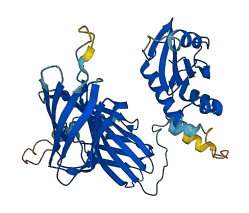
Descriptions
The autoinhibited protein was predicted that may have potential autoinhibitory elements via cis-regPred.
Autoinhibitory domains (AIDs)
Target domain |
|
Relief mechanism |
|
Assay |
cis-regPred |
Accessory elements
No accessory elements
Autoinhibited structure

Activated structure
1 structures for P54672
| Entry ID | Method | Resolution | Chain | Position | Source |
|---|---|---|---|---|---|
| AF-P54672-F1 | Predicted | AlphaFoldDB |
No variants for P54672
| Variant ID(s) | Position | Change | Description | Diseaes Association | Provenance |
|---|---|---|---|---|---|
| No variants for P54672 | |||||
No associated diseases with P54672
6 regional properties for P54672
| Type | Name | Position | InterPro Accession |
|---|---|---|---|
| conserved_site | Clathrin adaptor, mu subunit, conserved site | 161 - 181 | IPR018240-1 |
| conserved_site | Clathrin adaptor, mu subunit, conserved site | 268 - 282 | IPR018240-2 |
| domain | AP complex, mu/sigma subunit | 1 - 125 | IPR022775 |
| domain | Mu homology domain | 162 - 439 | IPR028565 |
| domain | Mu2, C-terminal domain | 170 - 438 | IPR043512 |
| domain | AP-2 complex subunit mu, N-terminal | 1 - 138 | IPR043532 |
Functions
5 GO annotations of cellular component
| Name | Definition |
|---|---|
| AP-2 adaptor complex | A heterotetrameric AP-type membrane coat adaptor complex that consists of alpha, beta2, mu2 and sigma2 subunits, and links clathrin to the membrane surface of a vesicle, and the cargo receptors during receptor/clathrin mediated endocytosis. Vesicles with AP-2-containing coats are normally found primarily near the plasma membrane, on endocytic vesicles. In at least humans, the AP-2 complex can be heterogeneric due to the existence of multiple subunit isoforms encoded by different alpha genes (alphaA and alphaC). |
| clathrin coat of coated pit | The coat found on coated pits and the coated vesicles derived from coated pits; comprises clathrin and the AP-2 adaptor complex. |
| clathrin-coated pit | A part of the endomembrane system in the form of an invagination of a membrane upon which a clathrin coat forms, and that can be converted by vesicle budding into a clathrin-coated vesicle. Coated pits form on the plasma membrane, where they are involved in receptor-mediated selective transport of many proteins and other macromolecules across the cell membrane, in the trans-Golgi network, and on some endosomes. |
| cytoplasmic vesicle | A vesicle found in the cytoplasm of a cell. |
| SNARE complex | A protein complex involved in membrane fusion; a stable ternary complex consisting of a four-helix bundle, usually formed from one R-SNARE and three Q-SNAREs with an ionic layer sandwiched between hydrophobic layers. One well-characterized example is the neuronal SNARE complex formed of synaptobrevin 2, syntaxin 1a, and SNAP-25. |
1 GO annotations of molecular function
| Name | Definition |
|---|---|
| clathrin adaptor activity | Bringing together a cargo protein with clathrin, responsible for the formation of endocytic vesicles. |
4 GO annotations of biological process
| Name | Definition |
|---|---|
| clathrin-dependent endocytosis | An endocytosis process that begins when material is taken up into clathrin-coated pits, which then pinch off to form clathrin-coated endocytic vesicles. |
| endocytosis | A vesicle-mediated transport process in which cells take up external materials or membrane constituents by the invagination of a small region of the plasma membrane to form a new membrane-bounded vesicle. |
| intracellular protein transport | The directed movement of proteins in a cell, including the movement of proteins between specific compartments or structures within a cell, such as organelles of a eukaryotic cell. |
| vesicle-mediated transport | A cellular transport process in which transported substances are moved in membrane-bounded vesicles; transported substances are enclosed in the vesicle lumen or located in the vesicle membrane. The process begins with a step that directs a substance to the forming vesicle, and includes vesicle budding and coating. Vesicles are then targeted to, and fuse with, an acceptor membrane. |
No homologous proteins in AiPD
| UniProt AC | Gene Name | Protein Name | Species | Evidence Code |
|---|---|---|---|---|
| No homologous proteins | ||||
| 10 | 20 | 30 | 40 | 50 | 60 |
| MISALFLMNG | KGEVLISRIY | RDDISRGVAN | AFRLEVIGSQ | ETRSPVKLIG | STSFMYIKVG |
| 70 | 80 | 90 | 100 | 110 | 120 |
| NIYIVGVSRQ | NVNACMVFEV | LHQLVDIFKS | YFDNLDEDSI | RNNFVLVYEL | LDEILDFGYP |
| 130 | 140 | 150 | 160 | 170 | 180 |
| QNCSTDVLKL | YITQGQGKLK | SLDKLKQDKI | SKITIQATGT | TPWRTPDIKY | KRNELYIDVV |
| 190 | 200 | 210 | 220 | 230 | 240 |
| ESVNLLMSAE | GNILRADVSG | QVMMKCFLSG | MPECKFGMND | KVIMDREKST | NGGSAARSGA |
| 250 | 260 | 270 | 280 | 290 | 300 |
| RRANGIEIDD | ITFHQCVRLG | KFDSDRTVSF | IPPDGEFELM | RYRTTEHINL | PFKVIPIVRE |
| 310 | 320 | 330 | 340 | 350 | 360 |
| MGRTRLECSV | TVKSNFSSKM | FGANVKVIIP | TPKNTAVCKI | VVAAGKAKYM | PEQDAIIWRI |
| 370 | 380 | 390 | 400 | 410 | 420 |
| RRFPGDTEFT | LRAEVELMAS | VNLDKKAWSR | PPISMEFQVT | MFTASGFSVR | FLKVVEKSNY |
| 430 | |||||
| TPIKWVRYLT | KAGTYQNRI |