P54651
Gene name |
hspD (hsc90, hsp90, DDB_G0267400) |
Protein name |
Heat shock cognate 90 kDa protein |
Names |
|
Species |
Dictyostelium discoideum (Slime mold) |
KEGG Pathway |
ddi:DDB_G0267400 |
EC number |
|
Protein Class |
|
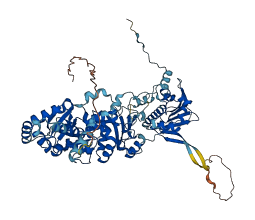
Descriptions
The autoinhibited protein was predicted that may have potential autoinhibitory elements via cis-regPred.
Autoinhibitory domains (AIDs)
Target domain |
|
Relief mechanism |
|
Assay |
cis-regPred |
Accessory elements
No accessory elements
Autoinhibited structure

Activated structure
10 structures for P54651
| Entry ID | Method | Resolution | Chain | Position | Source |
|---|---|---|---|---|---|
| 4XC0 | X-ray | 177 A | A | 1-223 | PDB |
| 4XCJ | X-ray | 175 A | A | 1-223 | PDB |
| 4XCL | X-ray | 121 A | A | 1-223 | PDB |
| 4XD8 | X-ray | 155 A | A | 1-223 | PDB |
| 4XDM | X-ray | 150 A | A | 1-223 | PDB |
| 4XE2 | X-ray | 120 A | A | 1-223 | PDB |
| 4XKA | X-ray | 200 A | A | 1-223 | PDB |
| 4XKK | X-ray | 270 A | A | 1-223 | PDB |
| 4XKO | X-ray | 246 A | A | 1-223 | PDB |
| AF-P54651-F1 | Predicted | AlphaFoldDB |
No variants for P54651
| Variant ID(s) | Position | Change | Description | Diseaes Association | Provenance |
|---|---|---|---|---|---|
| No variants for P54651 | |||||
No associated diseases with P54651
6 GO annotations of cellular component
| Name | Definition |
|---|---|
| cytosol | The part of the cytoplasm that does not contain organelles but which does contain other particulate matter, such as protein complexes. |
| extracellular matrix | A structure lying external to one or more cells, which provides structural support, biochemical or biomechanical cues for cells or tissues. |
| perinuclear region of cytoplasm | Cytoplasm situated near, or occurring around, the nucleus. |
| phagocytic vesicle | A membrane-bounded intracellular vesicle that arises from the ingestion of particulate material by phagocytosis. |
| plasma membrane | The membrane surrounding a cell that separates the cell from its external environment. It consists of a phospholipid bilayer and associated proteins. |
| protein-containing complex | A stable assembly of two or more macromolecules, i.e. proteins, nucleic acids, carbohydrates or lipids, in which at least one component is a protein and the constituent parts function together. |
4 GO annotations of molecular function
| Name | Definition |
|---|---|
| ATP binding | Binding to ATP, adenosine 5'-triphosphate, a universally important coenzyme and enzyme regulator. |
| ATP hydrolysis activity | Catalysis of the reaction: ATP + H2O = ADP + H+ phosphate. ATP hydrolysis is used in some reactions as an energy source, for example to catalyze a reaction or drive transport against a concentration gradient. |
| ATP-dependent protein folding chaperone | Binding to a protein or a protein-containing complex to assist the protein folding process, driven by ATP hydrolysis. |
| unfolded protein binding | Binding to an unfolded protein. |
4 GO annotations of biological process
| Name | Definition |
|---|---|
| cellular response to heat | Any process that results in a change in state or activity of a cell (in terms of movement, secretion, enzyme production, gene expression, etc.) as a result of a heat stimulus, a temperature stimulus above the optimal temperature for that organism. |
| protein folding | The process of assisting in the covalent and noncovalent assembly of single chain polypeptides or multisubunit complexes into the correct tertiary structure. |
| protein stabilization | Any process involved in maintaining the structure and integrity of a protein and preventing it from degradation or aggregation. |
| regulation of aggregation involved in sorocarp development | Any process that modulates the frequency, rate or extent of aggregation during sorocarp development. Aggregation involved in sorocarp development is the process whose specific outcome is the progression of the aggregate over time, from its formation to the point when a slug is formed. Aggregate development begins in response to starvation and continues by the chemoattractant-mediated movement of cells toward each other. The aggregate is a multicellular structure that gives rise to the slug. |
No homologous proteins in AiPD
| UniProt AC | Gene Name | Protein Name | Species | Evidence Code |
|---|---|---|---|---|
| No homologous proteins | ||||
| 10 | 20 | 30 | 40 | 50 | 60 |
| MAESQVERFT | FQAEINQLMS | LIINTFYSNK | EVFLRELISN | ASDALDKIRY | QSLTDASVLE |
| 70 | 80 | 90 | 100 | 110 | 120 |
| SKTELEIKII | PDKTAKTLTL | IDSGIGMTKT | DMVKNLGTIA | RSGTKNFMEQ | LQSGAADISM |
| 130 | 140 | 150 | 160 | 170 | 180 |
| IGQFGVGFYS | AYLVADTVIV | HSKNNDDEQY | VWESSAGGEF | TIALDHTEPL | GRGTKIVLHM |
| 190 | 200 | 210 | 220 | 230 | 240 |
| KEDQLDYLDE | TKIKNLVKKH | SEFIQYPISL | LTIKEKEVDE | ETTAKEGEEE | STDAKIEEIE |
| 250 | 260 | 270 | 280 | 290 | 300 |
| EEKEKKKVKV | QEKEWDVLNK | TKPLWTRNPS | DVTKEEYNSF | YKSISNDWEE | PLAVKHFSVE |
| 310 | 320 | 330 | 340 | 350 | 360 |
| GQLEFKAILF | VPKKAPFDLF | ESKKKANNIK | LYVKRVFIMD | NCADIIPEYL | NFVRGIVDSE |
| 370 | 380 | 390 | 400 | 410 | 420 |
| DLPLNISRET | LQQNKILTVI | RKNLVKKCIE | LFNEIAENSE | DYKKFYEAFS | KNLKLGVHED |
| 430 | 440 | 450 | 460 | 470 | 480 |
| SQNREKFADL | LRYQTSKSGD | ELVTLKEYVG | RMKEGQNEIY | YITGESKKAV | ENSPFIEGLK |
| 490 | 500 | 510 | 520 | 530 | 540 |
| KKNLEVIYMC | DPIDEYAVQQ | LKEYDGKKLV | SITKEGLKLD | ETEDEKKKAE | QDKAANEELL |
| 550 | 560 | 570 | 580 | 590 | 600 |
| KQVKDVLGDK | VEKVVLSTRL | ANSPCVLVTS | EYGWSANMER | IMKAQALRDS | SMSSYMSSKK |
| 610 | 620 | 630 | 640 | 650 | 660 |
| TLELNPDHPI | VRDLAKKAAE | KSKTFKDFVY | LLYETALLTS | GFSLDEPSSF | ASRIHRMIKL |
| 670 | 680 | 690 | |||
| GLSIQDDSSA | TTEESTNTTT | SDDIPPLEEN | DEPSEMEKVD |