P54648
Gene name |
vatC (DDB_G0284473) |
Protein name |
V-type proton ATPase subunit C |
Names |
V-ATPase subunit C, Vacuolar proton pump subunit C |
Species |
Dictyostelium discoideum (Slime mold) |
KEGG Pathway |
ddi:DDB_G0284473 |
EC number |
|
Protein Class |
|
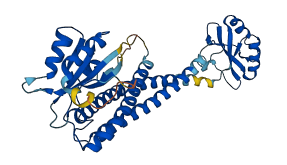
Descriptions
The autoinhibited protein was predicted that may have potential autoinhibitory elements via cis-regPred.
Autoinhibitory domains (AIDs)
Target domain |
|
Relief mechanism |
|
Assay |
cis-regPred |
Accessory elements
No accessory elements
Autoinhibited structure

Activated structure
1 structures for P54648
| Entry ID | Method | Resolution | Chain | Position | Source |
|---|---|---|---|---|---|
| AF-P54648-F1 | Predicted | AlphaFoldDB |
No variants for P54648
| Variant ID(s) | Position | Change | Description | Diseaes Association | Provenance |
|---|---|---|---|---|---|
| No variants for P54648 | |||||
No associated diseases with P54648
No regional properties for P54648
| Type | Name | Position | InterPro Accession |
|---|---|---|---|
| No domain, repeats, and functional sites for P54648 | |||
5 GO annotations of cellular component
| Name | Definition |
|---|---|
| contractile vacuolar membrane | The lipid bilayer surrounding the contractile vacuole. |
| early endosome | A membrane-bounded organelle that receives incoming material from primary endocytic vesicles that have been generated by clathrin-dependent and clathrin-independent endocytosis; vesicles fuse with the early endosome to deliver cargo for sorting into recycling or degradation pathways. |
| lysosome | A small lytic vacuole that has cell cycle-independent morphology found in most animal cells and that contains a variety of hydrolases, most of which have their maximal activities in the pH range 5-6. The contained enzymes display latency if properly isolated. About 40 different lysosomal hydrolases are known and lysosomes have a great variety of morphologies and functions. |
| pathogen-containing vacuole | A membrane-bound intracellular compartment that is formed upon internalization of a pathogen into a host cell, and in which the pathogen resides. |
| vacuolar proton-transporting V-type ATPase, V1 domain | The V1 domain of a proton-transporting V-type ATPase found in the vacuolar membrane. |
1 GO annotations of molecular function
| Name | Definition |
|---|---|
| proton-transporting ATPase activity, rotational mechanism | Enables the transfer of protons from one side of a membrane to the other according to the reaction: ATP + H2O + H+(in) = ADP + phosphate + H+(out), by a rotational mechanism. |
No GO annotations of biological process
| Name | Definition |
|---|---|
| No GO annotations for biological process |
No homologous proteins in AiPD
| UniProt AC | Gene Name | Protein Name | Species | Evidence Code |
|---|---|---|---|---|
| No homologous proteins | ||||
| 10 | 20 | 30 | 40 | 50 | 60 |
| MSETQEFWLI | SAPNLPGADI | FDQVNQKTAK | ENSLSENKKF | NTPALRVGTL | NSLITLNDEL |
| 70 | 80 | 90 | 100 | 110 | 120 |
| QKIDTIVEST | TKKIARQLVD | LVGTKPGKDK | SLSINGHTIP | QYLQQFAWDD | AKYNLKLSLQ |
| 130 | 140 | 150 | 160 | 170 | 180 |
| EIVEKISSAV | SKIDDDLKIK | SSEYSTLSSS | VASEERKASG | NLQVRTLNDL | ITADNIVQTD |
| 190 | 200 | 210 | 220 | 230 | 240 |
| YFTTAFVVIP | KQSEKEFLAC | YETISDFVLG | RSAKRVAQDN | DYFLYSVILF | KKFYENFKTK |
| 250 | 260 | 270 | 280 | 290 | 300 |
| IIEKKWVVRD | FKLEDNKPTQ | ERSKLTEDKK | NCRTSLIRWC | RLNFPEAFMA | WVHLKVVRVF |
| 310 | 320 | 330 | 340 | 350 | 360 |
| VESVLRFGIP | FNFQAILMKP | QKGADKKVRD | ILFDQFKYLG | SAHISGKNET | DDSEKFYPYI |
| SVSVNWEN |