P54148
Gene name |
sll0537 |
Protein name |
Putative ammonium transporter sll0537 |
Names |
|
Species |
Synechocystis sp (strain PCC 6803 / Kazusa) |
KEGG Pathway |
syn:sll0537 |
EC number |
|
Protein Class |
|
Descriptions
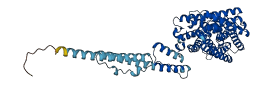
The autoinhibited protein was predicted that may have potential autoinhibitory elements via cis-regPred.
Autoinhibitory domains (AIDs)
Target domain |
|
Relief mechanism |
|
Assay |
cis-regPred |
Accessory elements
No accessory elements
Autoinhibited structure

Activated structure
1 structures for P54148
| Entry ID | Method | Resolution | Chain | Position | Source |
|---|---|---|---|---|---|
| AF-P54148-F1 | Predicted | AlphaFoldDB |
No variants for P54148
| Variant ID(s) | Position | Change | Description | Diseaes Association | Provenance |
|---|---|---|---|---|---|
| No variants for P54148 | |||||
No associated diseases with P54148
2 GO annotations of cellular component
| Name | Definition |
|---|---|
| integral component of membrane | The component of a membrane consisting of the gene products and protein complexes having at least some part of their peptide sequence embedded in the hydrophobic region of the membrane. |
| plasma membrane | The membrane surrounding a cell that separates the cell from its external environment. It consists of a phospholipid bilayer and associated proteins. |
1 GO annotations of molecular function
| Name | Definition |
|---|---|
| ammonium transmembrane transporter activity | Enables the transfer of ammonium from one side of a membrane to the other. Ammonium is the cation NH4+ which is formed from N2 by root-nodule bacteria in leguminous plants and is an excretory product in ammonotelic animals. |
3 GO annotations of biological process
| Name | Definition |
|---|---|
| ammonium homeostasis | Any biological process involved in the maintenance of an internal steady state of ammonium. |
| ammonium transmembrane transport | The process in which ammonium is transported across a membrane. Ammonium is the cation NH4+. |
| signal transduction | The cellular process in which a signal is conveyed to trigger a change in the activity or state of a cell. Signal transduction begins with reception of a signal (e.g. a ligand binding to a receptor or receptor activation by a stimulus such as light), or for signal transduction in the absence of ligand, signal-withdrawal or the activity of a constitutively active receptor. Signal transduction ends with regulation of a downstream cellular process, e.g. regulation of transcription or regulation of a metabolic process. Signal transduction covers signaling from receptors located on the surface of the cell and signaling via molecules located within the cell. For signaling between cells, signal transduction is restricted to events at and within the receiving cell. |
No homologous proteins in AiPD
| UniProt AC | Gene Name | Protein Name | Species | Evidence Code |
|---|---|---|---|---|
| No homologous proteins | ||||
| 10 | 20 | 30 | 40 | 50 | 60 |
| MTSIDTLWLL | LCAGLVFFMQ | AGFMCLESGL | TRSKNSINVA | IKNFADFGIS | VALFWSFGFS |
| 70 | 80 | 90 | 100 | 110 | 120 |
| IMFGLSQGGW | WGTGYSFVDV | GGEPTLAVFF | LFQAMFCGTA | TTIISGAAAE | RLKFSAYLLV |
| 130 | 140 | 150 | 160 | 170 | 180 |
| AGLASGLIYP | LFGDWAWNGL | ATVAGIETTG | GWLENLGFRD | FAGSTVVHSV | GAWIGLATIL |
| 190 | 200 | 210 | 220 | 230 | 240 |
| VVGPRQGRFP | KTGKTLKIQG | SNMPFSVLGT | LILWFGWLGF | NGGSTFGLTP | EVPGIMVNTV |
| 250 | 260 | 270 | 280 | 290 | 300 |
| LAGVGGMLMA | GLISLLQDKM | IQVEPLMNGS | LAGLVAITAS | ANVVMTPIAM | VIGATGSAIA |
| 310 | 320 | 330 | 340 | 350 | 360 |
| YLVGKKMLHW | GVDDAVDAVA | VHGGAGVWGT | LCVGLFGQLP | LVDTGLNRWQ | QCGVQLLGIG |
| 370 | 380 | 390 | 400 | 410 | 420 |
| VCTLWAFGLA | WVFLTLLNRV | FALRISPEDE | EIGLNVSEHQ | ATTETYELFQ | VMDRQAKTHD |
| 430 | 440 | 450 | 460 | 470 | 480 |
| LSLRVPVNPF | TEVGHIAGRY | NQVMDAFEAR | HHRSVEDLAQ | IYYVTAAIAA | AIENNSFKAD |
| 490 | 500 | 510 | 520 | 530 | 540 |
| QLGLEEVTNR | ADELGALART | IQQMAEMLQQ | RDQELIAVKQ | QLVLQQQKQH | HGNGESVDLS |
| P |