P54074
Gene name |
ASI1 (YMR119W, YM8564.01, YM9718.18) |
Protein name |
ERAD-associated E3 ubiquitin-protein ligase ASI1 |
Names |
Amino acid sensor-independent protein 1 |
Species |
Saccharomyces cerevisiae (strain ATCC 204508 / S288c) (Baker's yeast) |
KEGG Pathway |
sce:YMR119W |
EC number |
2.3.2.27: Aminoacyltransferases |
Protein Class |
|
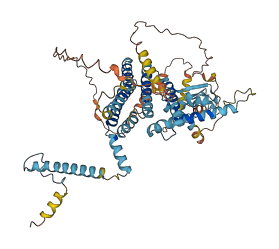
Descriptions
The autoinhibited protein was predicted that may have potential autoinhibitory elements via cis-regPred.
Autoinhibitory domains (AIDs)
Target domain |
|
Relief mechanism |
|
Assay |
cis-regPred |
Accessory elements
No accessory elements
Autoinhibited structure

Activated structure
1 structures for P54074
| Entry ID | Method | Resolution | Chain | Position | Source |
|---|---|---|---|---|---|
| AF-P54074-F1 | Predicted | AlphaFoldDB |
11 variants for P54074
| Variant ID(s) | Position | Change | Description | Diseaes Association | Provenance |
|---|---|---|---|---|---|
| s13-505639 | 103 | N>S | No | SGRP | |
| s13-505689 | 120 | V>I | No | SGRP | |
| s13-505701 | 124 | V>F | No | SGRP | |
| s13-505941 | 204 | F>L | No | SGRP | |
| s13-506196 | 289 | K>E | No | SGRP | |
| s13-506331 | 334 | A>T | No | SGRP | |
| s13-506787 | 486 | D>N | No | SGRP | |
| s13-506979 | 550 | K>E | No | SGRP | |
| s13-507001 | 557 | T>I | No | SGRP | |
| s13-507088 | 586 | F>Y | No | SGRP | |
| s13-507204 | 625 | K>Q | No | SGRP |
No associated diseases with P54074
No regional properties for P54074
| Type | Name | Position | InterPro Accession |
|---|---|---|---|
| No domain, repeats, and functional sites for P54074 | |||
Functions
| Description | ||
|---|---|---|
| EC Number | 2.3.2.27 | Aminoacyltransferases |
| Subcellular Localization |
|
|
| PANTHER Family | ||
| PANTHER Subfamily | ||
| PANTHER Protein Class | ||
| PANTHER Pathway Category | No pathway information available | |
4 GO annotations of cellular component
| Name | Definition |
|---|---|
| Asi complex | A nuclear ubiquitin ligase multiprotein complex located in the inner nuclear membrane (INM) that recognizes and ubiquitinates misfolded INM proteins and also some proteins involved in sterol biosynthesis, during ER-associated protein degradation (ERAD). In S. cerevisiae, this complex contains the ubiquitin ligases Asi1p and Asi3p. |
| integral component of membrane | The component of a membrane consisting of the gene products and protein complexes having at least some part of their peptide sequence embedded in the hydrophobic region of the membrane. |
| nuclear inner membrane | The inner, i.e. lumen-facing, lipid bilayer of the nuclear envelope. |
| nuclear periphery | The portion of the nuclear lumen proximal to the inner nuclear membrane. |
3 GO annotations of molecular function
| Name | Definition |
|---|---|
| metal ion binding | Binding to a metal ion. |
| ubiquitin protein ligase activity | Catalysis of the transfer of ubiquitin to a substrate protein via the reaction X-ubiquitin + S -> X + S-ubiquitin, where X is either an E2 or E3 enzyme, the X-ubiquitin linkage is a thioester bond, and the S-ubiquitin linkage is an amide bond: an isopeptide bond between the C-terminal glycine of ubiquitin and the epsilon-amino group of lysine residues in the substrate or, in the linear extension of ubiquitin chains, a peptide bond the between the C-terminal glycine and N-terminal methionine of ubiquitin residues. |
| ubiquitin-protein transferase activity | Catalysis of the transfer of ubiquitin from one protein to another via the reaction X-Ub + Y --> Y-Ub + X, where both X-Ub and Y-Ub are covalent linkages. |
4 GO annotations of biological process
| Name | Definition |
|---|---|
| cellular response to amino acid stimulus | Any process that results in a change in state or activity of a cell (in terms of movement, secretion, enzyme production, gene expression, etc.) as a result of an amino acid stimulus. An amino acid is a carboxylic acids containing one or more amino groups. |
| protein ubiquitination | The process in which one or more ubiquitin groups are added to a protein. |
| transcription factor catabolic process | The chemical reactions and pathways resulting in the breakdown of a sequence-specific DNA-binding transcription factor by hydrolysis of its peptide bonds, initiated by the covalent attachment of ubiquitin, and mediated by the proteasome. |
| ubiquitin-dependent protein catabolic process | The chemical reactions and pathways resulting in the breakdown of a protein or peptide by hydrolysis of its peptide bonds, initiated by the covalent attachment of a ubiquitin group, or multiple ubiquitin groups, to the protein. |
No homologous proteins in AiPD
| UniProt AC | Gene Name | Protein Name | Species | Evidence Code |
|---|---|---|---|---|
| No homologous proteins | ||||
| 10 | 20 | 30 | 40 | 50 | 60 |
| MNSSTSSENV | FINSFSYLNQ | TSQAVISGNS | TFANVINFPY | RLGLSFIGAV | NLQYEQTVKS |
| 70 | 80 | 90 | 100 | 110 | 120 |
| EEIPPTLRSV | FDTIGFFFSP | YAIFCFVIAI | VLNRFVVFYA | VLNNGSRRTL | PLWLSNVFHV |
| 130 | 140 | 150 | 160 | 170 | 180 |
| SAVVVLAMVS | LGPLTLGKDF | KILGDPAFAQ | EKFLLNIFYA | FAYSYCVETI | FTIMRNSSPL |
| 190 | 200 | 210 | 220 | 230 | 240 |
| EGTDYSLFEL | SIQFYTMTNN | NTKFLDSPDY | IIDCSMAILS | RILIHLVEIF | RLRNYRLLFS |
| 250 | 260 | 270 | 280 | 290 | 300 |
| TIMNLCHICY | LGIRVKQGGW | KSLPFSVKFR | HFPKLFSVSI | ICLSLLIFKL | SCLIRWDPFG |
| 310 | 320 | 330 | 340 | 350 | 360 |
| KSRNSCELLQ | FYPLSRNWKK | YLNYTGEEDF | SAMATKFALL | LCSGTELMEK | GIRREFPAIN |
| 370 | 380 | 390 | 400 | 410 | 420 |
| IPDNVNEKFF | ISGYLNELSK | PYKENTSISF | PKKNSSILKQ | RFFLMFPKSI | IWIMKKLVGQ |
| 430 | 440 | 450 | 460 | 470 | 480 |
| VFFGFRDNKD | EDIPDNDPSK | MLKITKTNSL | NNSAGHKEDI | ELELLNTSDD | EYSEDYEPSE |
| 490 | 500 | 510 | 520 | 530 | 540 |
| VESLGDSDEE | NLEEDSLIFN | ETRDALLDLF | SSEDNEVHTD | YNWIMSTSRI | LQQKLLSDKT |
| 550 | 560 | 570 | 580 | 590 | 600 |
| LTRASILDTK | LSEVDETFGT | ESDFDLSCAV | CKVNERNTVL | WPCRCFAICE | DCRISLGLRG |
| 610 | 620 | ||||
| FSTCVCCRSK | VHGYCKVHPV | SDSK |