P53916
Gene name |
TEP1 (YNL128W, N1220, N1872) |
Protein name |
Probable phosphatidylinositol 3,4,5-trisphosphate 3-phosphatase TEP1 |
Names |
|
Species |
Saccharomyces cerevisiae (strain ATCC 204508 / S288c) (Baker's yeast) |
KEGG Pathway |
sce:YNL128W |
EC number |
3.1.3.67: Phosphoric monoester hydrolases |
Protein Class |
|
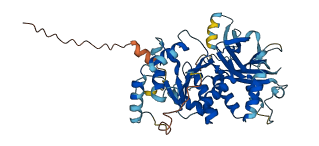
Descriptions
The autoinhibited protein was predicted that may have potential autoinhibitory elements via cis-regPred.
Autoinhibitory domains (AIDs)
Target domain |
|
Relief mechanism |
|
Assay |
cis-regPred |
Accessory elements
No accessory elements
Autoinhibited structure

Activated structure
1 structures for P53916
| Entry ID | Method | Resolution | Chain | Position | Source |
|---|---|---|---|---|---|
| AF-P53916-F1 | Predicted | AlphaFoldDB |
8 variants for P53916
| Variant ID(s) | Position | Change | Description | Diseaes Association | Provenance |
|---|---|---|---|---|---|
| s14-382695 | 112 | F>Y | No | SGRP | |
| s14-382707 | 116 | D>G | No | SGRP | |
| s14-382898 | 180 | Y>H | No | SGRP | |
| s14-382922 | 188 | V>M | No | SGRP | |
| s14-383282 | 308 | L>F | No | SGRP | |
| s14-383534 | 392 | V>L | No | SGRP | |
| s14-383577 | 406 | S>N | No | SGRP | |
| s14-383639 | 427 | L>M | No | SGRP |
No associated diseases with P53916
No regional properties for P53916
| Type | Name | Position | InterPro Accession |
|---|---|---|---|
| No domain, repeats, and functional sites for P53916 | |||
Functions
| Description | ||
|---|---|---|
| EC Number | 3.1.3.67 | Phosphoric monoester hydrolases |
| Subcellular Localization |
|
|
| PANTHER Family | ||
| PANTHER Subfamily | ||
| PANTHER Protein Class | ||
| PANTHER Pathway Category | No pathway information available | |
5 GO annotations of cellular component
| Name | Definition |
|---|---|
| cell projection | A prolongation or process extending from a cell, e.g. a flagellum or axon. |
| cytoplasm | The contents of a cell excluding the plasma membrane and nucleus, but including other subcellular structures. |
| cytosol | The part of the cytoplasm that does not contain organelles but which does contain other particulate matter, such as protein complexes. |
| nucleus | A membrane-bounded organelle of eukaryotic cells in which chromosomes are housed and replicated. In most cells, the nucleus contains all of the cell's chromosomes except the organellar chromosomes, and is the site of RNA synthesis and processing. In some species, or in specialized cell types, RNA metabolism or DNA replication may be absent. |
| plasma membrane | The membrane surrounding a cell that separates the cell from its external environment. It consists of a phospholipid bilayer and associated proteins. |
3 GO annotations of molecular function
| Name | Definition |
|---|---|
| phosphatidylinositol-3,4,5-trisphosphate 3-phosphatase activity | Catalysis of the reaction: phosphatidylinositol-3,4,5-trisphosphate + H2O = phosphatidylinositol-4,5-bisphosphate + phosphate. |
| protein tyrosine phosphatase activity | Catalysis of the reaction: protein tyrosine phosphate + H2O = protein tyrosine + phosphate. |
| protein tyrosine/serine/threonine phosphatase activity | Catalysis of the reactions: protein serine + H2O = protein serine + phosphate; protein threonine phosphate + H2O = protein threonine + phosphate; and protein tyrosine phosphate + H2O = protein tyrosine + phosphate. |
6 GO annotations of biological process
| Name | Definition |
|---|---|
| ascospore wall assembly | The aggregation, arrangement and bonding together of a set of components to form an ascospore wall. During sporulation in Ascomycota, each ascospore nucleus becomes surrounded by a specialized spore wall, formed by deposition of spore wall components in the lumenal space between the outer and inner leaflets of the prospore membrane. An example of this process is found in Saccharomyces cerevisiae. |
| cell motility | Any process involved in the controlled self-propelled movement of a cell that results in translocation of the cell from one place to another. |
| dephosphorylation | The process of removing one or more phosphoric (ester or anhydride) residues from a molecule. |
| phosphatidylinositol 3-kinase signaling | A series of reactions within the signal-receiving cell, mediated by the intracellular phosphatidylinositol 3-kinase (PI3K). Many cell surface receptor linked signaling pathways signal through PI3K to regulate numerous cellular functions. |
| protein dephosphorylation | The process of removing one or more phosphoric residues from a protein. |
| regulation of protein kinase B signaling | Any process that modulates the frequency, rate or extent of protein kinase B signaling, a series of reactions mediated by the intracellular serine/threonine kinase protein kinase B. |
No homologous proteins in AiPD
| UniProt AC | Gene Name | Protein Name | Species | Evidence Code |
|---|---|---|---|---|
| No homologous proteins | ||||
| 10 | 20 | 30 | 40 | 50 | 60 |
| MREEGSELEM | EKGFLKWKPV | NLMKKILSLP | MKKTKNDIGL | RLDISYILVN | LIVCSYPVNT |
| 70 | 80 | 90 | 100 | 110 | 120 |
| YPKLLYRNSL | DDLILFLTVY | HGKGNFRIFN | FRGEKEDSDY | KDNDLIGIAA | KFESKDFEIQ |
| 130 | 140 | 150 | 160 | 170 | 180 |
| ELRSTLINDG | KIPISPIDLE | TRTLVEEETN | NVICERIGWL | DHFPPPFELL | EEIVDGIENY |
| 190 | 200 | 210 | 220 | 230 | 240 |
| LSVSKNRVAV | LHCRMGKGRS | GMITVAYLMK | YLQCPLGEAR | LIFMQARFKY | GMTNGVTIPS |
| 250 | 260 | 270 | 280 | 290 | 300 |
| QLRYLRYHEF | FITHEKAAQE | GISNEAVKFK | FKFRLAKMTF | LRPSSLITSE | SAIVTTKIQH |
| 310 | 320 | 330 | 340 | 350 | 360 |
| YNDDRNALLT | RKVVYSDIMA | HECGGNMTFI | FGRDYLTLEN | DCRIEFTLGT | SKSKAASSII |
| 370 | 380 | 390 | 400 | 410 | 420 |
| SWTSCASCWL | NIYLETLMHI | IKDDSSPDYF | QVERLKRDEM | LGTTISWQEL | DGFGELSTHG |
| 430 | |||||
| LKLFQALKLE | WEII |