P53860
Gene name |
PDR16 (SFH3, YNL231C, N1158) |
Protein name |
Phosphatidylinositol transfer protein PDR16 |
Names |
PITP, Pleiotropic drug resistance protein 16, SEC14 homolog 3 |
Species |
Saccharomyces cerevisiae (strain ATCC 204508 / S288c) (Baker's yeast) |
KEGG Pathway |
sce:YNL231C |
EC number |
|
Protein Class |
|
Descriptions
The autoinhibited protein was predicted that may have potential autoinhibitory elements via cis-regPred.
Autoinhibitory domains (AIDs)
Target domain |
|
Relief mechanism |
|
Assay |
cis-regPred |
Accessory elements
No accessory elements
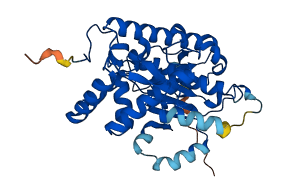
Autoinhibited structure

Activated structure
5 structures for P53860
| Entry ID | Method | Resolution | Chain | Position | Source |
|---|---|---|---|---|---|
| 4FMM | X-ray | 234 A | A/B | 1-351 | PDB |
| 4J7P | X-ray | 200 A | A/B | 2-351 | PDB |
| 4J7Q | X-ray | 155 A | A/B | 15-345 | PDB |
| 4M8Z | X-ray | 193 A | A/B | 1-351 | PDB |
| AF-P53860-F1 | Predicted | AlphaFoldDB |
4 variants for P53860
| Variant ID(s) | Position | Change | Description | Diseaes Association | Provenance |
|---|---|---|---|---|---|
| s14-217013 | 11 | A>T | No | SGRP | |
| s14-217003 | 14 | D>G | No | SGRP | |
| s14-216920 | 42 | G>C | No | SGRP | |
| s14-216027 | 339 | K>N | No | SGRP |
No associated diseases with P53860
8 GO annotations of cellular component
| Name | Definition |
|---|---|
| cell periphery | The part of a cell encompassing the cell cortex, the plasma membrane, and any external encapsulating structures. |
| cytoplasm | The contents of a cell excluding the plasma membrane and nucleus, but including other subcellular structures. |
| cytosol | The part of the cytoplasm that does not contain organelles but which does contain other particulate matter, such as protein complexes. |
| endoplasmic reticulum membrane | The lipid bilayer surrounding the endoplasmic reticulum. |
| lipid droplet | An intracellular non-membrane-bounded organelle comprising a matrix of coalesced lipids surrounded by a phospholipid monolayer. May include associated proteins. |
| nucleus-vacuole junction | An organelle membrane contact site formed between the vacuole membrane and the outer nuclear membrane. In S. cerevisiae these contacts are mediated through direct physical interaction between Vac8p and Nvj1p. |
| phosphatidylinositol transporter complex | A protein complex which is capable of phosphatidylinositol transporter activity. |
| plasma membrane | The membrane surrounding a cell that separates the cell from its external environment. It consists of a phospholipid bilayer and associated proteins. |
3 GO annotations of molecular function
| Name | Definition |
|---|---|
| identical protein binding | Binding to an identical protein or proteins. |
| phosphatidylinositol transfer activity | Removes phosphatidylinositol from a membrane or a monolayer lipid particle, transports it through the aqueous phase while protected in a hydrophobic pocket, and brings it to an acceptor membrane or lipid particle. |
| sterol binding | Binding to a sterol, a steroid containing a hydroxy group in the 3 position, closely related to cholestan-3-ol. |
5 GO annotations of biological process
| Name | Definition |
|---|---|
| negative regulation of sexual sporulation resulting in formation of a cellular spore | Any process that stops, prevents, or reduces the frequency, rate or extent of the formation of cellular spores derived from the products of meiosis. |
| phospholipid biosynthetic process | The chemical reactions and pathways resulting in the formation of a phospholipid, a lipid containing phosphoric acid as a mono- or diester. |
| phospholipid transport | The directed movement of phospholipids into, out of or within a cell, or between cells, by means of some agent such as a transporter or pore. Phospholipids are any lipids containing phosphoric acid as a mono- or diester. |
| response to xenobiotic stimulus | Any process that results in a change in state or activity of a cell or an organism (in terms of movement, secretion, enzyme production, gene expression, etc.) as a result of a stimulus from a xenobiotic, a compound foreign to the organim exposed to it. It may be synthesized by another organism (like ampicilin) or it can be a synthetic chemical. |
| sterol biosynthetic process | The chemical reactions and pathways resulting in the formation of sterols, steroids with one or more hydroxyl groups and a hydrocarbon side-chain in the molecule. |
No homologous proteins in AiPD
| UniProt AC | Gene Name | Protein Name | Species | Evidence Code |
|---|---|---|---|---|
| No homologous proteins | ||||
| 10 | 20 | 30 | 40 | 50 | 60 |
| MFKRFSKKKE | APEDPKNLIN | IDKPIKELPA | SIAIPKEKPL | TGEQQKMYDE | VLKHFSNPDL |
| 70 | 80 | 90 | 100 | 110 | 120 |
| KVYTSEKNKS | EDDLKPLEEE | EKAWLTRECF | LRYLRATKWV | LKDCIDRITM | TLAWRREFGI |
| 130 | 140 | 150 | 160 | 170 | 180 |
| SHLGEEHGDK | ITADLVAVEN | ESGKQVILGY | ENDARPILYL | KPGRQNTKTS | HRQVQHLVFM |
| 190 | 200 | 210 | 220 | 230 | 240 |
| LERVIDFMPA | GQDSLALLID | FKDYPDVPKV | PGNSKIPPIG | VGKEVLHILQ | THYPERLGKA |
| 250 | 260 | 270 | 280 | 290 | 300 |
| LLTNIPWLAW | TFLKLIHPFI | DPLTREKLVF | DEPFVKYVPK | NELDSLYGGD | LKFKYNHDVY |
| 310 | 320 | 330 | 340 | 350 | |
| WPALVETARE | KRDHYFKRFQ | SFGGIVGLSE | VDLRGTHEKL | LYPVKSESST | V |