P53768
Gene name |
HAP2 (KLLA0A00891g) |
Protein name |
Transcriptional activator HAP2 |
Names |
|
Species |
Kluyveromyces lactis (strain ATCC 8585 / CBS 2359 / DSM 70799 / NBRC 1267 / NRRL Y-1140 / WM37) (Yeast) (Candida sphaerica) |
KEGG Pathway |
kla:KLLA0_A00891g |
EC number |
|
Protein Class |
|
Descriptions
The autoinhibited protein was predicted that may have potential autoinhibitory elements via cis-regPred.
Autoinhibitory domains (AIDs)
Target domain |
|
Relief mechanism |
|
Assay |
cis-regPred |
Accessory elements
No accessory elements
Autoinhibited structure

Activated structure
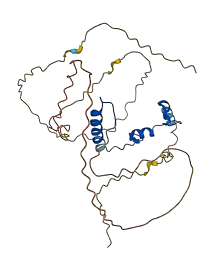
1 structures for P53768
| Entry ID | Method | Resolution | Chain | Position | Source |
|---|---|---|---|---|---|
| AF-P53768-F1 | Predicted | AlphaFoldDB |
No variants for P53768
| Variant ID(s) | Position | Change | Description | Diseaes Association | Provenance |
|---|---|---|---|---|---|
| No variants for P53768 | |||||
No associated diseases with P53768
1 regional properties for P53768
| Type | Name | Position | InterPro Accession |
|---|---|---|---|
| active_site | Phenylalanine/histidine ammonia-lyases, active site | 249 - 265 | IPR022313 |
1 GO annotations of cellular component
| Name | Definition |
|---|---|
| CCAAT-binding factor complex | A heteromeric transcription factor complex that binds to the CCAAT-box upstream of promoters; functions as both an activator and a repressor, depending on its interacting cofactors. Typically trimeric consisting of NFYA, NFYB and NFYC subunits. In Saccharomyces, it activates the transcription of genes in response to growth in a nonfermentable carbon source and consists of four known subunits: HAP2, HAP3, HAP4 and HAP5. |
2 GO annotations of molecular function
| Name | Definition |
|---|---|
| DNA binding | Any molecular function by which a gene product interacts selectively and non-covalently with DNA (deoxyribonucleic acid). |
| DNA-binding transcription factor activity | A transcription regulator activity that modulates transcription of gene sets via selective and non-covalent binding to a specific double-stranded genomic DNA sequence (sometimes referred to as a motif) within a cis-regulatory region. Regulatory regions include promoters (proximal and distal) and enhancers. Genes are transcriptional units, and include bacterial operons. |
No GO annotations of biological process
| Name | Definition |
|---|---|
| No GO annotations for biological process |
No homologous proteins in AiPD
| UniProt AC | Gene Name | Protein Name | Species | Evidence Code |
|---|---|---|---|---|
| No homologous proteins | ||||
| 10 | 20 | 30 | 40 | 50 | 60 |
| MPTELITYEQ | NFSSGVDAEN | DYPPLDSGMG | SFQVSELERQ | GDSHKRSNDE | ISELRDETLN |
| 70 | 80 | 90 | 100 | 110 | 120 |
| GREKKLRQSE | SISRNSTGNA | QVEAIPHHSI | NVDQSDNLLS | EQENPTKVYL | YDDPHLENDP |
| 130 | 140 | 150 | 160 | 170 | 180 |
| QQRQEESDAN | GIMEKLTDDN | SMKQVSNAKT | SLETAQFLET | SNSMELQRTK | PHDMNIISPS |
| 190 | 200 | 210 | 220 | 230 | 240 |
| EPLEQPFYVN | AKQYYRILKR | RYARAKLEEN | LKISRERRPY | LHESRHKHAM | RRPRGQGGRF |
| 250 | 260 | 270 | 280 | 290 | |
| LTAAEMAEMK | RKEEEGTDND | SFLQEHVPKM | NVLPQQLPGP | VKDNNNEKSD | EKPVAKEASN |