P53762
Gene name |
Arnt |
Protein name |
Aryl hydrocarbon receptor nuclear translocator |
Names |
ARNT protein, Dioxin receptor, nuclear translocator, Hypoxia-inducible factor 1-beta, HIF-1-beta, HIF1-beta |
Species |
Mus musculus (Mouse) |
KEGG Pathway |
mmu:11863 |
EC number |
|
Protein Class |
|
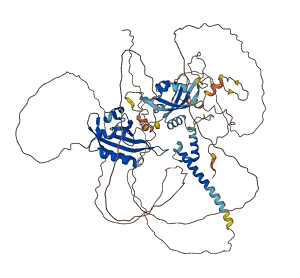
Descriptions
The autoinhibited protein was predicted that may have potential autoinhibitory elements via cis-regPred.
Autoinhibitory domains (AIDs)
Target domain |
|
Relief mechanism |
|
Assay |
cis-regPred |
Accessory elements
No accessory elements
Autoinhibited structure

Activated structure
18 structures for P53762
| Entry ID | Method | Resolution | Chain | Position | Source |
|---|---|---|---|---|---|
| 4ZP4 | X-ray | 235 A | A/C | 82-464 | PDB |
| 4ZPH | X-ray | 280 A | A/C | 82-464 | PDB |
| 4ZPK | X-ray | 360 A | A | 82-464 | PDB |
| 4ZPR | X-ray | 390 A | A | 82-464 | PDB |
| 4ZQD | X-ray | 287 A | A/C | 82-464 | PDB |
| 5NJ8 | X-ray | 330 A | B/D | 84-345 | PDB |
| 5SY5 | X-ray | 320 A | A/C/E | 82-464 | PDB |
| 5SY7 | X-ray | 420 A | A | 82-464 | PDB |
| 6E3S | X-ray | 300 A | A | 81-464 | PDB |
| 6E3T | X-ray | 300 A | A | 81-464 | PDB |
| 6E3U | X-ray | 285 A | A | 81-464 | PDB |
| 7V7L | X-ray | 230 A | A | 81-464 | PDB |
| 7V7W | X-ray | 251 A | A | 81-464 | PDB |
| 7VNI | X-ray | 200 A | C/D | 358-466 | PDB |
| 7W80 | X-ray | 275 A | A | 81-464 | PDB |
| 7XHV | X-ray | 400 A | A | 82-360 | PDB |
| 7XI4 | X-ray | 471 A | A | 82-464 | PDB |
| AF-P53762-F1 | Predicted | AlphaFoldDB |
23 variants for P53762
| Variant ID(s) | Position | Change | Description | Diseaes Association | Provenance |
|---|---|---|---|---|---|
| rs3393373044 | 5 | T>A | No | EVA | |
| rs3388647484 | 19 | P>L | No | EVA | |
| rs33119805 | 37 | V>L | No | EVA | |
| rs8251887 | 41 | I>V | No | EVA | |
| rs243287530 | 67 | M>I | No | EVA | |
| rs3388644607 | 98 | E>V | No | EVA | |
| rs3393164623 | 152 | G>L* | No | EVA | |
| rs3388652581 | 393 | G>E | No | EVA | |
| rs3388647436 | 418 | L>I | No | EVA | |
| rs3388647455 | 447 | Q>H | No | EVA | |
| rs3717575 | 497 | G>E | No | EVA | |
| rs33122907 | 508 | H>Q | No | EVA | |
| rs3388645027 | 508 | H>R | No | EVA | |
| rs3388649819 | 535 | S>R | No | EVA | |
| rs3388641345 | 540 | H>R | No | EVA | |
| rs3388648715 | 540 | H>Y | No | EVA | |
| rs3388648678 | 541 | S>G | No | EVA | |
| rs8252009 | 618 | S>F | No | EVA | |
| rs8252008 | 619 | S>F | No | EVA | |
| rs8252007 | 634 | A>V | No | EVA | |
| rs242830581 | 651 | A>T | No | EVA | |
| rs3402644551 | 669 | V>L | No | EVA | |
| rs3388637130 | 685 | G>D | No | EVA |
No associated diseases with P53762
No regional properties for P53762
| Type | Name | Position | InterPro Accession |
|---|---|---|---|
| No domain, repeats, and functional sites for P53762 | |||
7 GO annotations of cellular component
| Name | Definition |
|---|---|
| aryl hydrocarbon receptor complex | A protein complex that acts as an aryl hydrocarbon (Ah) receptor. Cytosolic and nuclear Ah receptor complexes have different subunit composition, but both contain the ligand-binding subunit AhR. |
| cytoplasm | The contents of a cell excluding the plasma membrane and nucleus, but including other subcellular structures. |
| nuclear body | Extra-nucleolar nuclear domains usually visualized by confocal microscopy and fluorescent antibodies to specific proteins. |
| nucleoplasm | That part of the nuclear content other than the chromosomes or the nucleolus. |
| nucleus | A membrane-bounded organelle of eukaryotic cells in which chromosomes are housed and replicated. In most cells, the nucleus contains all of the cell's chromosomes except the organellar chromosomes, and is the site of RNA synthesis and processing. In some species, or in specialized cell types, RNA metabolism or DNA replication may be absent. |
| RNA polymerase II transcription regulator complex | A transcription factor complex that acts at a regulatory region of a gene transcribed by RNA polymerase II. |
| transcription regulator complex | A protein complex that is capable of associating with DNA by direct binding, or via other DNA-binding proteins or complexes, and regulating transcription. |
12 GO annotations of molecular function
| Name | Definition |
|---|---|
| aryl hydrocarbon receptor binding | Binding to an aryl hydrocarbon receptor. |
| cis-regulatory region sequence-specific DNA binding | Binding to a specific upstream regulatory DNA sequence (transcription factor recognition sequence or binding site) located in cis relative to the transcription start site (i.e., on the same strand of DNA) of a gene transcribed by some RNA polymerase. The proximal promoter is in cis with and relatively close to the core promoter. |
| DNA-binding transcription factor activity | A transcription regulator activity that modulates transcription of gene sets via selective and non-covalent binding to a specific double-stranded genomic DNA sequence (sometimes referred to as a motif) within a cis-regulatory region. Regulatory regions include promoters (proximal and distal) and enhancers. Genes are transcriptional units, and include bacterial operons. |
| DNA-binding transcription factor activity, RNA polymerase II-specific | A DNA-binding transcription factor activity that modulates the transcription of specific gene sets transcribed by RNA polymerase II. |
| nuclear receptor activity | A DNA-binding transcription factor activity regulated by binding to a ligand that modulates the transcription of specific gene sets transcribed by RNA polymerase II. Nuclear receptor ligands are usually lipid-based (such as a steroid hormone) and the binding of the ligand to its receptor often occurs in the cytoplasm, which leads to its tranlocation to the nucleus. |
| protein heterodimerization activity | Binding to a nonidentical protein to form a heterodimer. |
| protein homodimerization activity | Binding to an identical protein to form a homodimer. |
| protein-containing complex binding | Binding to a macromolecular complex. |
| RNA polymerase II cis-regulatory region sequence-specific DNA binding | Binding to a specific upstream regulatory DNA sequence (transcription factor recognition sequence or binding site) located in cis relative to the transcription start site (i.e., on the same strand of DNA) of a gene transcribed by RNA polymerase II. |
| RNA polymerase II-specific DNA-binding transcription factor binding | Binding to a sequence-specific DNA binding RNA polymerase II transcription factor, any of the factors that interact selectively and non-covalently with a specific DNA sequence in order to modulate transcription. |
| sequence-specific DNA binding | Binding to DNA of a specific nucleotide composition, e.g. GC-rich DNA binding, or with a specific sequence motif or type of DNA e.g. promotor binding or rDNA binding. |
| sequence-specific double-stranded DNA binding | Binding to double-stranded DNA of a specific nucleotide composition, e.g. GC-rich DNA binding, or with a specific sequence motif or type of DNA, e.g. promotor binding or rDNA binding. |
11 GO annotations of biological process
| Name | Definition |
|---|---|
| cell differentiation | The process in which relatively unspecialized cells, e.g. embryonic or regenerative cells, acquire specialized structural and/or functional features that characterize the cells, tissues, or organs of the mature organism or some other relatively stable phase of the organism's life history. Differentiation includes the processes involved in commitment of a cell to a specific fate and its subsequent development to the mature state. |
| embryonic placenta development | The embryonically driven process whose specific outcome is the progression of the placenta over time, from its formation to the mature structure. The placenta is an organ of metabolic interchange between fetus and mother, partly of embryonic origin and partly of maternal origin. |
| positive regulation of DNA-templated transcription | Any process that activates or increases the frequency, rate or extent of cellular DNA-templated transcription. |
| positive regulation of hormone biosynthetic process | Any process that activates or increases the frequency, rate or extent of the chemical reactions and pathways resulting in the formation of hormones. |
| positive regulation of protein sumoylation | Any process that activates or increases the frequency, rate or extent of the addition of SUMO groups to a protein. |
| positive regulation of transcription by RNA polymerase II | Any process that activates or increases the frequency, rate or extent of transcription from an RNA polymerase II promoter. |
| positive regulation of vascular endothelial growth factor production | Any process that increases or activates the frequency, rate, or extent of production of vascular endothelial growth factor. |
| regulation of transcription by RNA polymerase II | Any process that modulates the frequency, rate or extent of transcription mediated by RNA polymerase II. |
| regulation of transcription from RNA polymerase II promoter in response to oxidative stress | Modulation of the frequency, rate or extent of transcription from an RNA polymerase II promoter as a result of a stimulus indicating the organism is under oxidative stress, a state often resulting from exposure to high levels of reactive oxygen species, e.g. superoxide anions, hydrogen peroxide (H2O2), and hydroxyl radicals. |
| response to hypoxia | Any process that results in a change in state or activity of a cell or an organism (in terms of movement, secretion, enzyme production, gene expression, etc.) as a result of a stimulus indicating lowered oxygen tension. Hypoxia, defined as a decline in O2 levels below normoxic levels of 20.8 - 20.95%, results in metabolic adaptation at both the cellular and organismal level. |
| response to toxic substance | Any process that results in a change in state or activity of a cell or an organism (in terms of movement, secretion, enzyme production, gene expression, etc.) as a result of a toxic stimulus. |
| 10 | 20 | 30 | 40 | 50 | 60 |
| MAATTANPEM | TSDVPSLGPT | IASGNPGPGI | QGGGAVVQRA | IKRRSGLDFD | DEVEVNTKFL |
| 70 | 80 | 90 | 100 | 110 | 120 |
| RCDDDQMCND | KERFARSDDE | QSSADKERLA | RENHSEIERR | RRNKMTAYIT | ELSDMVPTCS |
| 130 | 140 | 150 | 160 | 170 | 180 |
| ALARKPDKLT | ILRMAVSHMK | SLRGTGNTST | DGSYKPSFLT | DQELKHLILE | AADGFLFIVS |
| 190 | 200 | 210 | 220 | 230 | 240 |
| CETGRVVYVS | DSVTPVLNQP | QSEWFGSTLY | DQVHPDDVDK | LREQLSTSEN | ALTGRVLDLK |
| 250 | 260 | 270 | 280 | 290 | 300 |
| TGTVKKEGQQ | SSMRMCMGSR | RSFICRMRCG | TSSVDPVSMN | RLSFLRNRCR | NGLGSVKEGE |
| 310 | 320 | 330 | 340 | 350 | 360 |
| PHFVVVHCTG | YIKAWPPAGV | SLPDDDPEAG | QGSKFCLVAI | GRLQVTSSPN | CTDMSNICQP |
| 370 | 380 | 390 | 400 | 410 | 420 |
| TEFISRHNIE | GIFTFVDHRC | VATVGYQPQE | LLGKNIVEFC | HPEDQQLLRD | SFQQVVKLKG |
| 430 | 440 | 450 | 460 | 470 | 480 |
| QVLSVMFRFR | SKTREWLWMR | TSSFTFQNPY | SDEIEYIICT | NTNVKNSSQE | PRPTLSNTIP |
| 490 | 500 | 510 | 520 | 530 | 540 |
| RSQLGPTANL | SLEMGTGQLP | SRQQQQQHTE | LDMVPGRDGL | ASYNHSQVSV | QPVASAGSEH |
| 550 | 560 | 570 | 580 | 590 | 600 |
| SKPLEKSEGL | FAQDRDPRFP | EIYPSITADQ | SKGISSSTVP | ATQQLFSQGS | SFPPNPRPAE |
| 610 | 620 | 630 | 640 | 650 | 660 |
| NFRNSGLTPP | VTIVQPSSSA | GQILAQISRH | SNPAQGSAPT | WTSSSRPGFA | AQQVPTQATA |
| 670 | 680 | 690 | 700 | 710 | 720 |
| KTRSSQFGVN | NFQTSSSFSA | MSLPGAPTAS | SGTAAYPALP | NRGSNFPPET | GQTTGQFQAR |
| 730 | 740 | 750 | 760 | 770 | 780 |
| TAEGVGVWPQ | WQGQQPHHRS | SSSEQHVQQT | QAQAPSQPEV | FQEMLSMLGD | QSNTYNNEEF |
| 790 | |||||
| PDLTMFPPFS | E |