P53581
Gene name |
sll0555 |
Protein name |
Methionine aminopeptidase C |
Names |
MAP C, MetAP C, Peptidase M |
Species |
Synechocystis sp (strain PCC 6803 / Kazusa) |
KEGG Pathway |
syn:sll0555 |
EC number |
3.4.11.18: Aminopeptidases |
Protein Class |
|
Descriptions
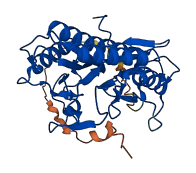
The autoinhibited protein was predicted that may have potential autoinhibitory elements via cis-regPred.
Autoinhibitory domains (AIDs)
Target domain |
|
Relief mechanism |
|
Assay |
cis-regPred |
Accessory elements
No accessory elements
Autoinhibited structure

Activated structure
1 structures for P53581
| Entry ID | Method | Resolution | Chain | Position | Source |
|---|---|---|---|---|---|
| AF-P53581-F1 | Predicted | AlphaFoldDB |
No variants for P53581
| Variant ID(s) | Position | Change | Description | Diseaes Association | Provenance |
|---|---|---|---|---|---|
| No variants for P53581 | |||||
No associated diseases with P53581
1 regional properties for P53581
| Type | Name | Position | InterPro Accession |
|---|---|---|---|
| domain | Peptidase M24 | 64 - 293 | IPR000994 |
Functions
| Description | ||
|---|---|---|
| EC Number | 3.4.11.18 | Aminopeptidases |
| Subcellular Localization |
|
|
| PANTHER Family | ||
| PANTHER Subfamily | ||
| PANTHER Protein Class | ||
| PANTHER Pathway Category | No pathway information available | |
1 GO annotations of cellular component
| Name | Definition |
|---|---|
| cytosol | The part of the cytoplasm that does not contain organelles but which does contain other particulate matter, such as protein complexes. |
2 GO annotations of molecular function
| Name | Definition |
|---|---|
| metalloaminopeptidase activity | Catalysis of the hydrolysis of a single N-terminal amino acid residue from a polypeptide chain by a mechanism in which water acts as a nucleophile, one or two metal ions hold the water molecule in place, and charged amino acid side chains are ligands for the metal ions. |
| transition metal ion binding | Binding to a transition metal ions; a transition metal is an element whose atom has an incomplete d-subshell of extranuclear electrons, or which gives rise to a cation or cations with an incomplete d-subshell. Transition metals often have more than one valency state. Biologically relevant transition metals include vanadium, manganese, iron, copper, cobalt, nickel, molybdenum and silver. |
2 GO annotations of biological process
| Name | Definition |
|---|---|
| protein initiator methionine removal | The protein modification process in which the translation-initiating methionine or formylmethionine residue is removed from a protein. |
| proteolysis | The hydrolysis of proteins into smaller polypeptides and/or amino acids by cleavage of their peptide bonds. |
No homologous proteins in AiPD
| UniProt AC | Gene Name | Protein Name | Species | Evidence Code |
|---|---|---|---|---|
| No homologous proteins | ||||
| 10 | 20 | 30 | 40 | 50 | 60 |
| MPRIFPWKLW | RKSRPAWPRF | LGTHPMNLLS | QLFAPPSPVP | SPTPKAKKRS | RRGVQIKTPA |
| 70 | 80 | 90 | 100 | 110 | 120 |
| EIAIMRQAGA | IAAQVLKEIA | ATVQPGMTTG | DLDQLAEERI | RSLGATPSFK | GYHGFPASIC |
| 130 | 140 | 150 | 160 | 170 | 180 |
| ACVNNEVVHG | IPRRRKKIRS | GDLLKVDTGA | YFQGYHGDSC | ITIAVGKVSP | QAQRLMEVAE |
| 190 | 200 | 210 | 220 | 230 | 240 |
| GALYAGIEQV | KPGNYLMDIA | GAIEDYVKPT | GYTIVEEFTG | HGVGQALHED | PHVFNVRCRD |
| 250 | 260 | 270 | 280 | 290 | 300 |
| LPNVKLKPGM | TLAIEPIVNA | GSRFTRTLGD | RWTVVTVDNA | LSAQFEHTVL | VTATGYELLT |
| DRRLV |