Descriptions
Autoinhibitory domains (AIDs)
Target domain |
159-338 (TATA binding domain) |
Relief mechanism |
Partner binding |
Assay |
|
Accessory elements
No accessory elements
Autoinhibited structure

Activated structure
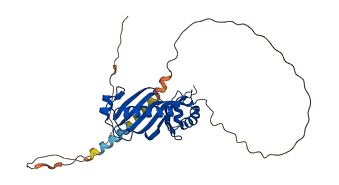
1 structures for P53360
| Entry ID | Method | Resolution | Chain | Position | Source |
|---|---|---|---|---|---|
| AF-P53360-F1 | Predicted | AlphaFoldDB |
No variants for P53360
| Variant ID(s) | Position | Change | Description | Diseaes Association | Provenance |
|---|---|---|---|---|---|
| No variants for P53360 | |||||
No associated diseases with P53360
1 regional properties for P53360
| Type | Name | Position | InterPro Accession |
|---|---|---|---|
| conserved_site | TATA-box binding protein, conserved site | 262 - 311 | IPR030491 |
2 GO annotations of cellular component
| Name | Definition |
|---|---|
| nucleus | A membrane-bounded organelle of eukaryotic cells in which chromosomes are housed and replicated. In most cells, the nucleus contains all of the cell's chromosomes except the organellar chromosomes, and is the site of RNA synthesis and processing. In some species, or in specialized cell types, RNA metabolism or DNA replication may be absent. |
| transcription factor TFIID complex | A complex composed of TATA binding protein (TBP) and TBP associated factors (TAFs); the total mass is typically about 800 kDa. Most of the TAFs are conserved across species. In TATA-containing promoters for RNA polymerase II (Pol II), TFIID is believed to recognize at least two distinct elements, the TATA element and a downstream promoter element. TFIID is also involved in recognition of TATA-less Pol II promoters. Binding of TFIID to DNA is necessary but not sufficient for transcription initiation from most RNA polymerase II promoters. |
3 GO annotations of molecular function
| Name | Definition |
|---|---|
| DNA binding | Any molecular function by which a gene product interacts selectively and non-covalently with DNA (deoxyribonucleic acid). |
| RNA polymerase II general transcription initiation factor binding | Binding to a basal RNA polymerase II transcription factor, any of the factors involved in formation of the preinitiation complex (PIC) by RNA polymerase II and defined as a basal or general transcription factor. |
| RNA polymerase III general transcription initiation factor activity | A general transcription initiation factor activity that contributes to transcription start site selection and transcription initiation of genes transcribed by RNA polymerase III. Factors required for RNA polymerase III transcription initiation include TFIIIA, TFIIIB and TFIIIC. RNA polymerase III transcribes genes encoding short RNAs, including tRNAs, 5S rRNA, U6 snRNA, the short ncRNA component of RNases P, the mitochondrial RNA processing (MRP) RNA, the signal recognition particle SRP RNA, and in higher eukaryotes a number of micro and other small RNAs, though there is some variability across species as to whether a given small noncoding RNA is transcribed by RNA polymerase II or RNA polymerase III. |
3 GO annotations of biological process
| Name | Definition |
|---|---|
| DNA-templated transcription, initiation | The initial step of transcription, consisting of the assembly of the RNA polymerase preinitiation complex (PIC) at a gene promoter, as well as the formation of the first few bonds of the RNA transcript. Transcription initiation includes abortive initiation events, which occur when the first few nucleotides are repeatedly synthesized and then released, and ends when promoter clearance takes place. |
| transcription by RNA polymerase II | The synthesis of RNA from a DNA template by RNA polymerase II (RNAP II), originating at an RNA polymerase II promoter. Includes transcription of messenger RNA (mRNA) and certain small nuclear RNAs (snRNAs). |
| transcription by RNA polymerase III | The synthesis of RNA from a DNA template by RNA polymerase III, originating at an RNAP III promoter. |
No homologous proteins in AiPD
| UniProt AC | Gene Name | Protein Name | Species | Evidence Code |
|---|---|---|---|---|
| No homologous proteins | ||||
| 10 | 20 | 30 | 40 | 50 | 60 |
| MDQNNSLPPY | AQGLASPQGA | MTPGIPIFSP | MMPYGTGLTP | QPIQNTNSLS | ILEEQQREQQ |
| 70 | 80 | 90 | 100 | 110 | 120 |
| QQQQQQQQQQ | QQAVATAAAS | VQQSTSQQST | QGASGQTPQL | FHSQTLTTAP | LPGTTPLYPS |
| 130 | 140 | 150 | 160 | 170 | 180 |
| PMTPMTPITP | ATPASESSGI | VPQLQNIVST | VNLGCKLDLK | TIALRARNAE | YNPKRFAAVI |
| 190 | 200 | 210 | 220 | 230 | 240 |
| MRIREPRTTA | LIFSSGKMVC | TGAKSEEQSR | LAARKYARVV | QKLGFPAKFL | DFKIQNMVGS |
| 250 | 260 | 270 | 280 | 290 | 300 |
| CDVKFPIRLE | GLVLTHQQFS | SYEPELFPGL | IYRMIKPRIV | LLIFVSGKVV | LTGAKVRAEI |
| 310 | |||||
| YEAFENIYPI | LKGFRKTT |