P53137
Gene name |
CUE3 (RQT3) |
Protein name |
RQC trigger complex subunit CUE3 |
Names |
CUE domain-containing protein 3, Coupling of ubiquitin conjugation to ER degradation protein 3 |
Species |
Saccharomyces cerevisiae (strain ATCC 204508 / S288c) (Baker's yeast) |
KEGG Pathway |
sce:YGL110C |
EC number |
|
Protein Class |
|
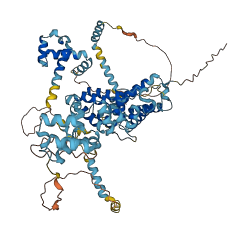
Descriptions
The autoinhibited protein was predicted that may have potential autoinhibitory elements via cis-regPred.
Autoinhibitory domains (AIDs)
Target domain |
|
Relief mechanism |
|
Assay |
cis-regPred |
Accessory elements
No accessory elements
Autoinhibited structure

Activated structure
4 structures for P53137
| Entry ID | Method | Resolution | Chain | Position | Source |
|---|---|---|---|---|---|
| 7ZPQ | EM | 347 A | CB | 1-297 | PDB |
| 7ZRS | EM | 480 A | CB | 1-297 | PDB |
| 7ZUW | EM | 430 A | CB | 1-297 | PDB |
| AF-P53137-F1 | Predicted | AlphaFoldDB |
7 variants for P53137
| Variant ID(s) | Position | Change | Description | Diseaes Association | Provenance |
|---|---|---|---|---|---|
| s07-303264 | 51 | T>A | No | SGRP | |
| s07-303080 | 112 | F>Y | No | SGRP | |
| s07-302847 | 190 | C>R | No | SGRP | |
| s07-302486 | 310 | T>I | No | SGRP | |
| s07-302322 | 365 | S>P | No | SGRP | |
| s07-302229 | 396 | S>G | No | SGRP | |
| s07-301683 | 578 | I>F | No | SGRP |
No associated diseases with P53137
1 GO annotations of cellular component
| Name | Definition |
|---|---|
| cytoplasm | The contents of a cell excluding the plasma membrane and nucleus, but including other subcellular structures. |
1 GO annotations of molecular function
| Name | Definition |
|---|---|
| ubiquitin binding | Binding to ubiquitin, a protein that when covalently bound to other cellular proteins marks them for proteolytic degradation. |
3 GO annotations of biological process
| Name | Definition |
|---|---|
| rescue of stalled ribosome | A process of translational elongation that takes place when a ribosome has stalled during translation, and results in freeing the ribosome from the stalled translation complex. |
| ribosome disassembly | The disaggregation of a ribosome into its constituent components; includes the dissociation of ribosomal subunits. |
| ribosome-associated ubiquitin-dependent protein catabolic process | The chemical reactions and pathways resulting in the breakdown of a protein or peptide encoded by an aberrant message and associated with a stalled ribosome. Degradation is initiated by the covalent attachment of a ubiquitin group, or multiple ubiquitin groups, to the ribosome-associated protein. |
No homologous proteins in AiPD
| UniProt AC | Gene Name | Protein Name | Species | Evidence Code |
|---|---|---|---|---|
| No homologous proteins | ||||
| 10 | 20 | 30 | 40 | 50 | 60 |
| MLSRYNRVIE | INGGNADISL | PIVKFPPFKL | RAQLIEKDPV | VWLHLIETYV | TYFEYLMQGA |
| 70 | 80 | 90 | 100 | 110 | 120 |
| NVELLDESTL | DHLRLFLRTY | LHEIADEEGK | LLSLGINHDV | SEQLYLLKGW | IFSLIKKCGL |
| 130 | 140 | 150 | 160 | 170 | 180 |
| LHLQIFGDSL | WNLIKVYVRR | NPDSIRGLID | GSLKPRINTQ | RVQLDKSYQV | QQHLKQLIES |
| 190 | 200 | 210 | 220 | 230 | 240 |
| GKFKRIDLRC | VEDLLSAKSM | QPNKFAENFF | TANWIEILEA | LWAKGQGRGH | KEARELIIIS |
| 250 | 260 | 270 | 280 | 290 | 300 |
| LFSVSADRLL | KITKELGISN | FETLALYPLL | GTMLINEGVH | KRLPDLKSKL | LFLNLGGLSM |
| 310 | 320 | 330 | 340 | 350 | 360 |
| DEGDHMSYPT | SSGTEVNEEQ | LSALMELFPQ | FSKYQLSQTL | LAYDNNIELV | TNKIFEDPTI |
| 370 | 380 | 390 | 400 | 410 | 420 |
| IEAFSREPAE | EEVEPVSDGD | NASFTEELSI | LDRGDSSKNK | ELDKKIISEG | VPDELRNKTL |
| 430 | 440 | 450 | 460 | 470 | 480 |
| TRALKLLYEA | DEDERDDTYD | EADVNRSDPS | KRIGLQEDEE | SYDTKDDSNE | VRQDHNYHIV |
| 490 | 500 | 510 | 520 | 530 | 540 |
| EAYLWNLLKE | DPKLFERSKR | GTKVRKTMKE | MTSWSDEKIE | GWCRMLERSP | TRARLLEKKF |
| 550 | 560 | 570 | 580 | 590 | 600 |
| MFKGNSKTGK | TSYVHNRDSQ | NDGNVVKEQA | KQKKSENIKK | HEPQSTEQKK | RQHAKNEKRK |
| 610 | 620 | ||||
| GARANHNRKK | GHDKKLARAG | NNAI |