P51581
Gene name |
CYP2E1 (CYP2E) |
Protein name |
Cytochrome P450 2E1 |
Names |
4-nitrophenol 2-hydroxylase, CYPIIE1, Cytochrome P450-J |
Species |
Mesocricetus auratus (Golden hamster) |
KEGG Pathway |
|
EC number |
1.14.13.n7: With NADH or NADPH as one donor, and incorporation of one atom of oxygen |
Protein Class |
|
Descriptions
The autoinhibited protein was predicted that may have potential autoinhibitory elements via cis-regPred.
Autoinhibitory domains (AIDs)
Target domain |
|
Relief mechanism |
|
Assay |
cis-regPred |
Accessory elements
No accessory elements
Autoinhibited structure

Activated structure
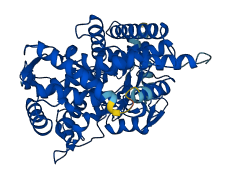
1 structures for P51581
| Entry ID | Method | Resolution | Chain | Position | Source |
|---|---|---|---|---|---|
| AF-P51581-F1 | Predicted | AlphaFoldDB |
No variants for P51581
| Variant ID(s) | Position | Change | Description | Diseaes Association | Provenance |
|---|---|---|---|---|---|
| No variants for P51581 | |||||
No associated diseases with P51581
1 regional properties for P51581
| Type | Name | Position | InterPro Accession |
|---|---|---|---|
| conserved_site | Cytochrome P450, conserved site | 430 - 439 | IPR017972 |
Functions
| Description | ||
|---|---|---|
| EC Number | 1.14.13.n7 | With NADH or NADPH as one donor, and incorporation of one atom of oxygen |
| Subcellular Localization |
|
|
| PANTHER Family | ||
| PANTHER Subfamily | ||
| PANTHER Protein Class | ||
| PANTHER Pathway Category | No pathway information available | |
2 GO annotations of cellular component
| Name | Definition |
|---|---|
| endoplasmic reticulum membrane | The lipid bilayer surrounding the endoplasmic reticulum. |
| mitochondrial inner membrane | The inner, i.e. lumen-facing, lipid bilayer of the mitochondrial envelope. It is highly folded to form cristae. |
8 GO annotations of molecular function
| Name | Definition |
|---|---|
| 4-nitrophenol 2-monooxygenase activity | Catalysis of the reaction: 4-nitrophenol + H(+) + NADH + O(2) = 4-nitrocatechol + H(2)O + NAD(+). |
| aromatase activity | Catalysis of the reduction of an aliphatic ring to yield an aromatic ring. |
| enzyme binding | Binding to an enzyme, a protein with catalytic activity. |
| heme binding | Binding to a heme, a compound composed of iron complexed in a porphyrin (tetrapyrrole) ring. |
| Hsp70 protein binding | Binding to a Hsp70 protein, heat shock proteins around 70kDa in size. |
| Hsp90 protein binding | Binding to Hsp90 proteins, any of a group of heat shock proteins around 90kDa in size. |
| iron ion binding | Binding to an iron (Fe) ion. |
| long-chain fatty acid omega-1 hydroxylase activity | Catalysis of the reaction: an (omega-1)-ethyl long-chain fatty acid + O2 + reduced = an (omega-1)-hydroxy-long-chain fatty acid + H+ + H2O + oxidized |
8 GO annotations of biological process
| Name | Definition |
|---|---|
| 4-nitrophenol metabolic process | The chemical reactions and pathways involving 4-nitrophenol, a nitroaromatic compound which is used in the production of dyes, leather treatment agents, fungicides and as an intermediate in the production of the insecticide parathion. |
| heterocycle metabolic process | The chemical reactions and pathways involving heterocyclic compounds, those with a cyclic molecular structure and at least two different atoms in the ring (or rings). |
| lipid hydroxylation | The covalent attachment of a hydroxyl group to one or more fatty acids in a lipid. |
| long-chain fatty acid metabolic process | The chemical reactions and pathways involving long-chain fatty acids, A long-chain fatty acid is a fatty acid with a chain length between C13 and C22. |
| monoterpenoid metabolic process | The chemical reactions and pathways involving monoterpenoid compounds, terpenoids having a C10 skeleton. |
| response to bacterium | Any process that results in a change in state or activity of a cell or an organism (in terms of movement, secretion, enzyme production, gene expression, etc.) as a result of a stimulus from a bacterium. |
| steroid metabolic process | The chemical reactions and pathways involving steroids, compounds with a 1,2,cyclopentanoperhydrophenanthrene nucleus. |
| xenobiotic metabolic process | The chemical reactions and pathways involving a xenobiotic compound, a compound foreign to the organim exposed to it. It may be synthesized by another organism (like ampicilin) or it can be a synthetic chemical. |
No homologous proteins in AiPD
| UniProt AC | Gene Name | Protein Name | Species | Evidence Code |
|---|---|---|---|---|
| No homologous proteins | ||||
| 10 | 20 | 30 | 40 | 50 | 60 |
| MAVFGVTIAL | LVWVATLLIV | SIWKQIYSSW | NLPPGPFPLP | ILGNIFQLDL | KNIPKSLTKL |
| 70 | 80 | 90 | 100 | 110 | 120 |
| AERFGPVFTL | HLGSKRIVVL | HGYKAVKEVL | LNHKNEFSGR | GDIPVFQEYM | NKGIIFNNGP |
| 130 | 140 | 150 | 160 | 170 | 180 |
| TWKDVRRFSL | SILRDYGMGK | QGNEARIQRE | AHFLMEELKK | TNGQPFDPTF | LVGCAPFNVI |
| 190 | 200 | 210 | 220 | 230 | 240 |
| SDILFHKRFD | YNDKTCLRLM | SLFNENFYLL | STPWIQAYNN | FENYLRYLPG | SHRKIMKNAS |
| 250 | 260 | 270 | 280 | 290 | 300 |
| EIRQYTLAKA | KEHLQSLDSS | CPRDVTDCLL | IEMEKEKDSQ | EPMYTMENIS | VTLADLFFAG |
| 310 | 320 | 330 | 340 | 350 | 360 |
| TETTSTTLRY | GLLILMKYPE | VEEKLHEEID | RVIGPSRVPV | FKDRLEMPYM | DAVVHEIQRF |
| 370 | 380 | 390 | 400 | 410 | 420 |
| ISLIPSNLPH | EATRDTMFRG | YVIPKGTVVI | PTLDSLLYDS | QEFPDPEKFK | PEHFLNENGK |
| 430 | 440 | 450 | 460 | 470 | 480 |
| FKYSDHFKAF | SAGKRVCVGE | GLARMELFLL | LTAILQHFNL | KSLVDPKDID | LNPVTIGFGC |
| 490 | |||||
| VPPEFKLCVI | PRS |