P51044
Gene name |
cit-1 |
Protein name |
Citrate synthase, mitochondrial |
Names |
|
Species |
Aspergillus niger |
KEGG Pathway |
|
EC number |
2.3.3.16: Acyl groups converted into alkyl groups on transfer |
Protein Class |
|
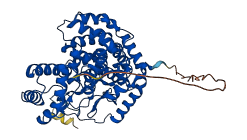
Descriptions
The autoinhibited protein was predicted that may have potential autoinhibitory elements via cis-regPred.
Autoinhibitory domains (AIDs)
Target domain |
|
Relief mechanism |
|
Assay |
cis-regPred |
Accessory elements
No accessory elements
Autoinhibited structure

Activated structure
1 structures for P51044
| Entry ID | Method | Resolution | Chain | Position | Source |
|---|---|---|---|---|---|
| AF-P51044-F1 | Predicted | AlphaFoldDB |
No variants for P51044
| Variant ID(s) | Position | Change | Description | Diseaes Association | Provenance |
|---|---|---|---|---|---|
| No variants for P51044 | |||||
No associated diseases with P51044
1 regional properties for P51044
| Type | Name | Position | InterPro Accession |
|---|---|---|---|
| active_site | Citrate synthase active site | 353 - 365 | IPR019810 |
Functions
| Description | ||
|---|---|---|
| EC Number | 2.3.3.16 | Acyl groups converted into alkyl groups on transfer |
| Subcellular Localization |
|
|
| PANTHER Family | ||
| PANTHER Subfamily | ||
| PANTHER Protein Class | ||
| PANTHER Pathway Category | No pathway information available | |
1 GO annotations of cellular component
| Name | Definition |
|---|---|
| mitochondrial matrix | The gel-like material, with considerable fine structure, that lies in the matrix space, or lumen, of a mitochondrion. It contains the enzymes of the tricarboxylic acid cycle and, in some organisms, the enzymes concerned with fatty acid oxidation. |
1 GO annotations of molecular function
| Name | Definition |
|---|---|
| citrate (Si)-synthase activity | Catalysis of the reaction: acetyl-CoA + H2O + oxaloacetate = citrate + CoA, where the acetyl group is added to the si-face of oxaloacetate; acetyl-CoA thus provides the two carbon atoms of the pro-S carboxymethyl group. |
2 GO annotations of biological process
| Name | Definition |
|---|---|
| citrate metabolic process | The chemical reactions and pathways involving citrate, 2-hydroxy-1,2,3-propanetricarboyxlate. Citrate is widely distributed in nature and is an important intermediate in the TCA cycle and the glyoxylate cycle. |
| tricarboxylic acid cycle | A nearly universal metabolic pathway in which the acetyl group of acetyl coenzyme A is effectively oxidized to two CO2 and four pairs of electrons are transferred to coenzymes. The acetyl group combines with oxaloacetate to form citrate, which undergoes successive transformations to isocitrate, 2-oxoglutarate, succinyl-CoA, succinate, fumarate, malate, and oxaloacetate again, thus completing the cycle. In eukaryotes the tricarboxylic acid is confined to the mitochondria. See also glyoxylate cycle. |
No homologous proteins in AiPD
| UniProt AC | Gene Name | Protein Name | Species | Evidence Code |
|---|---|---|---|---|
| No homologous proteins | ||||
| 10 | 20 | 30 | 40 | 50 | 60 |
| MASTLRLGTS | ALRSSSIAAK | PVVQSAAFNG | LRCYSTGKAK | SLKETFAEKL | PAELEKVKKL |
| 70 | 80 | 90 | 100 | 110 | 120 |
| RKEHGSKVIG | EVTLDQAYGG | ARGVKCLVWE | GSVLDSEEGI | RFRGRTIPEC | QELLPKAPGG |
| 130 | 140 | 150 | 160 | 170 | 180 |
| QEPLPEGLFW | LLLTGEIPTE | QQVRDLSAEW | AARSDLPKFI | EELIDRCPST | LHPMSQFSLA |
| 190 | 200 | 210 | 220 | 230 | 240 |
| VTALEHESAF | AKAYAKGINK | KDYWNYTFED | SMDLIAKLPT | IAAKIYRNVF | KDGKVAPIQK |
| 250 | 260 | 270 | 280 | 290 | 300 |
| DKDYSYNLAN | QLGYGDNNDF | VELMRLYLTI | HSDHEGGNVS | AHTTHLVGSA | LSSPMLSLAA |
| 310 | 320 | 330 | 340 | 350 | 360 |
| GLNGLAGPLH | GLANQEVLNW | LTKMKAAIGN | DLSDEAIKNY | LWSTLNAGQV | VPGYGHAVLR |
| 370 | 380 | 390 | 400 | 410 | 420 |
| KTDPRYVSQR | EFALRKLPDD | PMFKLVSQVY | KIAPGVLTEH | GKTKNPYPNV | DAHSGVLLQY |
| 430 | 440 | 450 | 460 | 470 | |
| YGLTEANYYT | VLFGVSRALG | VLPQLIIDRA | LGAPIERPKS | YSTELSPSLL | VLSCK |