P50757
Gene name |
MMP2 |
Protein name |
72 kDa type IV collagenase |
Names |
72 kDa gelatinase, Gelatinase A, Matrix metalloproteinase-2, MMP-2 |
Species |
Oryctolagus cuniculus (Rabbit) |
KEGG Pathway |
ocu:100009000 |
EC number |
3.4.24.24: Metalloendopeptidases |
Protein Class |
|
Descriptions
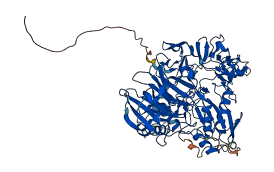
The autoinhibited protein was predicted that may have potential autoinhibitory elements via cis-regPred.
Autoinhibitory domains (AIDs)
Target domain |
|
Relief mechanism |
|
Assay |
cis-regPred |
Accessory elements
No accessory elements
Autoinhibited structure

Activated structure
1 structures for P50757
| Entry ID | Method | Resolution | Chain | Position | Source |
|---|---|---|---|---|---|
| AF-P50757-F1 | Predicted | AlphaFoldDB |
No variants for P50757
| Variant ID(s) | Position | Change | Description | Diseaes Association | Provenance |
|---|---|---|---|---|---|
| No variants for P50757 | |||||
No associated diseases with P50757
14 regional properties for P50757
| Type | Name | Position | InterPro Accession |
|---|---|---|---|
| domain | Fibronectin type II domain | 226 - 276 | IPR000562-1 |
| domain | Fibronectin type II domain | 284 - 334 | IPR000562-2 |
| domain | Fibronectin type II domain | 342 - 392 | IPR000562-3 |
| domain | Hemopexin-like domain | 468 - 662 | IPR000585 |
| domain | Peptidase M10, metallopeptidase | 118 - 446 | IPR001818 |
| domain | Peptidoglycan binding-like | 48 - 97 | IPR002477 |
| domain | Peptidase, metallopeptidase | 115 - 447 | IPR006026 |
| conserved_site | Hemopexin, conserved site | 608 - 623 | IPR018486 |
| repeat | Hemopexin-like repeats | 474 - 520 | IPR018487-1 |
| repeat | Hemopexin-like repeats | 519 - 565 | IPR018487-2 |
| repeat | Hemopexin-like repeats | 567 - 617 | IPR018487-3 |
| repeat | Hemopexin-like repeats | 616 - 662 | IPR018487-4 |
| binding_site | Peptidase M10A, cysteine switch, zinc binding site | 100 - 107 | IPR021158 |
| domain | Peptidase M10A, catalytic domain | 118 - 446 | IPR033739 |
Functions
| Description | ||
|---|---|---|
| EC Number | 3.4.24.24 | Metalloendopeptidases |
| Subcellular Localization |
|
|
| PANTHER Family | ||
| PANTHER Subfamily | ||
| PANTHER Protein Class | ||
| PANTHER Pathway Category | No pathway information available | |
4 GO annotations of cellular component
| Name | Definition |
|---|---|
| extracellular matrix | A structure lying external to one or more cells, which provides structural support, biochemical or biomechanical cues for cells or tissues. |
| extracellular region | The space external to the outermost structure of a cell. For cells without external protective or external encapsulating structures this refers to space outside of the plasma membrane. This term covers the host cell environment outside an intracellular parasite. |
| membrane | A lipid bilayer along with all the proteins and protein complexes embedded in it an attached to it. |
| nucleus | A membrane-bounded organelle of eukaryotic cells in which chromosomes are housed and replicated. In most cells, the nucleus contains all of the cell's chromosomes except the organellar chromosomes, and is the site of RNA synthesis and processing. In some species, or in specialized cell types, RNA metabolism or DNA replication may be absent. |
3 GO annotations of molecular function
| Name | Definition |
|---|---|
| endopeptidase activity | Catalysis of the hydrolysis of internal, alpha-peptide bonds in a polypeptide chain. |
| metalloendopeptidase activity | Catalysis of the hydrolysis of internal, alpha-peptide bonds in a polypeptide chain by a mechanism in which water acts as a nucleophile, one or two metal ions hold the water molecule in place, and charged amino acid side chains are ligands for the metal ions. |
| zinc ion binding | Binding to a zinc ion (Zn). |
4 GO annotations of biological process
| Name | Definition |
|---|---|
| angiogenesis | Blood vessel formation when new vessels emerge from the proliferation of pre-existing blood vessels. |
| cellular response to UV-A | Any process that results in a change in state or activity of a cell (in terms of movement, secretion, enzyme production, gene expression, etc.) as a result of a UV-A radiation stimulus. UV-A radiation (UV-A light) spans the wavelengths 315 to 400 nm. |
| collagen catabolic process | The proteolytic chemical reactions and pathways resulting in the breakdown of collagen in the extracellular matrix, usually carried out by proteases secreted by nearby cells. |
| proteolysis | The hydrolysis of proteins into smaller polypeptides and/or amino acids by cleavage of their peptide bonds. |
No homologous proteins in AiPD
| UniProt AC | Gene Name | Protein Name | Species | Evidence Code |
|---|---|---|---|---|
| No homologous proteins | ||||
| 10 | 20 | 30 | 40 | 50 | 60 |
| MEALGARGAL | AGFLRALCVL | GCLLGRATAP | PSPVIKFPGD | VAPKTDKELA | VQYLNTFYGC |
| 70 | 80 | 90 | 100 | 110 | 120 |
| PKDSCNLFVL | KDTLKKMQKF | FGLPQTGELD | QSTIETMRKP | RCGNPDVANY | NFFPRKPKWD |
| 130 | 140 | 150 | 160 | 170 | 180 |
| KNQITYRIIG | YTPDLDPETV | DDAFARAFQV | WSNVTPLRFS | RIHDGEADIM | INFGRWEHGD |
| 190 | 200 | 210 | 220 | 230 | 240 |
| GYPFDGKDGL | LAHAFAPGTG | VGGDSHFDDD | ELWTLGEGQV | VRVKYGNADG | EYCKFPFLFN |
| 250 | 260 | 270 | 280 | 290 | 300 |
| GKEYTSCTDT | GRSDGFLWCS | TTYNFEKDGK | YGFCPHEALF | TMGGNADGQP | CKFPFRFQGT |
| 310 | 320 | 330 | 340 | 350 | 360 |
| SYSSCTTEGR | TDGYRWCGTT | EDYDRDKKYG | FCPETAMSTI | GGNSEGAPCV | FPFTFLGNKY |
| 370 | 380 | 390 | 400 | 410 | 420 |
| ESCTSAGRSD | GKMWCATSTN | YDDDRKWGFC | PDQGYSLFLV | AAHEFGHAMG | LEHSQDPGAL |
| 430 | 440 | 450 | 460 | 470 | 480 |
| MAPIYTYTKN | FRLSQDDIKG | IQELYGASPD | AGTDAGTGPT | PTLGPVTPEI | CTQDIVFDGI |
| 490 | 500 | 510 | 520 | 530 | 540 |
| AQIRGEIFFF | KDRFIWRTVT | PGDKPMGPLL | VATFWPELPE | KIDAVYEAPQ | EEKAVFFAGN |
| 550 | 560 | 570 | 580 | 590 | 600 |
| EYWVYSASTL | ERGYPKPLTS | LGLPPDVQRV | DAAFNWSKNK | KTYIFAGDKF | WRYNEVKKKM |
| 610 | 620 | 630 | 640 | 650 | 660 |
| DPGFPRLIAD | AWNAIPDHLD | AVVDLQGSGH | SYFFKGTYYL | KLENQSLKSV | KVGSIKTDWL |
| GC |