P50506
Gene name |
HXK |
Protein name |
Hexokinase |
Names |
|
Species |
Schwanniomyces occidentalis (Yeast) (Debaryomyces occidentalis) |
KEGG Pathway |
|
EC number |
2.7.1.1: Phosphotransferases with an alcohol group as acceptor |
Protein Class |
|
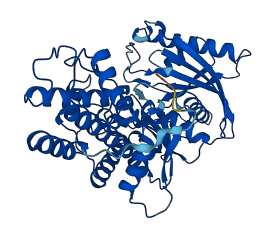
Descriptions
The autoinhibited protein was predicted that may have potential autoinhibitory elements via cis-regPred.
Autoinhibitory domains (AIDs)
Target domain |
|
Relief mechanism |
|
Assay |
cis-regPred |
Accessory elements
No accessory elements
Autoinhibited structure

Activated structure
1 structures for P50506
| Entry ID | Method | Resolution | Chain | Position | Source |
|---|---|---|---|---|---|
| AF-P50506-F1 | Predicted | AlphaFoldDB |
No variants for P50506
| Variant ID(s) | Position | Change | Description | Diseaes Association | Provenance |
|---|---|---|---|---|---|
| No variants for P50506 | |||||
No associated diseases with P50506
Functions
| Description | ||
|---|---|---|
| EC Number | 2.7.1.1 | Phosphotransferases with an alcohol group as acceptor |
| Subcellular Localization |
|
|
| PANTHER Family | ||
| PANTHER Subfamily | ||
| PANTHER Protein Class | ||
| PANTHER Pathway Category | No pathway information available | |
No GO annotations of cellular component
| Name | Definition |
|---|---|
| No GO annotations for cellular component |
4 GO annotations of molecular function
| Name | Definition |
|---|---|
| ATP binding | Binding to ATP, adenosine 5'-triphosphate, a universally important coenzyme and enzyme regulator. |
| fructokinase activity | Catalysis of the reaction: ATP + D-fructose = ADP + D-fructose 6-phosphate. |
| glucokinase activity | Catalysis of the reaction: ATP + D-glucose = ADP + D-glucose-6-phosphate. |
| glucose binding | Binding to D- or L-enantiomers of glucose. |
3 GO annotations of biological process
| Name | Definition |
|---|---|
| cellular glucose homeostasis | A cellular homeostatic process involved in the maintenance of an internal steady state of glucose within a cell or between a cell and its external environment. |
| glycolytic process | The chemical reactions and pathways resulting in the breakdown of a carbohydrate into pyruvate, with the concomitant production of a small amount of ATP and the reduction of NAD(P) to NAD(P)H. Glycolysis begins with the metabolism of a carbohydrate to generate products that can enter the pathway and ends with the production of pyruvate. Pyruvate may be converted to acetyl-coenzyme A, ethanol, lactate, or other small molecules. |
| mannose metabolic process | The chemical reactions and pathways involving mannose, the aldohexose manno-hexose, the C-2 epimer of glucose. The D-(+)-form is widely distributed in mannans and hemicelluloses and is of major importance in the core oligosaccharide of N-linked oligosaccharides of glycoproteins. |
No homologous proteins in AiPD
| UniProt AC | Gene Name | Protein Name | Species | Evidence Code |
|---|---|---|---|---|
| No homologous proteins | ||||
| 10 | 20 | 30 | 40 | 50 | 60 |
| MVHLGPKPPQ | HRKGSFLDVP | EYLLKELTEL | EGLLTVSGET | LRKITDHFIS | ELEKGLSKQG |
| 70 | 80 | 90 | 100 | 110 | 120 |
| GNIPMIPGWV | MDFPTGKEMG | DYLAIDLGGT | NLRVVLVKLG | GNRDFDTTQS | KFALPENMRT |
| 130 | 140 | 150 | 160 | 170 | 180 |
| AKSEELWEFI | AECLQKFVEE | EFRNGVLSNL | PLGFTFSYPA | SQGSINEGYL | QRWTKGFDIE |
| 190 | 200 | 210 | 220 | 230 | 240 |
| GVEGHDVVPM | LQAAIEKRKV | PIEVVALIND | TTGTLVASMY | TDPEAKMGLF | SGTGCNGAYY |
| 250 | 260 | 270 | 280 | 290 | 300 |
| DVVDNIPKLE | GKVPDDIKSS | SPMAINCEYG | AFDNEHIILP | RTKYDIQIDE | ESPRPGQQAF |
| 310 | 320 | 330 | 340 | 350 | 360 |
| EKMISGYYLG | EVLRLILLDL | TSKQLIFKDQ | DLSKLQVPFI | LDTSIPARIE | EDPFENLSDV |
| 370 | 380 | 390 | 400 | 410 | 420 |
| QELFQEILGI | QTTSPERKII | RRLAELIGER | SARLSICGIA | AICKKRGYKT | AHCAADGSVY |
| 430 | 440 | 450 | 460 | 470 | |
| NKYPGFKERA | AKGLRDIFQW | ESEEDPIVIV | PAEDGLGAGA | AIIAALTEKR | LKDGLPLV |