P50125
Gene name |
cysD |
Protein name |
Homocysteine synthase |
Names |
O-acetylhomoserine sulfhydrylase, OAH SHL, OAH sulfhydrylase |
Species |
Emericella nidulans (strain FGSC A4 / ATCC 38163 / CBS 112.46 / NRRL 194 / M139) (Aspergillus nidulans) |
KEGG Pathway |
ani:AN8277.2 |
EC number |
2.5.1.49: Transferring alkyl or aryl groups, other than methyl groups |
Protein Class |
|
Descriptions
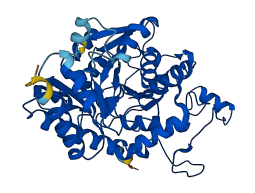
The autoinhibited protein was predicted that may have potential autoinhibitory elements via cis-regPred.
Autoinhibitory domains (AIDs)
Target domain |
|
Relief mechanism |
|
Assay |
cis-regPred |
Accessory elements
No accessory elements
Autoinhibited structure

Activated structure
1 structures for P50125
| Entry ID | Method | Resolution | Chain | Position | Source |
|---|---|---|---|---|---|
| AF-P50125-F1 | Predicted | AlphaFoldDB |
5 variants for P50125
| Variant ID(s) | Position | Change | Description | Diseaes Association | Provenance |
|---|---|---|---|---|---|
| 170 | V>A | strain: JAM 2006 [UniProt] | No | ||
| 231 | D>E | strain: JAM 2006 [UniProt] | No | ||
| 330 | S>P | strain: JAM 2006 [UniProt] | No | ||
| 333 | E>G | strain: JAM 2006 [UniProt] | No | ||
| 436 | S>G | strain: JAM 2006 [UniProt] | No |
No associated diseases with P50125
No regional properties for P50125
| Type | Name | Position | InterPro Accession |
|---|---|---|---|
| No domain, repeats, and functional sites for P50125 | |||
Functions
| Description | ||
|---|---|---|
| EC Number | 2.5.1.49 | Transferring alkyl or aryl groups, other than methyl groups |
| Subcellular Localization |
|
|
| PANTHER Family | ||
| PANTHER Subfamily | ||
| PANTHER Protein Class | ||
| PANTHER Pathway Category | No pathway information available | |
No GO annotations of cellular component
| Name | Definition |
|---|---|
| No GO annotations for cellular component |
2 GO annotations of molecular function
| Name | Definition |
|---|---|
| O-acetylhomoserine aminocarboxypropyltransferase activity | Catalysis of the reaction: O-acetyl-L-homoserine + methanethiol = L-methionine + acetate. Also reacts with other thiols and H2S, producing homocysteine or thioethers. |
| pyridoxal phosphate binding | Binding to pyridoxal 5' phosphate, 3-hydroxy-5-(hydroxymethyl)-2-methyl4-pyridine carboxaldehyde 5' phosphate, the biologically active form of vitamin B6. |
3 GO annotations of biological process
| Name | Definition |
|---|---|
| cysteine biosynthetic process | The chemical reactions and pathways resulting in the formation of cysteine, 2-amino-3-mercaptopropanoic acid. |
| cysteine metabolic process | The chemical reactions and pathways involving cysteine, 2-amino-3-mercaptopropanoic acid. |
| transsulfuration | The interconversion of homocysteine and cysteine via cystathionine. In contrast with enteric bacteria and mammals, Saccharomyces cerevisiae has two transsulfuration pathways employing two separate sets of enzymes. |
No homologous proteins in AiPD
| UniProt AC | Gene Name | Protein Name | Species | Evidence Code |
|---|---|---|---|---|
| No homologous proteins | ||||
| 10 | 20 | 30 | 40 | 50 | 60 |
| MSDPSPKRFE | TLQLHAGQEP | DPATNSRAVP | IYATTSYTFN | DSAHGARLFG | LKEFGNIYSR |
| 70 | 80 | 90 | 100 | 110 | 120 |
| IMNPTVDVFE | KRIAALEGGV | AAVAASSGQA | AQFMAISALA | HAGDNIVSTS | NLYGGTYNQF |
| 130 | 140 | 150 | 160 | 170 | 180 |
| KVLFPRLGIT | TKFVQGDKAE | DIAAAIDDRT | KAVYVETIGN | PRYNVPDFEV | IAKVAHEKGI |
| 190 | 200 | 210 | 220 | 230 | 240 |
| PLVVDNTFGA | GGYFVRPIEH | GADIVVHSAT | KWIGGHGTTI | GGVVVDSGKF | DWGKNAARFP |
| 250 | 260 | 270 | 280 | 290 | 300 |
| QFTQPSEGYH | GLNFWETFGP | IAFAIRVRVE | ILRDLGSALN | PFAAQQLILG | LETLSLRAER |
| 310 | 320 | 330 | 340 | 350 | 360 |
| HASNALALAN | WLKKNDHVSW | VSYVGLEEHS | SHEVAKKYLK | RGFGGVLSFG | VKGEAAVGSQ |
| 370 | 380 | 390 | 400 | 410 | 420 |
| VVDNFKLISN | LANVGDSKTL | AIHPWSTTHE | QLTDQERIDS | GVTEDAIRIS | VGTEHIDDII |
| 430 | |||||
| ADFEQSFAAT | FKVVRSA |