P49816
Gene name |
Tsc2 |
Protein name |
Tuberin |
Names |
Tuberous sclerosis 2 protein homolog |
Species |
Rattus norvegicus (Rat) |
KEGG Pathway |
rno:24855 |
EC number |
|
Protein Class |
|
Descriptions
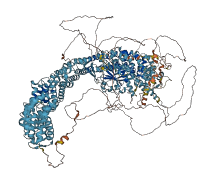
The autoinhibited protein was predicted that may have potential autoinhibitory elements via cis-regPred.
Autoinhibitory domains (AIDs)
Target domain |
|
Relief mechanism |
|
Assay |
cis-regPred |
Accessory elements
No accessory elements
Autoinhibited structure

Activated structure
1 structures for P49816
| Entry ID | Method | Resolution | Chain | Position | Source |
|---|---|---|---|---|---|
| AF-P49816-F1 | Predicted | AlphaFoldDB |
No variants for P49816
| Variant ID(s) | Position | Change | Description | Diseaes Association | Provenance |
|---|---|---|---|---|---|
| No variants for P49816 | |||||
1 associated diseases with P49816
Without disease ID
Functions
21 GO annotations of cellular component
| Name | Definition |
|---|---|
| caveola | A membrane raft that forms small pit, depression, or invagination that communicates with the outside of a cell and extends inward, indenting the cytoplasm and the cell membrane. Examples include flask-shaped invaginations of the plasma membrane in adipocytes associated with caveolin proteins, and minute pits or incuppings of the cell membrane formed during pinocytosis. Caveolae may be pinched off to form free vesicles within the cytoplasm. |
| cell projection | A prolongation or process extending from a cell, e.g. a flagellum or axon. |
| cytoplasm | The contents of a cell excluding the plasma membrane and nucleus, but including other subcellular structures. |
| cytoskeleton | A cellular structure that forms the internal framework of eukaryotic and prokaryotic cells. The cytoskeleton includes intermediate filaments, microfilaments, microtubules, the microtrabecular lattice, and other structures characterized by a polymeric filamentous nature and long-range order within the cell. The various elements of the cytoskeleton not only serve in the maintenance of cellular shape but also have roles in other cellular functions, including cellular movement, cell division, endocytosis, and movement of organelles. |
| cytosol | The part of the cytoplasm that does not contain organelles but which does contain other particulate matter, such as protein complexes. |
| dendrite | A neuron projection that has a short, tapering, morphology. Dendrites receive and integrate signals from other neurons or from sensory stimuli, and conduct nerve impulses towards the axon or the cell body. In most neurons, the impulse is conveyed from dendrites to axon via the cell body, but in some types of unipolar neuron, the impulse does not travel via the cell body. |
| glutamatergic synapse | A synapse that uses glutamate as a neurotransmitter. |
| Golgi apparatus | A membrane-bound cytoplasmic organelle of the endomembrane system that further processes the core oligosaccharides (e.g. N-glycans) added to proteins in the endoplasmic reticulum and packages them into membrane-bound vesicles. The Golgi apparatus operates at the intersection of the secretory, lysosomal, and endocytic pathways. |
| growth cone | The migrating motile tip of a growing neuron projection, where actin accumulates, and the actin cytoskeleton is the most dynamic. |
| intracellular membrane-bounded organelle | Organized structure of distinctive morphology and function, bounded by a single or double lipid bilayer membrane and occurring within the cell. Includes the nucleus, mitochondria, plastids, vacuoles, and vesicles. Excludes the plasma membrane. |
| lysosome | A small lytic vacuole that has cell cycle-independent morphology found in most animal cells and that contains a variety of hydrolases, most of which have their maximal activities in the pH range 5-6. The contained enzymes display latency if properly isolated. About 40 different lysosomal hydrolases are known and lysosomes have a great variety of morphologies and functions. |
| membrane | A lipid bilayer along with all the proteins and protein complexes embedded in it an attached to it. |
| membrane raft | Any of the small (10-200 nm), heterogeneous, highly dynamic, sterol- and sphingolipid-enriched membrane domains that compartmentalize cellular processes. Small rafts can sometimes be stabilized to form larger platforms through protein-protein and protein-lipid interactions. |
| neuron projection | A prolongation or process extending from a nerve cell, e.g. an axon or dendrite. |
| neuronal cell body | The portion of a neuron that includes the nucleus, but excludes cell projections such as axons and dendrites. |
| nucleus | A membrane-bounded organelle of eukaryotic cells in which chromosomes are housed and replicated. In most cells, the nucleus contains all of the cell's chromosomes except the organellar chromosomes, and is the site of RNA synthesis and processing. In some species, or in specialized cell types, RNA metabolism or DNA replication may be absent. |
| perinuclear region of cytoplasm | Cytoplasm situated near, or occurring around, the nucleus. |
| postsynaptic density | An electron dense network of proteins within and adjacent to the postsynaptic membrane of an asymmetric, neuron-neuron synapse. Its major components include neurotransmitter receptors and the proteins that spatially and functionally organize them such as anchoring and scaffolding molecules, signaling enzymes and cytoskeletal components. |
| protein-containing complex | A stable assembly of two or more macromolecules, i.e. proteins, nucleic acids, carbohydrates or lipids, in which at least one component is a protein and the constituent parts function together. |
| synapse | The junction between an axon of one neuron and a dendrite of another neuron, a muscle fiber or a glial cell. As the axon approaches the synapse it enlarges into a specialized structure, the presynaptic terminal bouton, which contains mitochondria and synaptic vesicles. At the tip of the terminal bouton is the presynaptic membrane; facing it, and separated from it by a minute cleft (the synaptic cleft) is a specialized area of membrane on the receiving cell, known as the postsynaptic membrane. In response to the arrival of nerve impulses, the presynaptic terminal bouton secretes molecules of neurotransmitters into the synaptic cleft. These diffuse across the cleft and transmit the signal to the postsynaptic membrane. |
| TSC1-TSC2 complex | A protein complex consisting of at least tumerin and hamartin; its formation may regulate hamartin homomultimer formation. The complex acts as a GTPase activating protein (GAP) for the small GTPase (Rheb), and inhibits the TOR signaling pathway. |
8 GO annotations of molecular function
| Name | Definition |
|---|---|
| 14-3-3 protein binding | Binding to a 14-3-3 protein. A 14-3-3 protein is any of a large family of approximately 30kDa acidic proteins which exist primarily as homo- and heterodimers within all eukaryotic cells, and have been implicated in the modulation of distinct biological processes by binding to specific phosphorylated sites on diverse target proteins, thereby forcing conformational changes or influencing interactions between their targets and other molecules. Each 14-3-3 protein sequence can be roughly divided into three sections: a divergent amino terminus, the conserved core region and a divergent carboxy-terminus. The conserved middle core region of the 14-3-3s encodes an amphipathic groove that forms the main functional domain, a cradle for interacting with client proteins. |
| GTPase activator activity | Binds to and increases the activity of a GTPase, an enzyme that catalyzes the hydrolysis of GTP. |
| Hsp90 protein binding | Binding to Hsp90 proteins, any of a group of heat shock proteins around 90kDa in size. |
| phosphatase binding | Binding to a phosphatase. |
| protein homodimerization activity | Binding to an identical protein to form a homodimer. |
| protein N-terminus binding | Binding to a protein N-terminus, the end of any peptide chain at which the 2-amino (or 2-imino) function of a constituent amino acid is not attached in peptide linkage to another amino-acid residue. |
| protein-containing complex binding | Binding to a macromolecular complex. |
| small GTPase binding | Binding to a small monomeric GTPase. |
59 GO annotations of biological process
| Name | Definition |
|---|---|
| aging | A developmental process that is a deterioration and loss of function over time. Aging includes loss of functions such as resistance to disease, homeostasis, and fertility, as well as wear and tear. Aging includes cellular senescence, but is more inclusive. May precede death and may succeed developmental maturation (GO:0021700). |
| anoikis | Apoptosis triggered by inadequate or inappropriate adherence to substrate e.g. after disruption of the interactions between normal epithelial cells and the extracellular matrix. |
| B cell proliferation | The expansion of a B cell population by cell division. Follows B cell activation. |
| cell population proliferation | The multiplication or reproduction of cells, resulting in the expansion of a cell population. |
| cell projection organization | A process that is carried out at the cellular level which results in the assembly, arrangement of constituent parts, or disassembly of a prolongation or process extending from a cell, e.g. a flagellum or axon. |
| cellular response to insulin stimulus | Any process that results in a change in state or activity of a cell (in terms of movement, secretion, enzyme production, gene expression, etc.) as a result of an insulin stimulus. Insulin is a polypeptide hormone produced by the islets of Langerhans of the pancreas in mammals, and by the homologous organs of other organisms. |
| establishment of cell polarity | The specification and formation of anisotropic intracellular organization or cell growth patterns. |
| establishment of protein localization | The directed movement of a protein to a specific location. |
| excitatory chemical synaptic transmission | Synaptic transmission that results in an excitatory postsynaptic potential. |
| glucose import | The directed movement of the hexose monosaccharide glucose into a cell or organelle. |
| heart development | The process whose specific outcome is the progression of the heart over time, from its formation to the mature structure. The heart is a hollow, muscular organ, which, by contracting rhythmically, keeps up the circulation of the blood. |
| inhibitory chemical synaptic transmission | Synaptic transmission that results in an inhibitory postsynaptic potential. |
| insulin-like growth factor receptor signaling pathway | The series of molecular signals initiated by a ligand binding to an insulin-like growth factor receptor on the surface of a target cell, and ending with the regulation of a downstream cellular process, e.g. transcription. |
| negative regulation of axonogenesis | Any process that stops, prevents, or reduces the frequency, rate or extent of axonogenesis. |
| negative regulation of B cell proliferation | Any process that stops, prevents or reduces the rate or extent of B cell proliferation. |
| negative regulation of cell population proliferation | Any process that stops, prevents or reduces the rate or extent of cell proliferation. |
| negative regulation of cell size | Any process that reduces cell size. |
| negative regulation of epithelial cell proliferation | Any process that stops, prevents or reduces the rate or extent of epithelial cell proliferation. |
| negative regulation of epithelial to mesenchymal transition | Any process that decreases the rate, frequency, or extent of epithelial to mesenchymal transition. Epithelial to mesenchymal transition where an epithelial cell loses apical/basolateral polarity, severs intercellular adhesive junctions, degrades basement membrane components and becomes a migratory mesenchymal cell. |
| negative regulation of fibroblast proliferation | Any process that stops, prevents, or reduces the frequency, rate or extent of multiplication or reproduction of fibroblast cells. |
| negative regulation of insulin receptor signaling pathway | Any process that stops, prevents, or reduces the frequency, rate or extent of insulin receptor signaling. |
| negative regulation of macroautophagy | Any process that stops, prevents, or reduces the frequency, rate or extent of macroautophagy. |
| negative regulation of MAP kinase activity | Any process that stops, prevents, or reduces the frequency, rate or extent of MAP kinase activity. |
| negative regulation of phosphatidylinositol 3-kinase signaling | Any process that stops, prevents, or reduces the frequency, rate or extent of signal transduction mediated by the phosphatidylinositol 3-kinase cascade. |
| negative regulation of pinocytosis | Any process that stops, prevents, or reduces the frequency, rate or extent of pinocytosis. Pinocytosis is the process in which cells take in liquid material from their external environment; literally 'cell drinking'. Liquid is enclosed in vesicles, formed by invagination of the plasma membrane. These vesicles then move into the cell and pass their contents to endosomes. |
| negative regulation of protein kinase activity | Any process that stops, prevents, or reduces the frequency, rate or extent of protein kinase activity. |
| negative regulation of protein kinase B signaling | Any process that stops, prevents, or reduces the frequency, rate or extent of protein kinase B signaling, a series of reactions mediated by the intracellular serine/threonine kinase protein kinase B. |
| negative regulation of protein phosphorylation | Any process that stops, prevents or reduces the rate of addition of phosphate groups to amino acids within a protein. |
| negative regulation of T cell proliferation | Any process that stops, prevents or reduces the rate or extent of T cell proliferation. |
| negative regulation of TOR signaling | Any process that stops, prevents, or reduces the frequency, rate or extent of TOR signaling. |
| negative regulation of TORC1 signaling | Any process that stops, prevents or reduces the frequency, rate or extent of TORC1 signaling. |
| negative regulation of vascular endothelial cell proliferation | Any process that stops, prevents or reduces the frequency, rate or extent of vascular endothelial cell proliferation. |
| negative regulation of Wnt signaling pathway | Any process that stops, prevents, or reduces the frequency, rate or extent of the Wnt signaling pathway. |
| neural tube closure | The last step in the formation of the neural tube, where the paired neural folds are brought together and fuse at the dorsal midline. |
| phosphatidylinositol 3-kinase signaling | A series of reactions within the signal-receiving cell, mediated by the intracellular phosphatidylinositol 3-kinase (PI3K). Many cell surface receptor linked signaling pathways signal through PI3K to regulate numerous cellular functions. |
| positive chemotaxis | The directed movement of a motile cell or organism towards a higher concentration of a chemical. |
| positive regulation of autophagy | Any process that activates, maintains or increases the rate of autophagy. Autophagy is the process in which cells digest parts of their own cytoplasm. |
| positive regulation of cell adhesion | Any process that activates or increases the frequency, rate or extent of cell adhesion. |
| positive regulation of dendritic spine development | Any process that increases the rate, frequency, or extent of dendritic spine development, the process whose specific outcome is the progression of the dendritic spine over time, from its formation to the mature structure. |
| positive regulation of fibroblast migration | Any process that increases the rate, frequency or extent of fibroblast cell migration. Fibroblast cell migration is accomplished by extension and retraction of a pseudopodium. |
| positive regulation of GTPase activity | Any process that activates or increases the activity of a GTPase. |
| positive regulation of macroautophagy | Any process, such as recognition of nutrient depletion, that activates or increases the rate of macroautophagy to bring cytosolic macromolecules to the vacuole/lysosome for degradation. |
| positive regulation of neuron projection development | Any process that increases the rate, frequency or extent of neuron projection development. Neuron projection development is the process whose specific outcome is the progression of a neuron projection over time, from its formation to the mature structure. A neuron projection is any process extending from a neural cell, such as axons or dendrites (collectively called neurites). |
| positive regulation of transcription by RNA polymerase II | Any process that activates or increases the frequency, rate or extent of transcription from an RNA polymerase II promoter. |
| protein import into nucleus | The directed movement of a protein from the cytoplasm to the nucleus. |
| protein kinase B signaling | A series of reactions, mediated by the intracellular serine/threonine kinase protein kinase B (also called AKT), which occurs as a result of a single trigger reaction or compound. |
| protein localization | Any process in which a protein is transported to, or maintained in, a specific location. |
| protein localization to cell surface | A process in which a protein is transported to, or maintained in, a location within the external part of the cell wall and/or plasma membrane. |
| protein transport into plasma membrane raft | The directed movement of a protein into a plasma membrane raft. |
| regulation of cell cycle | Any process that modulates the rate or extent of progression through the cell cycle. |
| regulation of endocytosis | Any process that modulates the frequency, rate or extent of endocytosis. |
| regulation of insulin receptor signaling pathway | Any process that modulates the frequency, rate or extent of insulin receptor signaling. |
| regulation of postsynapse organization | Any process that modulates the physical form of a postsynapse. |
| regulation of small GTPase mediated signal transduction | Any process that modulates the frequency, rate or extent of small GTPase mediated signal transduction. |
| response to hypoxia | Any process that results in a change in state or activity of a cell or an organism (in terms of movement, secretion, enzyme production, gene expression, etc.) as a result of a stimulus indicating lowered oxygen tension. Hypoxia, defined as a decline in O2 levels below normoxic levels of 20.8 - 20.95%, results in metabolic adaptation at both the cellular and organismal level. |
| signal transduction | The cellular process in which a signal is conveyed to trigger a change in the activity or state of a cell. Signal transduction begins with reception of a signal (e.g. a ligand binding to a receptor or receptor activation by a stimulus such as light), or for signal transduction in the absence of ligand, signal-withdrawal or the activity of a constitutively active receptor. Signal transduction ends with regulation of a downstream cellular process, e.g. regulation of transcription or regulation of a metabolic process. Signal transduction covers signaling from receptors located on the surface of the cell and signaling via molecules located within the cell. For signaling between cells, signal transduction is restricted to events at and within the receiving cell. |
| social behavior | Behavior directed towards society, or taking place between members of the same species. Occurs predominantly, or only, in individuals that are part of a group. |
| T cell proliferation | The expansion of a T cell population by cell division. Follows T cell activation. |
| transcription by RNA polymerase II | The synthesis of RNA from a DNA template by RNA polymerase II (RNAP II), originating at an RNA polymerase II promoter. Includes transcription of messenger RNA (mRNA) and certain small nuclear RNAs (snRNAs). |
| 10 | 20 | 30 | 40 | 50 | 60 |
| MAKPTSKDSG | LKEKFKILLG | LGTSRPNPRC | AEGKQTEFII | TAEILRELSG | ECGLNNRIRM |
| 70 | 80 | 90 | 100 | 110 | 120 |
| IGQICDVAKT | KKLEEHAVEA | LWKAVSDLLQ | PERPPEARHA | VLALLKAIVQ | GQGDRLGVLR |
| 130 | 140 | 150 | 160 | 170 | 180 |
| ALFFKVIKDY | PSNEDLHERL | EVFKALTDNG | RHITYLEEEL | AEFVLQWMDV | GLSSEFLLVL |
| 190 | 200 | 210 | 220 | 230 | 240 |
| VNLVKFNSCY | LDEYIAPMVH | MICLLCIRTV | SSVDIEVSLQ | VLDAVVCYNC | LPAESLPLFI |
| 250 | 260 | 270 | 280 | 290 | 300 |
| ITLCRTVNVK | ELCEPCWKLM | RNLLGTHLGH | SAIYNMCRIM | ENRSYMEDAP | LLRGAVFFVG |
| 310 | 320 | 330 | 340 | 350 | 360 |
| MALWGAHRLY | SLKNSPTSVL | PSFYEAMTCP | NEVVSYEIVL | SITRLIKKYR | KELQAVTWDI |
| 370 | 380 | 390 | 400 | 410 | 420 |
| LLDIIERLLQ | QLQNLDSPEL | RTIVHDLLTT | VEELCDQNEF | HGSQERYYEL | VESYADQRPE |
| 430 | 440 | 450 | 460 | 470 | 480 |
| SSLLNLITYR | AQSIHPAKDG | WIQNLQLLME | RFFRNECRSA | VRIKVLDVLS | FVLLINRQFY |
| 490 | 500 | 510 | 520 | 530 | 540 |
| EEELINSVVI | SQLSHIPEDK | DHQVRKLATQ | LLVDLAEGCH | THHFNSLLDI | IEKVMARSLS |
| 550 | 560 | 570 | 580 | 590 | 600 |
| PPLELEERDL | AVYSASLEDV | KTAVLGLLVI | LQTKLYTLPA | SHATRVYETL | ISHIQLHYKH |
| 610 | 620 | 630 | 640 | 650 | 660 |
| GYSLPIASSI | RLQAFDFLLL | LRADSLHRLG | LPNKDGVVRF | SPYCLCDCAE | LDRASEKKAS |
| 670 | 680 | 690 | 700 | 710 | 720 |
| GPLSPPTGPP | SPVPTGPAVR | LGHLPYSLLF | RVLLQCLKQE | TDWKVLKLVL | SKLPESLRYK |
| 730 | 740 | 750 | 760 | 770 | 780 |
| VLIFTSPCSV | DQLSSALCSM | LSAPKTLERL | RGTPEGFSRT | DLHLAVVPVL | TALISYHNYL |
| 790 | 800 | 810 | 820 | 830 | 840 |
| DKTRQREMVY | CLEQGLIYRC | ASQCVVALAI | CSVEMPDIII | KALPVLVVKL | THISATASMA |
| 850 | 860 | 870 | 880 | 890 | 900 |
| IPLLEFLSTL | ARLPHLYRNF | AAEQYASVFA | ISLPYTNPSK | FNQYIVCLAH | HVIAMWFIRC |
| 910 | 920 | 930 | 940 | 950 | 960 |
| RLPFRKDFVP | YITKGLRSNV | LLSFDDTPEK | DKFRARSTSL | NERPKSLRIA | RAPKQGLNNS |
| 970 | 980 | 990 | 1000 | 1010 | 1020 |
| PPVKEFKESC | AAEAFRCRSI | SVSEHVVRSR | IQTSLTSASL | GSADENSMAQ | ADDNLKNLHL |
| 1030 | 1040 | 1050 | 1060 | 1070 | 1080 |
| ELTETCLDMM | ARYVFSNFTA | VPKRSPVGEF | LLAGGRTKTW | LVGNKLVTVT | TSVGTGTRSL |
| 1090 | 1100 | 1110 | 1120 | 1130 | 1140 |
| LGLDSGDLQG | GSASSSDPGT | HVRQTKEAPA | KLESQAGQQV | SRGARDRVRS | MSGGHGLRVG |
| 1150 | 1160 | 1170 | 1180 | 1190 | 1200 |
| VLDTSAPYTP | GGPASLGAQA | APAARPEKPC | AGAQLPAAEK | ANLAAYVPLL | TQGWAEILVR |
| 1210 | 1220 | 1230 | 1240 | 1250 | 1260 |
| RPTGNTSWLM | SLENPLSPFS | SDINNMPLQE | LSNALMAAER | FKEHRDTALY | KSLSVPAAGT |
| 1270 | 1280 | 1290 | 1300 | 1310 | 1320 |
| AKPPTLPRSN | TVASFSSLYQ | PSCQGQLHRS | VSWADSAVVL | EEGSPGEAHV | PVEPPELEDF |
| 1330 | 1340 | 1350 | 1360 | 1370 | 1380 |
| EAALGTDRHC | QRPDAYSRSS | SASSQEEKSH | LEELAAGGIP | IERAISSEGA | RPTVDLSFQP |
| 1390 | 1400 | 1410 | 1420 | 1430 | 1440 |
| SQPLSKSSSS | PELQTLQDIL | GDLGDKTDIG | RLSPEAKVRS | QSGILDGEAA | TWSAPGEESR |
| 1450 | 1460 | 1470 | 1480 | 1490 | 1500 |
| ITVPPEGPLP | SSSPRSPSGL | RPRGYTISDS | APSRRGKRVE | RDNFKSRTAA | SSAEKVPGIN |
| 1510 | 1520 | 1530 | 1540 | 1550 | 1560 |
| PSFVFLQLYH | SPFCGDESNK | PILLPNESFE | RSVQLLDQIP | SYDTHKIAVL | YVGEGQSSSE |
| 1570 | 1580 | 1590 | 1600 | 1610 | 1620 |
| LAILSNEHGS | YRYTEFLTGL | GRLIELKDCQ | PDKVYLGGLD | VCGEDGQFTY | CWHDDIMQAV |
| 1630 | 1640 | 1650 | 1660 | 1670 | 1680 |
| FHIATLMPTK | DVDKHRCDKK | RHLGNDFVSI | IYNDSGEDFK | LGTIKGQFNF | VHVIITPLDY |
| 1690 | 1700 | 1710 | 1720 | 1730 | 1740 |
| KCNLLTLQCR | KDMEGLVDTS | VAKIVSDRNL | SFVARQMALH | ANMASQVHHR | RSNPTDIYPS |
| 1750 | 1760 | 1770 | 1780 | 1790 | 1800 |
| KWIARLRHIK | RLRQRIREEV | HYSNPSLPLM | HPPAHTKVPA | QAPTEATPTY | ETGQRKRLIS |
| SVDDFTEFV |