P49772
Gene name |
Flt3lg (Flt3l) |
Protein name |
Fms-related tyrosine kinase 3 ligand |
Names |
Flt3 ligand, Flt3L, SL cytokine |
Species |
Mus musculus (Mouse) |
KEGG Pathway |
mmu:14256 |
EC number |
|
Protein Class |
|
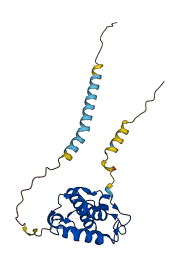
Descriptions
The autoinhibited protein was predicted that may have potential autoinhibitory elements via cis-regPred.
Autoinhibitory domains (AIDs)
Target domain |
|
Relief mechanism |
|
Assay |
cis-regPred |
Accessory elements
No accessory elements
Autoinhibited structure

Activated structure
1 structures for P49772
| Entry ID | Method | Resolution | Chain | Position | Source |
|---|---|---|---|---|---|
| AF-P49772-F1 | Predicted | AlphaFoldDB |
20 variants for P49772
| Variant ID(s) | Position | Change | Description | Diseaes Association | Provenance |
|---|---|---|---|---|---|
| rs266198838 | 23 | P>S | No | EVA | |
| rs239290434 | 43 | K>E | No | EVA | |
| rs255515397 | 44 | V>E | No | EVA | |
| rs221505696 | 44 | V>M | No | EVA | |
| rs237510676 | 46 | F>I | No | EVA | |
| rs223134767 | 48 | E>D | No | EVA | |
| rs237176364 | 52 | H>Y | No | EVA | |
| rs3388904931 | 53 | L>P | No | EVA | |
| rs3388902552 | 54 | L>F | No | EVA | |
| rs3388907760 | 59 | V>D | No | EVA | |
| rs225522813 | 61 | V>M | No | EVA | |
| rs233418927 | 82 | R>S | No | EVA | |
| rs3388882173 | 84 | I>K | No | EVA | |
| rs3388886985 | 95 | M>K | No | EVA | |
| rs3388908664 | 103 | N>K | No | EVA | |
| rs238445844 | 127 | N>D | No | EVA | |
| rs230868821 | 133 | K>Q | No | EVA | |
| rs264656633 | 136 | C>R | No | EVA | |
| rs242032493 | 140 | L>I | No | EVA | |
| rs226080484 | 143 | K>R | No | EVA |
No associated diseases with P49772
No regional properties for P49772
| Type | Name | Position | InterPro Accession |
|---|---|---|---|
| No domain, repeats, and functional sites for P49772 | |||
5 GO annotations of cellular component
| Name | Definition |
|---|---|
| cell surface | The external part of the cell wall and/or plasma membrane. |
| extracellular region | The space external to the outermost structure of a cell. For cells without external protective or external encapsulating structures this refers to space outside of the plasma membrane. This term covers the host cell environment outside an intracellular parasite. |
| extracellular space | That part of a multicellular organism outside the cells proper, usually taken to be outside the plasma membranes, and occupied by fluid. |
| integral component of membrane | The component of a membrane consisting of the gene products and protein complexes having at least some part of their peptide sequence embedded in the hydrophobic region of the membrane. |
| intrinsic component of external side of plasma membrane | The component of a plasma membrane consisting of gene products and protein complexes that penetrate the external side of the plasma membrane only, either directly or via some covalently attached hydrophobic anchor. |
2 GO annotations of molecular function
| Name | Definition |
|---|---|
| cytokine activity | The activity of a soluble extracellular gene product that interacts with a receptor to effect a change in the activity of the receptor to control the survival, growth, differentiation and effector function of tissues and cells. |
| receptor tyrosine kinase binding | Binding to a receptor that possesses protein tyrosine kinase activity. |
17 GO annotations of biological process
| Name | Definition |
|---|---|
| embryonic hemopoiesis | The stages of blood cell formation that take place within the embryo. |
| homeostasis of number of cells within a tissue | Any biological process involved in the maintenance of the steady-state number of cells within a population of cells in a tissue. |
| lymphocyte differentiation | The process in which a relatively unspecialized precursor cell acquires specialized features of a lymphocyte. A lymphocyte is a leukocyte commonly found in the blood and lymph that has the characteristics of a large nucleus, a neutral staining cytoplasm, and prominent heterochromatin. |
| natural killer cell differentiation | The process in which a relatively unspecialized cell acquires the specialized features of a natural killer cell. |
| negative regulation of apoptotic process in bone marrow cell | Any process that stops, prevents, or reduces the frequency, rate or extent of the occurrence or rate of cell death by apoptotic process in the bone marrow. |
| positive regulation of cell cycle | Any process that activates or increases the rate or extent of progression through the cell cycle. |
| positive regulation of cell population proliferation | Any process that activates or increases the rate or extent of cell proliferation. |
| positive regulation of cell proliferation in bone marrow | A process that activates or increases the frequency, rate or extent of cell proliferation in the bone marrow. |
| positive regulation of myoblast differentiation | Any process that activates or increases the frequency, rate or extent of myoblast differentiation. A myoblast is a mononucleate cell type that, by fusion with other myoblasts, gives rise to the myotubes that eventually develop into skeletal muscle fibers. |
| positive regulation of myoblast fusion | Any process that activates or increases the frequency, rate or extent of myoblast fusion. |
| positive regulation of natural killer cell differentiation | Any process that activates or increases the frequency, rate or extent of natural killer cell differentiation. |
| positive regulation of natural killer cell proliferation | Any process that activates or increases the frequency, rate or extent of natural killer cell proliferation. |
| positive regulation of osteoclast proliferation | Any process that increases the rate, frequency, or extent of the multiplication or reproduction of osteoclasts, resulting in the expansion of an osteoclast cell population. |
| positive regulation of protein phosphorylation | Any process that activates or increases the frequency, rate or extent of addition of phosphate groups to amino acids within a protein. |
| positive regulation of transcription by RNA polymerase II | Any process that activates or increases the frequency, rate or extent of transcription from an RNA polymerase II promoter. |
| protein phosphorylation | The process of introducing a phosphate group on to a protein. |
| regulation of myeloid dendritic cell activation | Any process that modulates the frequency or rate of myeloid dendritic cell activation. |
No homologous proteins in AiPD
| UniProt AC | Gene Name | Protein Name | Species | Evidence Code |
|---|---|---|---|---|
| No homologous proteins | ||||
| 10 | 20 | 30 | 40 | 50 | 60 |
| MTVLAPAWSP | NSSLLLLLLL | LSPCLRGTPD | CYFSHSPISS | NFKVKFRELT | DHLLKDYPVT |
| 70 | 80 | 90 | 100 | 110 | 120 |
| VAVNLQDEKH | CKALWSLFLA | QRWIEQLKTV | AGSKMQTLLE | DVNTEIHFVT | SCTFQPLPEC |
| 130 | 140 | 150 | 160 | 170 | 180 |
| LRFVQTNISH | LLKDTCTQLL | ALKPCIGKAC | QNFSRCLEVQ | CQPDSSTLLP | PRSPIALEAT |
| 190 | 200 | 210 | 220 | 230 | |
| ELPEPRPRQL | LLLLLLLLPL | TLVLLAAAWG | LRWQRARRRG | ELHPGVPLPS | HP |