P49139
Gene name |
MAPKAPK2 |
Protein name |
MAP kinase-activated protein kinase 2 |
Names |
MAPK-activated protein kinase 2, MAPKAP kinase 2, MAPKAP-K2, MAPKAPK-2, MK-2, MK2 |
Species |
Oryctolagus cuniculus (Rabbit) |
KEGG Pathway |
|
EC number |
2.7.11.1: Protein-serine/threonine kinases |
Protein Class |
|
Descriptions
The autoinhibited protein was predicted that may have potential autoinhibitory elements via cis-regPred.
Autoinhibitory domains (AIDs)
Target domain |
|
Relief mechanism |
|
Assay |
cis-regPred |
Accessory elements
172-194 (Activation loop from InterPro)
Target domain |
30-291 (Protein kinase domain) |
Relief mechanism |
|
Assay |
|
Autoinhibited structure

Activated structure
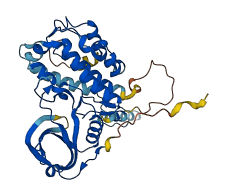
1 structures for P49139
| Entry ID | Method | Resolution | Chain | Position | Source |
|---|---|---|---|---|---|
| AF-P49139-F1 | Predicted | AlphaFoldDB |
No variants for P49139
| Variant ID(s) | Position | Change | Description | Diseaes Association | Provenance |
|---|---|---|---|---|---|
| No variants for P49139 | |||||
No associated diseases with P49139
Functions
| Description | ||
|---|---|---|
| EC Number | 2.7.11.1 | Protein-serine/threonine kinases |
| Subcellular Localization |
|
|
| PANTHER Family | ||
| PANTHER Subfamily | ||
| PANTHER Protein Class | ||
| PANTHER Pathway Category | No pathway information available | |
2 GO annotations of cellular component
| Name | Definition |
|---|---|
| cytoplasm | The contents of a cell excluding the plasma membrane and nucleus, but including other subcellular structures. |
| nucleus | A membrane-bounded organelle of eukaryotic cells in which chromosomes are housed and replicated. In most cells, the nucleus contains all of the cell's chromosomes except the organellar chromosomes, and is the site of RNA synthesis and processing. In some species, or in specialized cell types, RNA metabolism or DNA replication may be absent. |
3 GO annotations of molecular function
| Name | Definition |
|---|---|
| ATP binding | Binding to ATP, adenosine 5'-triphosphate, a universally important coenzyme and enzyme regulator. |
| protein serine kinase activity | Catalysis of the reactions: ATP + protein serine = ADP + protein serine phosphate. |
| protein serine/threonine kinase activity | Catalysis of the reactions: ATP + protein serine = ADP + protein serine phosphate, and ATP + protein threonine = ADP + protein threonine phosphate. |
10 GO annotations of biological process
| Name | Definition |
|---|---|
| 3'-UTR-mediated mRNA stabilization | An mRNA stabilization process in which one or more RNA-binding proteins associate with the 3'-untranslated region (UTR) of an mRNA. |
| cellular response to DNA damage stimulus | Any process that results in a change in state or activity of a cell (in terms of movement, secretion, enzyme production, gene expression, etc.) as a result of a stimulus indicating damage to its DNA from environmental insults or errors during metabolism. |
| inflammatory response | The immediate defensive reaction (by vertebrate tissue) to infection or injury caused by chemical or physical agents. The process is characterized by local vasodilation, extravasation of plasma into intercellular spaces and accumulation of white blood cells and macrophages. |
| macropinocytosis | An endocytosis process that results in the uptake of liquid material by cells from their external environment by the 'ruffling' of the cell membrane to form heterogeneously sized intracellular vesicles called macropinosomes, which can be up to 5 micrometers in size. |
| protein phosphorylation | The process of introducing a phosphate group on to a protein. |
| regulation of interleukin-6 production | Any process that modulates the frequency, rate, or extent of interleukin-6 production. |
| regulation of tumor necrosis factor production | Any process that modulates the frequency, rate or extent of tumor necrosis factor production. |
| response to cytokine | Any process that results in a change in state or activity of a cell or an organism (in terms of movement, secretion, enzyme production, gene expression, etc.) as a result of a cytokine stimulus. |
| response to lipopolysaccharide | Any process that results in a change in state or activity of an organism (in terms of movement, secretion, enzyme production, gene expression, etc.) as a result of a lipopolysaccharide stimulus; lipopolysaccharide is a major component of the cell wall of gram-negative bacteria. |
| toll-like receptor signaling pathway | The series of molecular signals initiated by a ligand binding to a toll-like receptor on the surface of a target cell. Toll-like receptors directly bind pattern motifs from a variety of microbial sources to initiate an innate immune response. |
No homologous proteins in AiPD
| UniProt AC | Gene Name | Protein Name | Species | Evidence Code |
|---|---|---|---|---|
| No homologous proteins | ||||
| 10 | 20 | 30 | 40 | 50 | 60 |
| PPPPPPQQFP | QFHVRSGLQI | KKNAIIDDYK | VTSQVLGLGI | NGKVLQIFSK | KTQEKFALKM |
| 70 | 80 | 90 | 100 | 110 | 120 |
| LQDCPKARRE | VELHWRASQC | PHIVRIVDVY | ENLYAGRKCL | LIVMECLDGG | ELFSRIQDRG |
| 130 | 140 | 150 | 160 | 170 | 180 |
| DQAFTEREAS | EIMKSIGEAI | QYLHSINIAH | RDVKPENLLY | TSKRPKAILK | LTDFGFAKET |
| 190 | 200 | 210 | 220 | 230 | 240 |
| TSHNSLTTPC | YTPYYVAPEV | LGPEKYDKSC | DMWSLGVIMY | ILLCGYPPFY | SNHGLAISPG |
| 250 | 260 | 270 | 280 | 290 | 300 |
| MKTRIRMGQY | EFPNPEWSEV | SEEVKMLIRN | LLKTEPTQRM | TITEFMNHPW | IMQSTKVPQT |
| 310 | 320 | 330 | 340 | 350 | 360 |
| PLHTSRVLKE | DKERWEDVKE | EMTSALATMR | VDYEQIKIKK | IEDASNPLLL | KRRKKARALE |
| AAALAH |