P49109
Gene name |
FMO5 |
Protein name |
Flavin-containing monooxygenase 5 |
Names |
FMO 5, Dimethylaniline monooxygenase [N-oxide-forming] 5, Dimethylaniline oxidase 5, Hepatic flavin-containing monooxygenase 5, NADPH oxidase |
Species |
Cavia porcellus (Guinea pig) |
KEGG Pathway |
cpoc:100135521 |
EC number |
1.6.3.1: With oxygen as acceptor |
Protein Class |
|
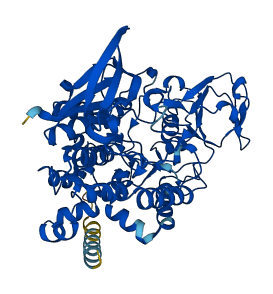
Descriptions
The autoinhibited protein was predicted that may have potential autoinhibitory elements via cis-regPred.
Autoinhibitory domains (AIDs)
Target domain |
|
Relief mechanism |
|
Assay |
cis-regPred |
Accessory elements
No accessory elements
Autoinhibited structure

Activated structure
1 structures for P49109
| Entry ID | Method | Resolution | Chain | Position | Source |
|---|---|---|---|---|---|
| AF-P49109-F1 | Predicted | AlphaFoldDB |
No variants for P49109
| Variant ID(s) | Position | Change | Description | Diseaes Association | Provenance |
|---|---|---|---|---|---|
| No variants for P49109 | |||||
No associated diseases with P49109
No regional properties for P49109
| Type | Name | Position | InterPro Accession |
|---|---|---|---|
| No domain, repeats, and functional sites for P49109 | |||
Functions
| Description | ||
|---|---|---|
| EC Number | 1.6.3.1 | With oxygen as acceptor |
| Subcellular Localization |
|
|
| PANTHER Family | ||
| PANTHER Subfamily | ||
| PANTHER Protein Class | ||
| PANTHER Pathway Category | No pathway information available | |
3 GO annotations of cellular component
| Name | Definition |
|---|---|
| cytosol | The part of the cytoplasm that does not contain organelles but which does contain other particulate matter, such as protein complexes. |
| endoplasmic reticulum membrane | The lipid bilayer surrounding the endoplasmic reticulum. |
| integral component of membrane | The component of a membrane consisting of the gene products and protein complexes having at least some part of their peptide sequence embedded in the hydrophobic region of the membrane. |
6 GO annotations of molecular function
| Name | Definition |
|---|---|
| aldehyde oxidase activity | Catalysis of the reaction: an aldehyde + H2O + O2 = a carboxylic acid + hydrogen peroxide. |
| flavin adenine dinucleotide binding | Binding to FAD, flavin-adenine dinucleotide, the coenzyme or the prosthetic group of various flavoprotein oxidoreductase enzymes, in either the oxidized form, FAD, or the reduced form, FADH2. |
| monooxygenase activity | Catalysis of the incorporation of one atom from molecular oxygen into a compound and the reduction of the other atom of oxygen to water. |
| N,N-dimethylaniline monooxygenase activity | Catalysis of the reaction: N,N-dimethylaniline + NADPH + H+ + O2 = N,N-dimethylaniline N-oxide + NADP+ + H2O. |
| NADP binding | Binding to nicotinamide-adenine dinucleotide phosphate, a coenzyme involved in many redox and biosynthetic reactions; binding may be to either the oxidized form, NADP+, or the reduced form, NADPH. |
| NADPH oxidase H202-forming activity | Catalysis of the reaction: NADPH + H+ + O2 = NADP + hydrogen peroxide (H2O2). |
4 GO annotations of biological process
| Name | Definition |
|---|---|
| lipid metabolic process | The chemical reactions and pathways involving lipids, compounds soluble in an organic solvent but not, or sparingly, in an aqueous solvent. Includes fatty acids; neutral fats, other fatty-acid esters, and soaps; long-chain (fatty) alcohols and waxes; sphingoids and other long-chain bases; glycolipids, phospholipids and sphingolipids; and carotenes, polyprenols, sterols, terpenes and other isoprenoids. |
| NADPH oxidation | A metabolic process that results in the oxidation of reduced nicotinamide adenine dinucleotide, NADPH, to the oxidized form, NADP. |
| regulation of cholesterol metabolic process | Any process that modulates the rate, frequency, or extent of cholesterol metabolism, the chemical reactions and pathways involving cholesterol, cholest-5-en-3 beta-ol, the principal sterol of vertebrates and the precursor of many steroids, including bile acids and steroid hormones. |
| xenobiotic metabolic process | The chemical reactions and pathways involving a xenobiotic compound, a compound foreign to the organim exposed to it. It may be synthesized by another organism (like ampicilin) or it can be a synthetic chemical. |
No homologous proteins in AiPD
| UniProt AC | Gene Name | Protein Name | Species | Evidence Code |
|---|---|---|---|---|
| No homologous proteins | ||||
| 10 | 20 | 30 | 40 | 50 | 60 |
| MTKKRIAVIG | GGVSGLSSIK | CCLEEGLEPV | CFERSADIGG | LWRFQENPEE | GRASIYKSVI |
| 70 | 80 | 90 | 100 | 110 | 120 |
| INTSKEMMCF | SDYPIPDHYP | NFMHNSHVLE | YFRMYAKEFG | LLKYIQFKTT | VCNVKKRPDF |
| 130 | 140 | 150 | 160 | 170 | 180 |
| STSGQWEVVT | EHEGKTKVDV | FDAVMVCTGH | HTNAHLPLES | FPGIEKFKGQ | YFHSRDYKNP |
| 190 | 200 | 210 | 220 | 230 | 240 |
| EAFTGKRVVI | IGIGNSGGDL | AVEISHTAKQ | VFLSTRRGSW | ILNRVGKHGY | PTDVLLSSRF |
| 250 | 260 | 270 | 280 | 290 | 300 |
| TYFLSKILGQ | SLSNAYVEKQ | MNERFDHEMF | GLKPKHRAMS | QHPTVNDDLP | NRIIAGMVKV |
| 310 | 320 | 330 | 340 | 350 | 360 |
| KGNVKEFTET | AAIFEDGSRE | DDIDAVIFAT | GYSFDFPFLE | DSVKVVKNKV | SLYKKVFPPN |
| 370 | 380 | 390 | 400 | 410 | 420 |
| LERPTLAIIG | LIQPLGAIMP | ISELQGRWAV | QVFKGLKTLP | SQSEMMAEIT | KAQEEIAKRY |
| 430 | 440 | 450 | 460 | 470 | 480 |
| VDSQRHTIQG | DYIQTMEEIA | EFVGVKPNLL | SLAFTDPKLA | LKLFFGPCTP | IHYRLQGPGK |
| 490 | 500 | 510 | 520 | 530 | |
| WHGARKAILT | TYDRIRKPLN | TRETEKSNSM | VSAVTTGCFM | LAVVFFAIIM | AYA |