P48565
Gene name |
RIM21 (PAL2, YNL294C, N0466) |
Protein name |
pH-response regulator protein palH/RIM21 |
Names |
Regulator of IME2 protein 21 |
Species |
Saccharomyces cerevisiae (strain ATCC 204508 / S288c) (Baker's yeast) |
KEGG Pathway |
sce:YNL294C |
EC number |
|
Protein Class |
|
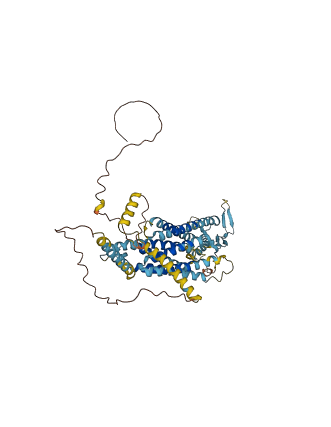
Descriptions
The autoinhibited protein was predicted that may have potential autoinhibitory elements via cis-regPred.
Autoinhibitory domains (AIDs)
Target domain |
|
Relief mechanism |
|
Assay |
cis-regPred |
Accessory elements
No accessory elements
Autoinhibited structure

Activated structure
1 structures for P48565
| Entry ID | Method | Resolution | Chain | Position | Source |
|---|---|---|---|---|---|
| AF-P48565-F1 | Predicted | AlphaFoldDB |
9 variants for P48565
| Variant ID(s) | Position | Change | Description | Diseaes Association | Provenance |
|---|---|---|---|---|---|
| s14-80156 | 35 | N>K | No | SGRP | |
| s14-80071 | 64 | S>T | No | SGRP | |
| s14-80010 | 84 | S>N | No | SGRP | |
| s14-79212 | 350 | P>L | No | SGRP | |
| s14-79101 | 387 | T>M | No | SGRP | |
| s14-79085 | 392 | E>D | No | SGRP | |
| s14-79050 | 404 | P>L | No | SGRP | |
| s14-79032 | 410 | V>E | No | SGRP | |
| s14-78684 | 526 | T>I | No | SGRP |
No associated diseases with P48565
No regional properties for P48565
| Type | Name | Position | InterPro Accession |
|---|---|---|---|
| No domain, repeats, and functional sites for P48565 | |||
3 GO annotations of cellular component
| Name | Definition |
|---|---|
| endoplasmic reticulum | The irregular network of unit membranes, visible only by electron microscopy, that occurs in the cytoplasm of many eukaryotic cells. The membranes form a complex meshwork of tubular channels, which are often expanded into slitlike cavities called cisternae. The ER takes two forms, rough (or granular), with ribosomes adhering to the outer surface, and smooth (with no ribosomes attached). |
| integral component of membrane | The component of a membrane consisting of the gene products and protein complexes having at least some part of their peptide sequence embedded in the hydrophobic region of the membrane. |
| plasma membrane | The membrane surrounding a cell that separates the cell from its external environment. It consists of a phospholipid bilayer and associated proteins. |
No GO annotations of molecular function
| Name | Definition |
|---|---|
| No GO annotations for molecular function |
8 GO annotations of biological process
| Name | Definition |
|---|---|
| ascospore formation | The process in which cells that are products of meiosis acquire the specialized features of ascospores. Ascospores are generally found in clusters of four or eight spores within a single mother cell, the ascus, and are characteristic of the ascomycete fungi (phylum Ascomycota). |
| cellular response to alkaline pH | Any process that results in a change in state or activity of a cell (in terms of movement, secretion, enzyme production, gene expression, etc.) as a result of a pH stimulus with pH > 7. pH is a measure of the acidity or basicity of an aqueous solution. |
| cellular response to pH | Any process that results in a change in state or activity of a cell (in terms of movement, secretion, enzyme production, gene expression, etc.) as a result of a pH stimulus. pH is a measure of the acidity or basicity of an aqueous solution. |
| fungal-type cell wall biogenesis | A cellular process that results in the biosynthesis of constituent macromolecules, assembly, and arrangement of constituent parts of a fungal-type cell wall. The fungal-type cell wall contains beta-glucan and may contain chitin. |
| invasive growth in response to glucose limitation | A growth pattern exhibited by budding haploid cells under certain growth conditions, in which cells retain the typical axial budding pattern of haploids, but become elongated and fail to separate after division; during growth on a solid substrate, this results in penetration of cells into the agar medium. An example of this process is found in Saccharomyces cerevisiae. |
| protein localization to plasma membrane | A process in which a protein is transported to, or maintained in, a specific location in the plasma membrane. |
| regulation of protein processing | Any process that modulates the frequency, rate or extent of protein processing, a protein maturation process achieved by the cleavage of a peptide bond or bonds within a protein. |
| regulation of vacuole organization | Any process that modulates the frequency, rate or extent of a process involved in the formation, arrangement of constituent parts, or disassembly of a vacuole. |
No homologous proteins in AiPD
| UniProt AC | Gene Name | Protein Name | Species | Evidence Code |
|---|---|---|---|---|
| No homologous proteins | ||||
| 10 | 20 | 30 | 40 | 50 | 60 |
| MNLWRHSPEE | LAAYNSCHPM | KLGSGVLIQL | PLYDNSAVYA | EDITFRSFCC | ERVPVYVSTV |
| 70 | 80 | 90 | 100 | 110 | 120 |
| LRNSSPYRYL | DEVINDWQKF | IQVSDYVGGS | AEYAIYAVIL | SITSNFVITV | FLTVICCINI |
| 130 | 140 | 150 | 160 | 170 | 180 |
| SGRAYKRILQ | LLRIASLLAS | LNLTIFITKV | LRRLEKEHNV | YGVVRAHSIM | HIFSDDMTFV |
| 190 | 200 | 210 | 220 | 230 | 240 |
| VLDFLATLMF | QFCQVGIVIR | LFQRAQEKRI | IFFIGVILTI | TANILWVIPP | FANHTTKHRN |
| 250 | 260 | 270 | 280 | 290 | 300 |
| DWQILRPFVY | LFRIAIATSY | ASIVIYHIWQ | KKKLWFKFNQ | MGLLTLLTIL | VVLLLPGFFL |
| 310 | 320 | 330 | 340 | 350 | 360 |
| ADVSNLWISE | LGEVFNTTCY | VTSTVITWEW | LDRLNVLERK | EEAQSILGRP | IFEEEQQDYR |
| 370 | 380 | 390 | 400 | 410 | 420 |
| FAKYALRVQN | ALTRRESQDA | STDRHDTSSN | SEVCDLQTIS | RYDPEDQISV | GRSIDRMHFN |
| 430 | 440 | 450 | 460 | 470 | 480 |
| DRGTYKDVAL | KKLGYARDKI | LYFTDQIVQK | SVGHNNSSSS | KNEKTKQRKA | MVRKRLGLDK |
| 490 | 500 | 510 | 520 | 530 | |
| PGIYIYSTKD | VVFNSDEDDD | ENAEDEDDDE | YEVGSEGNNN | SSATFTSDHI | GHI |