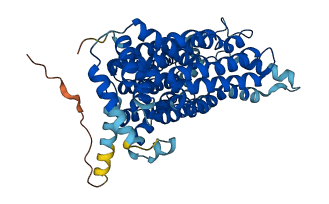
Descriptions
The autoinhibited protein was predicted that may have potential autoinhibitory elements via cis-regPred.
Autoinhibitory domains (AIDs)
Target domain |
|
Relief mechanism |
|
Assay |
cis-regPred |
Accessory elements
No accessory elements
Autoinhibited structure

Activated structure
1 structures for P47842
| Entry ID | Method | Resolution | Chain | Position | Source |
|---|---|---|---|---|---|
| AF-P47842-F1 | Predicted | AlphaFoldDB |
No variants for P47842
| Variant ID(s) | Position | Change | Description | Diseaes Association | Provenance |
|---|---|---|---|---|---|
| No variants for P47842 | |||||
No associated diseases with P47842
3 regional properties for P47842
| Type | Name | Position | InterPro Accession |
|---|---|---|---|
| conserved_site | Sugar transporter, conserved site | 126 - 151 | IPR005829-1 |
| conserved_site | Sugar transporter, conserved site | 322 - 338 | IPR005829-2 |
| domain | Major facilitator superfamily domain | 13 - 454 | IPR020846 |
Functions
5 GO annotations of cellular component
| Name | Definition |
|---|---|
| cell projection | A prolongation or process extending from a cell, e.g. a flagellum or axon. |
| integral component of membrane | The component of a membrane consisting of the gene products and protein complexes having at least some part of their peptide sequence embedded in the hydrophobic region of the membrane. |
| integral component of plasma membrane | The component of the plasma membrane consisting of the gene products and protein complexes having at least some part of their peptide sequence embedded in the hydrophobic region of the membrane. |
| membrane | A lipid bilayer along with all the proteins and protein complexes embedded in it an attached to it. |
| perikaryon | The portion of the cell soma (neuronal cell body) that excludes the nucleus. |
5 GO annotations of molecular function
| Name | Definition |
|---|---|
| D-glucose transmembrane transporter activity | Enables the transfer of the D-enantiomer of the hexose monosaccharide glucose from one side of a membrane to the other. |
| galactose transmembrane transporter activity | Enables the transfer of galactose from one side of a membrane to the other. D-galactose is widely distributed in combined form in plants, animals and microorganisms as a constituent of oligo- and polysaccharides; it also occurs in galactolipids and as its glucoside in lactose and melibiose. |
| glucose binding | Binding to D- or L-enantiomers of glucose. |
| glucose transmembrane transporter activity | Enables the transfer of the hexose monosaccharide glucose from one side of a membrane to the other. |
| hexose transmembrane transporter activity | Enables the transfer of a hexose sugar, a monosaccharide with 6 carbon atoms, from one side of a membrane to the other. |
5 GO annotations of biological process
| Name | Definition |
|---|---|
| dehydroascorbic acid transport | The directed movement of dehydroascorbate into, out of or within a cell, or between cells, by means of some agent such as a transporter or pore. Dehydroascorbate, 5-(1,2-dihydroxyethyl)furan-2,3,4(5H)-trione, is an oxidized form of vitamin C. |
| galactose transmembrane transport | The process in which galactose is transported across a lipid bilayer, from one side of a membrane to the other. D-galactose is widely distributed in combined form in plants, animals and microorganisms as a constituent of oligo- and polysaccharides; it also occurs in galactolipids and as its glucoside in lactose and melibiose. |
| glucose import | The directed movement of the hexose monosaccharide glucose into a cell or organelle. |
| glucose transmembrane transport | The process in which glucose is transported across a membrane. |
| monosaccharide transmembrane transport | The process in which a monosaccharide is transported across a lipid bilayer, from one side of a membrane to the other. Monosaccharides are the simplest carbohydrates; they are polyhydric alcohols containing either an aldehyde or a keto group and between three to ten or more carbon atoms. They form the constitutional repeating units of oligo- and polysaccharides. |
1 homologous proteins in AiPD
| UniProt AC | Gene Name | Protein Name | Species | Evidence Code |
|---|---|---|---|---|
| P58352 | SLC2A3 | Solute carrier family 2, facilitated glucose transporter member 3 | Bos taurus (Bovine) | PR |
| 10 | 20 | 30 | 40 | 50 | 60 |
| MGTQKVTVSL | IFALSIATIG | SFQFGYNTGV | INAPETIIKD | FLNYTLEEKS | ENLPTEVLLT |
| 70 | 80 | 90 | 100 | 110 | 120 |
| SLWSLSVAIF | SVGGMIGSFS | VGLFVNRFGR | RNSMLMVNLL | AVAGGCLMGF | CKIAQSVEML |
| 130 | 140 | 150 | 160 | 170 | 180 |
| ILGRLIIGLF | CGLCTGFVPM | YIGEISPTAL | RGAFGTLNQL | GIVIGILVAQ | IFGLKVIMGT |
| 190 | 200 | 210 | 220 | 230 | 240 |
| EELWPLLLGF | TIIPAVLQSA | ALPFCPESPR | FLLINRKEEE | NAKEILQRLW | GTQDVSQDIQ |
| 250 | 260 | 270 | 280 | 290 | 300 |
| EMKDESARMA | QEKQVTVLEL | FRSRSYRQPI | IISIMLQLSQ | QLSGINAVFY | YSTGIFKDAG |
| 310 | 320 | 330 | 340 | 350 | 360 |
| VEEPIYATIG | AGVVNTIFTV | VSLFLVERAG | RRTLHMIGLG | GMAVCSILMT | ISLLLKDNYN |
| 370 | 380 | 390 | 400 | 410 | 420 |
| WMSFVCIGAI | LVFVAFFEIG | PGPIPWFIVA | ELFSQGPRPA | AMAVAGCSNW | TSNFLVGLLF |
| 430 | 440 | 450 | 460 | 470 | 480 |
| PSAAFYLGAY | VFIIFTGFLI | VFLVFTFFKV | PETRGRTFEE | ITRAFEGQGQ | DANRAEKGPI |
| 490 | |||||
| VEMNSMQPVK | ETATV |