P47514
Gene name |
pdhC (MG272) |
Protein name |
Dihydrolipoyllysine-residue acetyltransferase component of pyruvate dehydrogenase complex |
Names |
Dihydrolipoamide acetyltransferase component of pyruvate dehydrogenase complex, E2 |
Species |
Mycoplasma genitalium (strain ATCC 33530 / DSM 19775 / NCTC 10195 / G37) (Mycoplasmoides genitalium) |
KEGG Pathway |
mge:MG_272 |
EC number |
2.3.1.12: Transferring groups other than amino-acyl groups |
Protein Class |
|
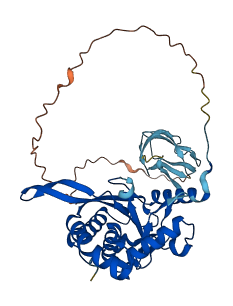
Descriptions
The autoinhibited protein was predicted that may have potential autoinhibitory elements via cis-regPred.
Autoinhibitory domains (AIDs)
Target domain |
|
Relief mechanism |
|
Assay |
cis-regPred |
Accessory elements
No accessory elements
Autoinhibited structure

Activated structure
1 structures for P47514
| Entry ID | Method | Resolution | Chain | Position | Source |
|---|---|---|---|---|---|
| AF-P47514-F1 | Predicted | AlphaFoldDB |
No variants for P47514
| Variant ID(s) | Position | Change | Description | Diseaes Association | Provenance |
|---|---|---|---|---|---|
| No variants for P47514 | |||||
No associated diseases with P47514
Functions
| Description | ||
|---|---|---|
| EC Number | 2.3.1.12 | Transferring groups other than amino-acyl groups |
| Subcellular Localization |
|
|
| PANTHER Family | ||
| PANTHER Subfamily | ||
| PANTHER Protein Class | ||
| PANTHER Pathway Category | No pathway information available | |
1 GO annotations of cellular component
| Name | Definition |
|---|---|
| cytoplasm | The contents of a cell excluding the plasma membrane and nucleus, but including other subcellular structures. |
3 GO annotations of molecular function
| Name | Definition |
|---|---|
| acetyltransferase activity | Catalysis of the transfer of an acetyl group to an acceptor molecule. |
| dihydrolipoyllysine-residue acetyltransferase activity | Catalysis of the reaction: acetyl-CoA + dihydrolipoamide = CoA + S-acetyldihydrolipoamide. |
| lipoic acid binding | Binding to lipoic acid, 1,2-dithiolane-3-pentanoic acid. |
1 GO annotations of biological process
| Name | Definition |
|---|---|
| glycolytic process | The chemical reactions and pathways resulting in the breakdown of a carbohydrate into pyruvate, with the concomitant production of a small amount of ATP and the reduction of NAD(P) to NAD(P)H. Glycolysis begins with the metabolism of a carbohydrate to generate products that can enter the pathway and ends with the production of pyruvate. Pyruvate may be converted to acetyl-coenzyme A, ethanol, lactate, or other small molecules. |
No homologous proteins in AiPD
| UniProt AC | Gene Name | Protein Name | Species | Evidence Code |
|---|---|---|---|---|
| No homologous proteins | ||||
| 10 | 20 | 30 | 40 | 50 | 60 |
| MANEFKFTDV | GEGLHEGKVT | EILKQVGDQI | KIDEALFVVE | TDKVTTELPS | PFAGTISAIN |
| 70 | 80 | 90 | 100 | 110 | 120 |
| VKVGDVVSIG | QVMAVIGEKT | STPLVEPKPQ | PTEEVAKVKE | AGASVVGEIK | VSDNLFPIFG |
| 130 | 140 | 150 | 160 | 170 | 180 |
| VKPHATPAVK | DTKVASSTNI | TVETTQKPES | KTEQKTIAIS | TMRKAIAEAM | TKSHAIIPTT |
| 190 | 200 | 210 | 220 | 230 | 240 |
| VLTFYVNATK | LKQYRESVNG | YALSKYSMKI | SYFAFFVKAI | VNALKKFPVF | NASYDPDQNE |
| 250 | 260 | 270 | 280 | 290 | 300 |
| IVLNDDINVG | IAVDTEEGLI | VPNIKQAQTK | SVVEIAQAIV | DLANKARTKK | IKLTDLNKGT |
| 310 | 320 | 330 | 340 | 350 | 360 |
| ISVTNFGSLG | AAVGTPIIKY | PEMCIVATGN | LEERIVKVEN | GIAVHTILPL | TIAADHRWVD |
| 370 | 380 | ||||
| GADVGRFGKE | IAKQIEELID | LTVA |