P47172
Gene name |
YJR141W (J2166) |
Protein name |
Uncharacterized protein YJR141W |
Names |
|
Species |
Saccharomyces cerevisiae (strain ATCC 204508 / S288c) (Baker's yeast) |
KEGG Pathway |
sce:YJR141W |
EC number |
|
Protein Class |
|
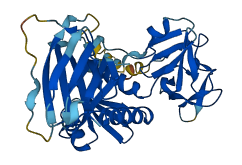
Descriptions
The autoinhibited protein was predicted that may have potential autoinhibitory elements via cis-regPred.
Autoinhibitory domains (AIDs)
Target domain |
|
Relief mechanism |
|
Assay |
cis-regPred |
Accessory elements
No accessory elements
Autoinhibited structure

Activated structure
1 structures for P47172
| Entry ID | Method | Resolution | Chain | Position | Source |
|---|---|---|---|---|---|
| AF-P47172-F1 | Predicted | AlphaFoldDB |
13 variants for P47172
| Variant ID(s) | Position | Change | Description | Diseaes Association | Provenance |
|---|---|---|---|---|---|
| s10-695977 | 26 | E>D | No | SGRP | |
| s10-695995 | 32 | D>E | No | SGRP | |
| s10-696074 | 59 | A>T | No | SGRP | |
| s10-696267 | 123 | N>T | No | SGRP | |
| s10-696287 | 130 | M>V | No | SGRP | |
| s10-696299 | 134 | F>V | No | SGRP | |
| s10-696359 | 154 | S>P | No | SGRP | |
| s10-696425 | 176 | F>L | No | SGRP | |
| s10-696455 | 186 | V>I | No | SGRP | |
| s10-696471 | 191 | E>G | No | SGRP | |
| s10-696494 | 199 | K>E | No | SGRP | |
| s10-696733 | 278 | N>K | No | SGRP | |
| s10-696860 | 321 | A>S | No | SGRP |
No associated diseases with P47172
No regional properties for P47172
| Type | Name | Position | InterPro Accession |
|---|---|---|---|
| No domain, repeats, and functional sites for P47172 | |||
3 GO annotations of cellular component
| Name | Definition |
|---|---|
| cytosol | The part of the cytoplasm that does not contain organelles but which does contain other particulate matter, such as protein complexes. |
| nucleus | A membrane-bounded organelle of eukaryotic cells in which chromosomes are housed and replicated. In most cells, the nucleus contains all of the cell's chromosomes except the organellar chromosomes, and is the site of RNA synthesis and processing. In some species, or in specialized cell types, RNA metabolism or DNA replication may be absent. |
| ubiquitin ligase complex | A protein complex that includes a ubiquitin-protein ligase and enables ubiquitin protein ligase activity. The complex also contains other proteins that may confer substrate specificity on the complex. |
3 GO annotations of molecular function
| Name | Definition |
|---|---|
| cyclin binding | Binding to cyclins, proteins whose levels in a cell varies markedly during the cell cycle, rising steadily until mitosis, then falling abruptly to zero. As cyclins reach a threshold level, they are thought to drive cells into G2 phase and thus to mitosis. |
| ubiquitin conjugating enzyme binding | Binding to a ubiquitin conjugating enzyme, any of the E2 proteins. |
| ubiquitin protein ligase activity | Catalysis of the transfer of ubiquitin to a substrate protein via the reaction X-ubiquitin + S -> X + S-ubiquitin, where X is either an E2 or E3 enzyme, the X-ubiquitin linkage is a thioester bond, and the S-ubiquitin linkage is an amide bond: an isopeptide bond between the C-terminal glycine of ubiquitin and the epsilon-amino group of lysine residues in the substrate or, in the linear extension of ubiquitin chains, a peptide bond the between the C-terminal glycine and N-terminal methionine of ubiquitin residues. |
8 GO annotations of biological process
| Name | Definition |
|---|---|
| mRNA polyadenylation | The enzymatic addition of a sequence of 40-200 adenylyl residues at the 3' end of a eukaryotic mRNA primary transcript. |
| negative regulation of protein ubiquitination | Any process that stops, prevents, or reduces the frequency, rate or extent of the addition of ubiquitin groups to a protein. |
| positive regulation of mRNA 3'-end processing | Any process that activates or increases the frequency, rate or extent of mRNA 3'-end processing. |
| pre-mRNA cleavage required for polyadenylation | The targeted, endonucleolytic cleavage of a pre-mRNA, required for polyadenylation of the 3' end. This cleavage is directed by binding sites near the 3' end of the mRNA and leaves a 3' hydoxyl end which then becomes a target for adenylation. |
| proteasome-mediated ubiquitin-dependent protein catabolic process | The chemical reactions and pathways resulting in the breakdown of a protein or peptide by hydrolysis of its peptide bonds, initiated by the covalent attachment of ubiquitin, and mediated by the proteasome. |
| protein autoubiquitination | The ubiquitination by a protein of one or more of its own amino acid residues, or residues on an identical protein. Ubiquitination occurs on the lysine residue by formation of an isopeptide crosslink. |
| protein monoubiquitination | Addition of a single ubiquitin group to a protein. |
| protein polyubiquitination | Addition of multiple ubiquitin groups to a protein, forming a ubiquitin chain. |
1 homologous proteins in AiPD
| UniProt AC | Gene Name | Protein Name | Species | Evidence Code |
|---|---|---|---|---|
| Q7Z6J8 | UBE3D | E3 ubiquitin-protein ligase E3D | Homo sapiens (Human) | PR |
| 10 | 20 | 30 | 40 | 50 | 60 |
| MVQYVVEWLP | RIQSISVVVE | GWKQVEIKNL | KDTLMSISGD | EEQVEDILLP | VEVEEKVDAS |
| 70 | 80 | 90 | 100 | 110 | 120 |
| YKFKNRGKDL | EWMTKLRSKS | SKIYDSSIMS | LPDGRWTKEE | LRSDSDFSIE | CLNCKQKIIS |
| 130 | 140 | 150 | 160 | 170 | 180 |
| KDNCQVLNDM | PSEFWFELMD | YWHCHKPDVK | EDKSSYTRFE | TLKPSKNEIL | IGSSYFQGTP |
| 190 | 200 | 210 | 220 | 230 | 240 |
| ATFENVATTK | ENDNVLCIKC | SAVLGQVTAG | SLYKLHKWKL | QLIRSGNTYK | FPPECDITIS |
| 250 | 260 | 270 | 280 | 290 | 300 |
| LINVVKANSC | RYVLVKCKTE | SLLVWIFSVD | IGVTLTGNKS | FKRAMKLLYT | NSVTTINRCL |
| 310 | 320 | 330 | 340 | ||
| NRQVVEELDF | QETSFNAFYS | ALQHTNALLP | SSMKKIGEWT | ISYTSLI |