P46963
Gene name |
CTK3 (YML112W, YM8339.07) |
Protein name |
CTD kinase subunit gamma |
Names |
CTDK-I gamma subunit, CTD kinase 32 kDa subunit, CTD kinase subunit 3 |
Species |
Saccharomyces cerevisiae (strain ATCC 204508 / S288c) (Baker's yeast) |
KEGG Pathway |
sce:YML112W |
EC number |
|
Protein Class |
|
Descriptions
The autoinhibited protein was predicted that may have potential autoinhibitory elements via cis-regPred.
Autoinhibitory domains (AIDs)
Target domain |
|
Relief mechanism |
|
Assay |
cis-regPred |
Accessory elements
No accessory elements
Autoinhibited structure

Activated structure
2 structures for P46963
| Entry ID | Method | Resolution | Chain | Position | Source |
|---|---|---|---|---|---|
| 7JV7 | X-ray | 185 A | C | 1-296 | PDB |
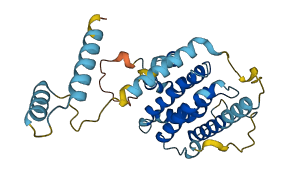
| AF-P46963-F1 | Predicted | AlphaFoldDB |
7 variants for P46963
| Variant ID(s) | Position | Change | Description | Diseaes Association | Provenance |
|---|---|---|---|---|---|
| s13-45165 | 35 | T>P | No | SGRP | |
| s13-45322 | 87 | R>I | No | SGRP | |
| s13-45369 | 103 | T>A | No | SGRP | |
| s13-45445 | 128 | K>T | No | SGRP | |
| s13-45706 | 215 | P>R | No | SGRP | |
| s13-45801 | 247 | Y>H | No | SGRP | |
| s13-45947 | 295 | I>M | No | SGRP |
No associated diseases with P46963
1 regional properties for P46963
| Type | Name | Position | InterPro Accession |
|---|---|---|---|
| domain | CTD kinase subunit gamma Ctk3, C-terminal | 226 - 289 | IPR024637 |
5 GO annotations of cellular component
| Name | Definition |
|---|---|
| carboxy-terminal domain protein kinase complex | A protein complex that phosphorylates amino acid residues of RNA polymerase II C-terminal domain repeats; phosphorylation occurs mainly on Ser2 and Ser5. |
| CTDK-1 complex | A positive transcription elongation factor complex that comprises the CDK kinase CTK1 (in budding yeast), Lsk1 (in fission yeast) (corresponding to the Panther PTHR24056:SF39 family), a cyclin and an additional gamma subunit (corresponding to the InterPRO entry IPR024638). |
| cytoplasm | The contents of a cell excluding the plasma membrane and nucleus, but including other subcellular structures. |
| nucleolus | A small, dense body one or more of which are present in the nucleus of eukaryotic cells. It is rich in RNA and protein, is not bounded by a limiting membrane, and is not seen during mitosis. Its prime function is the transcription of the nucleolar DNA into 45S ribosomal-precursor RNA, the processing of this RNA into 5.8S, 18S, and 28S components of ribosomal RNA, and the association of these components with 5S RNA and proteins synthesized outside the nucleolus. This association results in the formation of ribonucleoprotein precursors; these pass into the cytoplasm and mature into the 40S and 60S subunits of the ribosome. |
| nucleoplasm | That part of the nuclear content other than the chromosomes or the nucleolus. |
No GO annotations of molecular function
| Name | Definition |
|---|---|
| No GO annotations for molecular function |
7 GO annotations of biological process
| Name | Definition |
|---|---|
| cellular response to DNA damage stimulus | Any process that results in a change in state or activity of a cell (in terms of movement, secretion, enzyme production, gene expression, etc.) as a result of a stimulus indicating damage to its DNA from environmental insults or errors during metabolism. |
| mRNA 3'-end processing | Any process involved in forming the mature 3' end of an mRNA molecule. |
| phosphorylation of RNA polymerase II C-terminal domain | The process of introducing a phosphate group on to an amino acid residue in the C-terminal domain of RNA polymerase II. Typically, this occurs during the transcription cycle and results in production of an RNA polymerase II enzyme where the carboxy-terminal domain (CTD) of the largest subunit is extensively phosphorylated, often referred to as hyperphosphorylated or the II(0) form. Specific types of phosphorylation within the CTD are usually associated with specific regions of genes, though there are exceptions. The phosphorylation state regulates the association of specific complexes such as the capping enzyme or 3'-RNA processing machinery to the elongating RNA polymerase complex. |
| positive regulation of DNA-templated transcription, elongation | Any process that activates or increases the frequency, rate or extent of transcription elongation, the extension of an RNA molecule after transcription initiation and promoter clearance by the addition of ribonucleotides catalyzed by a DNA-dependent RNA polymerase. |
| positive regulation of transcription by RNA polymerase I | Any process that activates or increases the frequency, rate or extent of transcription mediated by RNA polymerase I. |
| positive regulation of transcription by RNA polymerase II | Any process that activates or increases the frequency, rate or extent of transcription from an RNA polymerase II promoter. |
| positive regulation of translational fidelity | Any process that increases the ability of the translational apparatus to interpret the genetic code. |
No homologous proteins in AiPD
| UniProt AC | Gene Name | Protein Name | Species | Evidence Code |
|---|---|---|---|---|
| No homologous proteins | ||||
| 10 | 20 | 30 | 40 | 50 | 60 |
| MDSLEARLQF | IQVLKNLQKT | LHKTRDSITS | SSTTTPPSSQ | QKLNNDPIQF | YLRNYRHHYE |
| 70 | 80 | 90 | 100 | 110 | 120 |
| DFHQCLFDTT | MKMDPLDRLD | VVIYYVRIIR | NLYPHSHSNT | NVTKVLNEVL | LMDIDLVFEL |
| 130 | 140 | 150 | 160 | 170 | 180 |
| CLPCQDWKSL | TNQATCKELF | LDLSKLIHYD | ATSVTHTPSD | TTLIDATTWY | SVKTERTTKD |
| 190 | 200 | 210 | 220 | 230 | 240 |
| YKESLQRTES | LLKDRDLKKL | AFFQQFNSDT | TAINPDLQTQ | PTNANILLHR | MEADRELHKR |
| 250 | 260 | 270 | 280 | 290 | |
| SKETSWYIER | PSNDILDESE | FKSLWTHFET | TDSGFDKDDY | KNIKALNDIA | KASYIY |