P46598
Gene name |
HSP90 (CAALFM_C702030WA, CaJ7.0234, CaO19.13868, CaO19.6515) |
Protein name |
Heat shock protein 90 homolog |
Names |
|
Species |
Candida albicans (strain SC5314 / ATCC MYA-2876) (Yeast) |
KEGG Pathway |
cal:CAALFM_C702030WA |
EC number |
|
Protein Class |
|
Descriptions
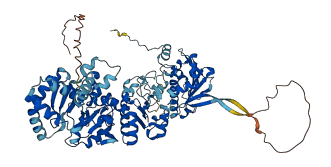
The autoinhibited protein was predicted that may have potential autoinhibitory elements via cis-regPred.
Autoinhibitory domains (AIDs)
Target domain |
|
Relief mechanism |
|
Assay |
cis-regPred |
Accessory elements
No accessory elements
Autoinhibited structure

Activated structure
No variants for P46598
| Variant ID(s) | Position | Change | Description | Diseaes Association | Provenance |
|---|---|---|---|---|---|
| No variants for P46598 | |||||
No associated diseases with P46598
11 GO annotations of cellular component
| Name | Definition |
|---|---|
| cell surface | The external part of the cell wall and/or plasma membrane. |
| cytoplasm | The contents of a cell excluding the plasma membrane and nucleus, but including other subcellular structures. |
| cytosol | The part of the cytoplasm that does not contain organelles but which does contain other particulate matter, such as protein complexes. |
| extracellular vesicle | Any vesicle that is part of the extracellular region. |
| fungal-type cell wall | A rigid yet dynamic structure surrounding the plasma membrane that affords protection from stresses and contributes to cell morphogenesis, consisting of extensively cross-linked glycoproteins and carbohydrates. The glycoproteins may be modified with N- or O-linked carbohydrates, or glycosylphosphatidylinositol (GPI) anchors; the polysaccharides are primarily branched glucans, including beta-linked and alpha-linked glucans, and may also include chitin and other carbohydrate polymers, but not cellulose or pectin. Enzymes involved in cell wall biosynthesis are also found in the cell wall. Note that some forms of fungi develop a capsule outside of the cell wall under certain circumstances; this is considered a separate structure. |
| hyphal cell wall | The cell wall surrounding a fungal hypha. |
| membrane | A lipid bilayer along with all the proteins and protein complexes embedded in it an attached to it. |
| perinuclear region of cytoplasm | Cytoplasm situated near, or occurring around, the nucleus. |
| plasma membrane | The membrane surrounding a cell that separates the cell from its external environment. It consists of a phospholipid bilayer and associated proteins. |
| protein aggregate center | Reversible aggregate of misfolded proteins and chaperones formed to shield thermosensitive proteins from degradation until conditions allow disaggregation and refolding. |
| protein-containing complex | A stable assembly of two or more macromolecules, i.e. proteins, nucleic acids, carbohydrates or lipids, in which at least one component is a protein and the constituent parts function together. |
4 GO annotations of molecular function
| Name | Definition |
|---|---|
| ATP binding | Binding to ATP, adenosine 5'-triphosphate, a universally important coenzyme and enzyme regulator. |
| ATP hydrolysis activity | Catalysis of the reaction: ATP + H2O = ADP + H+ phosphate. ATP hydrolysis is used in some reactions as an energy source, for example to catalyze a reaction or drive transport against a concentration gradient. |
| ATP-dependent protein folding chaperone | Binding to a protein or a protein-containing complex to assist the protein folding process, driven by ATP hydrolysis. |
| unfolded protein binding | Binding to an unfolded protein. |
11 GO annotations of biological process
| Name | Definition |
|---|---|
| adenylate cyclase-activating glucose-activated G protein-coupled receptor signaling pathway | An adenylate cyclase-activating G protein-coupled receptor signaling pathway initiated by glucose binding to its receptor on the surface of the target cell, and ending with the regulation of a downstream cellular process. |
| cellular response to heat | Any process that results in a change in state or activity of a cell (in terms of movement, secretion, enzyme production, gene expression, etc.) as a result of a heat stimulus, a temperature stimulus above the optimal temperature for that organism. |
| chaperone-mediated protein folding | The process of inhibiting aggregation and assisting in the covalent and noncovalent assembly of single chain polypeptides or multisubunit complexes into the correct tertiary structure that is dependent on interaction with a chaperone. |
| filamentous growth | The process in which a multicellular organism, a unicellular organism or a group of unicellular organisms grow in a threadlike, filamentous shape. |
| filamentous growth of a population of unicellular organisms | The process in which a group of unicellular organisms grow in a threadlike, filamentous shape. |
| heterochromatin assembly by small RNA | A heterochromatin formation-based gene silencing process mediated by a small RNA molecule that occur before the beginnning of trancription. |
| intracellular steroid hormone receptor signaling pathway | The series of molecular signals initiated by a steroid binding to an intracellular steroid hormone receptor. |
| negative regulation of filamentous growth of a population of unicellular organisms | Any process that stops, prevents or reduces the frequency, rate or extent of filamentous growth of a population of unicellular organisms. |
| protein folding | The process of assisting in the covalent and noncovalent assembly of single chain polypeptides or multisubunit complexes into the correct tertiary structure. |
| protein stabilization | Any process involved in maintaining the structure and integrity of a protein and preventing it from degradation or aggregation. |
| regulation of apoptotic process | Any process that modulates the occurrence or rate of cell death by apoptotic process. |
No homologous proteins in AiPD
| UniProt AC | Gene Name | Protein Name | Species | Evidence Code |
|---|---|---|---|---|
| No homologous proteins | ||||
| 10 | 20 | 30 | 40 | 50 | 60 |
| MADAKVETHE | FTAEISQLMS | LIINTVYSNK | EIFLRELISN | ASDALDKIRY | QALSDPSQLE |
| 70 | 80 | 90 | 100 | 110 | 120 |
| SEPELFIRII | PQKDQKVLEI | RDSGIGMTKA | DLVNNLGTIA | KSGTKSFMEA | LSAGADVSMI |
| 130 | 140 | 150 | 160 | 170 | 180 |
| GQFGVGFYSL | FLVADHVQVI | SKHNDDEQYV | WESNAGGKFT | VTLDETNERL | GRGTMLRLFL |
| 190 | 200 | 210 | 220 | 230 | 240 |
| KEDQLEYLEE | KRIKEVVKKH | SEFVAYPIQL | VVTKEVEKEV | PETEEEDKAA | EEDDKKPKLE |
| 250 | 260 | 270 | 280 | 290 | 300 |
| EVKDEEDEKK | EKKTKTVKEE | VTETEELNKT | KPLWTRNPSD | ITQDEYNAFY | KSISNDWEDP |
| 310 | 320 | 330 | 340 | 350 | 360 |
| LAVKHFSVEG | QLEFRAILFV | PKRAPFDAFE | SKKKKNNIKL | YVRRVFITDD | AEELIPEWLS |
| 370 | 380 | 390 | 400 | 410 | 420 |
| FIKGVVDSED | LPLNLSREML | QQNKILKVIR | KNIVKKMIET | FNEISEDQEQ | FNQFYTAFSK |
| 430 | 440 | 450 | 460 | 470 | 480 |
| NIKLGIHEDA | QNRQSLAKLL | RFYSTKSSEE | MTSLSDYVTR | MPEHQKNIYY | ITGESIKAVE |
| 490 | 500 | 510 | 520 | 530 | 540 |
| KSPFLDALKA | KNFEVLFMVD | PIDEYAMTQL | KEFEDKKLVD | ITKDFELEES | DEEKAAREKE |
| 550 | 560 | 570 | 580 | 590 | 600 |
| IKEYEPLTKA | LKDILGDQVE | KVVVSYKLVD | APAAIRTGQF | GWSANMERIM | KAQALRDTTM |
| 610 | 620 | 630 | 640 | 650 | 660 |
| SSYMSSKKTF | EISPSSPIIK | ELKKKVETDG | AEDKTVKDLT | TLLFDTALLT | SGFTLDEPSN |
| 670 | 680 | 690 | 700 | ||
| FAHRINRLIA | LGLNIDDDSE | ETAVEPEATT | TASTDEPAGE | SAMEEVD |