P46592
Gene name |
MNT2 (CAALFM_C301830CA, CaO19.1663, CaO19.9232) |
Protein name |
Glycolipid 2-alpha-mannosyltransferase 2 |
Names |
Alpha-1,2-mannosyltransferase 2 |
Species |
Candida albicans (strain SC5314 / ATCC MYA-2876) (Yeast) |
KEGG Pathway |
cal:CAALFM_C301830CA |
EC number |
|
Protein Class |
|
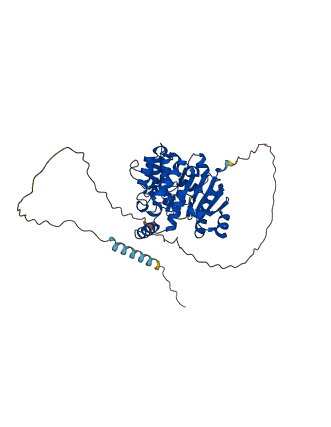
Descriptions
The autoinhibited protein was predicted that may have potential autoinhibitory elements via cis-regPred.
Autoinhibitory domains (AIDs)
Target domain |
|
Relief mechanism |
|
Assay |
cis-regPred |
Accessory elements
No accessory elements
Autoinhibited structure

Activated structure
1 structures for P46592
| Entry ID | Method | Resolution | Chain | Position | Source |
|---|---|---|---|---|---|
| AF-P46592-F1 | Predicted | AlphaFoldDB |
No variants for P46592
| Variant ID(s) | Position | Change | Description | Diseaes Association | Provenance |
|---|---|---|---|---|---|
| No variants for P46592 | |||||
No associated diseases with P46592
9 regional properties for P46592
| Type | Name | Position | InterPro Accession |
|---|---|---|---|
| domain | RNA recognition motif domain | 41 - 116 | IPR000504-1 |
| domain | RNA recognition motif domain | 117 - 195 | IPR000504-2 |
| domain | RNA recognition motif domain | 210 - 289 | IPR000504-3 |
| domain | RNA recognition motif domain | 313 - 385 | IPR000504-4 |
| domain | LSM-interacting domain | 425 - 443 | IPR008669 |
| domain | Occluded RNA-recognition motif | 312 - 392 | IPR031766 |
| domain | Prp24, RNA recognition motif1 | 41 - 113 | IPR034397 |
| domain | Prp24, RNA recognition motif2 | 117 - 195 | IPR034398 |
| domain | Prp24, RNA recognition motif 3 | 210 - 286 | IPR034540 |
3 GO annotations of cellular component
| Name | Definition |
|---|---|
| Golgi apparatus | A membrane-bound cytoplasmic organelle of the endomembrane system that further processes the core oligosaccharides (e.g. N-glycans) added to proteins in the endoplasmic reticulum and packages them into membrane-bound vesicles. The Golgi apparatus operates at the intersection of the secretory, lysosomal, and endocytic pathways. |
| Golgi membrane | The lipid bilayer surrounding any of the compartments of the Golgi apparatus. |
| integral component of membrane | The component of a membrane consisting of the gene products and protein complexes having at least some part of their peptide sequence embedded in the hydrophobic region of the membrane. |
1 GO annotations of molecular function
| Name | Definition |
|---|---|
| alpha-1,2-mannosyltransferase activity | Catalysis of the transfer of a mannose residue to an oligosaccharide, forming an alpha-(1->2) linkage. |
9 GO annotations of biological process
| Name | Definition |
|---|---|
| cell adhesion involved in multi-species biofilm formation | The attachment of a cell to a solid substrate, via cell adhesion molecules, contributing to the formation of a biofilm composed of microorganisms of different species. |
| cell wall mannoprotein biosynthetic process | The chemical reactions and pathways resulting in the formation of cell wall mannoproteins, any cell wall protein that contains covalently bound mannose residues. |
| cell-cell adhesion | The attachment of one cell to another cell via adhesion molecules. |
| cell-matrix adhesion | The binding of a cell to the extracellular matrix via adhesion molecules. |
| mannoprotein biosynthetic process | The chemical reactions and pathways resulting in the formation of a mannoprotein, a protein that contains covalently bound mannose residues. |
| mannosylation | The covalent attachment of a mannose residue to a substrate molecule. |
| mitigation of host defenses by symbiont | A process by which an organism avoids or tolerates the effects of its host organism's defense response. The host defense response is mounted by the host in response to the presence of the organism. The host is defined as the larger of the organisms involved in a symbiotic interaction. |
| protein N-linked glycosylation | A protein glycosylation process in which a carbohydrate or carbohydrate derivative unit is added to a protein via the N4 atom of peptidyl-asparagine, the omega-N of arginine, or the N1' atom peptidyl-tryptophan. |
| protein O-linked glycosylation | A protein glycosylation process in which a carbohydrate or carbohydrate derivative unit is added to a protein via the hydroxyl group of peptidyl-serine, peptidyl-threonine, peptidyl-hydroxylysine, or peptidyl-hydroxyproline, or via the phenol group of peptidyl-tyrosine, forming an O-glycan. |
No homologous proteins in AiPD
| UniProt AC | Gene Name | Protein Name | Species | Evidence Code |
|---|---|---|---|---|
| No homologous proteins | ||||
| 10 | 20 | 30 | 40 | 50 | 60 |
| MKPSIFYSSR | QPYLKYLAII | LTTITIYVLT | HSSYSADPNI | NDVTTKPISE | TVPQPPPQSP |
| 70 | 80 | 90 | 100 | 110 | 120 |
| SSPEQQQQQP | ANQDQIVKVP | EELKNKPQDL | VVDNNKDQKP | AVSGVPKSSS | SSPQQQEKQD |
| 130 | 140 | 150 | 160 | 170 | 180 |
| TKKESENSSS | SKDPVKPEKV | KATFVTLARN | SELYDLIKSI | RNVEDRFNRK | FNYDWVFLND |
| 190 | 200 | 210 | 220 | 230 | 240 |
| DDFTQEFKDL | TTALVSGKTK | YGKIPKEHWS | YPDWIDLKRA | EETRKNMKLQ | KIIYGDSESY |
| 250 | 260 | 270 | 280 | 290 | 300 |
| RHMCRFESGF | FWRHPLLDDY | DWYWRVEPSI | DIHCDLNYDL | FKYMEDNNKV | YGFTISIHEF |
| 310 | 320 | 330 | 340 | 350 | 360 |
| RATIPTLWDT | TKKFIKENPQ | YLAENNFMDF | ISDDKGETYN | LCHFWSNFEI | ANLNFWRGEA |
| 370 | 380 | 390 | 400 | 410 | 420 |
| YRKYFDYLDQ | TGGFFYERWG | DAPIHSIAAA | LFLPKDKIHY | FDDVGYKHSV | YTQCPLNPQF |
| 430 | 440 | 450 | 460 | ||
| RYEHKCHCNP | DNDFTFRGYS | CGKKYFEKMG | LQKPKEWEKY | Q |