P46510
Gene name |
|
Protein name |
Carbonic anhydrase |
Names |
Carbonate dehydratase |
Species |
Flaveria bidentis (Coastal plain yellowtops) (Ethulia bidentis) |
KEGG Pathway |
|
EC number |
4.2.1.1: Hydro-lyases |
Protein Class |
|
Descriptions
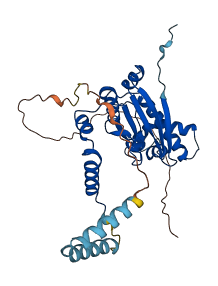
The autoinhibited protein was predicted that may have potential autoinhibitory elements via cis-regPred.
Autoinhibitory domains (AIDs)
Target domain |
|
Relief mechanism |
|
Assay |
cis-regPred |
Accessory elements
No accessory elements
Autoinhibited structure

Activated structure
1 structures for P46510
| Entry ID | Method | Resolution | Chain | Position | Source |
|---|---|---|---|---|---|
| AF-P46510-F1 | Predicted | AlphaFoldDB |
No variants for P46510
| Variant ID(s) | Position | Change | Description | Diseaes Association | Provenance |
|---|---|---|---|---|---|
| No variants for P46510 | |||||
No associated diseases with P46510
2 regional properties for P46510
| Type | Name | Position | InterPro Accession |
|---|---|---|---|
| conserved_site | Carbonic anhydrase, prokaryotic-like, conserved site | 161 - 168 | IPR015892-1 |
| conserved_site | Carbonic anhydrase, prokaryotic-like, conserved site | 205 - 225 | IPR015892-2 |
Functions
| Description | ||
|---|---|---|
| EC Number | 4.2.1.1 | Hydro-lyases |
| Subcellular Localization |
|
|
| PANTHER Family | ||
| PANTHER Subfamily | ||
| PANTHER Protein Class | ||
| PANTHER Pathway Category | No pathway information available | |
1 GO annotations of cellular component
| Name | Definition |
|---|---|
| cytoplasm | The contents of a cell excluding the plasma membrane and nucleus, but including other subcellular structures. |
2 GO annotations of molecular function
| Name | Definition |
|---|---|
| carbonate dehydratase activity | Catalysis of the reaction: H2CO3 = CO2 + H2O. |
| zinc ion binding | Binding to a zinc ion (Zn). |
1 GO annotations of biological process
| Name | Definition |
|---|---|
| carbon utilization | A series of processes that forms an integrated mechanism by which a cell or an organism detects the depletion of primary carbon sources and then activates genes to scavenge the last traces of the primary carbon source and to transport and metabolize alternative carbon sources such as carbon dioxide or carbonic acid. The utilization process begins when the cell or organism detects carbon levels, includes the activation of genes whose products detect, transport or metabolize carbon-containing substances, and ends when carbon is incorporated into the cell or organism's metabolism. |
No homologous proteins in AiPD
| UniProt AC | Gene Name | Protein Name | Species | Evidence Code |
|---|---|---|---|---|
| No homologous proteins | ||||
| 10 | 20 | 30 | 40 | 50 | 60 |
| MSAASAFAMN | APSFVNASSL | KKASTSARSG | VLSARFTCNS | SSSSSSSATP | PSLIRNEPVF |
| 70 | 80 | 90 | 100 | 110 | 120 |
| AAPAPIITPN | WTEDGNESYE | EAIDALKKTL | IEKGELEPVA | ATRIDQITAQ | AAAPDTKAPF |
| 130 | 140 | 150 | 160 | 170 | 180 |
| DPVERIKSGF | VKFKTEKFVT | NPALYDELAK | GQSPKFMVFA | CSDSRVCPSH | VLDFQPGEAF |
| 190 | 200 | 210 | 220 | 230 | 240 |
| VVRNVANMVP | PFDKTKYSGV | GAAVEYAVLH | LKVQEIFVIG | HSRCGGIKGL | MTFPDEGPHS |
| 250 | 260 | 270 | 280 | 290 | 300 |
| TDFIEDWVKV | CLPAKSKVVA | EHNGTHLDDQ | CVLCEKEAVN | VSLGNLLTYP | FVRDGLRNKT |
| 310 | 320 | ||||
| LALKGGHYDF | VNGTFELWAL | DFGLSSPTSV |