P46250
Gene name |
SEC14 (CAALFM_C500480CA, CaO19.8556, CaO19.941) |
Protein name |
SEC14 cytosolic factor |
Names |
Phosphatidylinositol/phosphatidylcholine transfer protein, PI/PC TP |
Species |
Candida albicans (strain SC5314 / ATCC MYA-2876) (Yeast) |
KEGG Pathway |
cal:CAALFM_C500480CA |
EC number |
|
Protein Class |
|
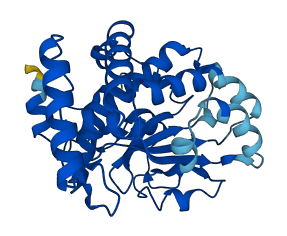
Descriptions
The autoinhibited protein was predicted that may have potential autoinhibitory elements via cis-regPred.
Autoinhibitory domains (AIDs)
Target domain |
|
Relief mechanism |
|
Assay |
cis-regPred |
Accessory elements
No accessory elements
Autoinhibited structure

Activated structure
1 structures for P46250
| Entry ID | Method | Resolution | Chain | Position | Source |
|---|---|---|---|---|---|
| AF-P46250-F1 | Predicted | AlphaFoldDB |
No variants for P46250
| Variant ID(s) | Position | Change | Description | Diseaes Association | Provenance |
|---|---|---|---|---|---|
| No variants for P46250 | |||||
No associated diseases with P46250
7 GO annotations of cellular component
| Name | Definition |
|---|---|
| cell division site | The eventual plane of cell division (also known as cell cleavage or cytokinesis) in a dividing cell. In Eukaryotes, the cleavage apparatus, composed of septin structures and the actomyosin contractile ring, forms along this plane, and the mitotic, or meiotic, spindle is aligned perpendicular to the division plane. In bacteria, the cell division site is generally located at mid-cell and is the site at which the cytoskeletal structure, the Z-ring, assembles. |
| cell tip | The region at the end of the longest axis of a cylindrical or elongated cell. |
| cytosol | The part of the cytoplasm that does not contain organelles but which does contain other particulate matter, such as protein complexes. |
| Golgi apparatus | A membrane-bound cytoplasmic organelle of the endomembrane system that further processes the core oligosaccharides (e.g. N-glycans) added to proteins in the endoplasmic reticulum and packages them into membrane-bound vesicles. The Golgi apparatus operates at the intersection of the secretory, lysosomal, and endocytic pathways. |
| Golgi membrane | The lipid bilayer surrounding any of the compartments of the Golgi apparatus. |
| nucleus | A membrane-bounded organelle of eukaryotic cells in which chromosomes are housed and replicated. In most cells, the nucleus contains all of the cell's chromosomes except the organellar chromosomes, and is the site of RNA synthesis and processing. In some species, or in specialized cell types, RNA metabolism or DNA replication may be absent. |
| prospore membrane | The prospore membrane is a double-membraned structure that extends from the cytoplasmic face of the spindle pole bodies to encompass the spindle pole bodies and the four nuclear lobes that are formed during meiosis. It helps isolate the meiotic nuclei from the cytoplasm during spore formation and serves as a foundation for the formation of the spore walls. An example of this component is found in Schizosaccharomyces pombe. |
2 GO annotations of molecular function
| Name | Definition |
|---|---|
| phosphatidylcholine transporter activity | Enables the directed movement of phosphatidylcholine into, out of or within a cell, or between cells. Phosphatidylcholine refers to a class of glycerophospholipids in which the phosphatidyl group is esterified to the hydroxyl group of choline. |
| phosphatidylinositol transfer activity | Removes phosphatidylinositol from a membrane or a monolayer lipid particle, transports it through the aqueous phase while protected in a hydrophobic pocket, and brings it to an acceptor membrane or lipid particle. |
9 GO annotations of biological process
| Name | Definition |
|---|---|
| ascospore-type prospore-specific spindle pole body remodeling | A spindle pole body (SPB) organization process that takes place during the second meiotic division during ascospore formation and results in the structural reorganization of the SPB; includes the recruitment of sporulation-specific proteins to the outer plaque to form the meiotic outer plaque (MOP). |
| CDP-choline pathway | The phosphatidylcholine biosynthetic process that begins with the phosphorylation of choline and ends with the combination of CDP-choline with diacylglycerol to form phosphatidylcholine. |
| Golgi to plasma membrane protein transport | The directed movement of proteins from the Golgi to the plasma membrane in transport vesicles that move from the trans-Golgi network to the plasma membrane. |
| Golgi to vacuole transport | The directed movement of substances from the Golgi to the vacuole. |
| Golgi vesicle budding | The evagination of the Golgi membrane, resulting in formation of a vesicle. |
| negative regulation of phosphatidylcholine biosynthetic process | Any process that stops, prevents or reduces the frequency, rate or extent of phosphatidylcholine biosynthetic process. |
| negative regulation of phosphatidylglycerol biosynthetic process | Any process that stops, prevents or reduces the frequency, rate or extent of phosphatidylglycerol biosynthetic process. |
| phosphatidylinositol metabolic process | The chemical reactions and pathways involving phosphatidylinositol, any glycophospholipid in which a sn-glycerol 3-phosphate residue is esterified to the 1-hydroxyl group of 1D-myo-inositol. |
| post-Golgi vesicle-mediated transport | The directed movement of substances from the Golgi to other parts of the cell, including organelles and the plasma membrane, mediated by small transport vesicles. |
No homologous proteins in AiPD
| UniProt AC | Gene Name | Protein Name | Species | Evidence Code |
|---|---|---|---|---|
| No homologous proteins | ||||
| 10 | 20 | 30 | 40 | 50 | 60 |
| MTTMTTEEIL | ASYPQITAPT | DQTGYTSNLT | PEQKTTLDIF | RQQLTELGYK | DRLDDASLLR |
| 70 | 80 | 90 | 100 | 110 | 120 |
| FLRARKFDIQ | KAIDMFVACE | KWREDFGVNT | ILKDFHYEEK | PIVAKMYPTY | YHKTDKDGRP |
| 130 | 140 | 150 | 160 | 170 | 180 |
| VYFEELGKVD | LVKMLKITTQ | ERMLKNLVWE | YEAMCQYRLP | ACSRKAGYLV | ETSCTVLDLS |
| 190 | 200 | 210 | 220 | 230 | 240 |
| GISVTSAYNV | IGYVREASKI | GQDYYPERMG | KFYLINAPFG | FSTAFKLFKP | FLDPVTVSKI |
| 250 | 260 | 270 | 280 | 290 | 300 |
| HILGYSYKKE | LLKQIPPQNL | PVKFGGMSDV | SDDDLLLKDV | GPWRDPEFIG | PEGECPRAYN |
| I |