P45896
Gene name |
sma-3 |
Protein name |
Dwarfin sma-3 |
Names |
MAD protein homolog 2 |
Species |
Caenorhabditis elegans |
KEGG Pathway |
cel:CELE_R13F6.9 |
EC number |
|
Protein Class |
|
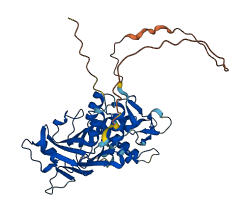
Descriptions
The autoinhibited protein was predicted that may have potential autoinhibitory elements via cis-regPred.
Autoinhibitory domains (AIDs)
Target domain |
|
Relief mechanism |
|
Assay |
cis-regPred |
Accessory elements
No accessory elements
Autoinhibited structure

Activated structure
1 structures for P45896
| Entry ID | Method | Resolution | Chain | Position | Source |
|---|---|---|---|---|---|
| AF-P45896-F1 | Predicted | AlphaFoldDB |
No variants for P45896
| Variant ID(s) | Position | Change | Description | Diseaes Association | Provenance |
|---|---|---|---|---|---|
| No variants for P45896 | |||||
No associated diseases with P45896
Functions
3 GO annotations of cellular component
| Name | Definition |
|---|---|
| cytoplasm | The contents of a cell excluding the plasma membrane and nucleus, but including other subcellular structures. |
| heteromeric SMAD protein complex | A protein complex composed of SMAD family proteins, a transcription factor complex which binds to the promoters of target genes and recruits co-activators and histone acetyltransferases, facilitating transcription. Phosphorylation of the non-SMAD4 subunit(s) enables binding of SMAD4 to form heteromeric complexes that enter the nucleus to initiate gene transcription. DNA-binding specificity is conferred by other transcription factors binding to SMAD complexes. Interactions with coactivators or corepressors modulate their transcriptional activity. Can be heterotrimeric or heterodimeric. |
| nucleus | A membrane-bounded organelle of eukaryotic cells in which chromosomes are housed and replicated. In most cells, the nucleus contains all of the cell's chromosomes except the organellar chromosomes, and is the site of RNA synthesis and processing. In some species, or in specialized cell types, RNA metabolism or DNA replication may be absent. |
5 GO annotations of molecular function
| Name | Definition |
|---|---|
| DNA-binding transcription factor activity, RNA polymerase II-specific | A DNA-binding transcription factor activity that modulates the transcription of specific gene sets transcribed by RNA polymerase II. |
| I-SMAD binding | Binding to an inhibitory SMAD signaling protein. |
| metal ion binding | Binding to a metal ion. |
| RNA polymerase II cis-regulatory region sequence-specific DNA binding | Binding to a specific upstream regulatory DNA sequence (transcription factor recognition sequence or binding site) located in cis relative to the transcription start site (i.e., on the same strand of DNA) of a gene transcribed by RNA polymerase II. |
| transcription coactivator activity | A transcription coregulator activity that activates or increases the transcription of specific gene sets via binding to a DNA-bound DNA-binding transcription factor, either on its own or as part of a complex. Coactivators often act by altering chromatin structure and modifications. For example, one class of transcription coactivators modifies chromatin structure through covalent modification of histones. A second class remodels the conformation of chromatin in an ATP-dependent fashion. A third class modulates interactions of DNA-bound DNA-binding transcription factors with other transcription coregulators. A fourth class of coactivator activity is the bridging of a DNA-binding transcription factor to the general (basal) transcription machinery. The Mediator complex, which bridges sequence-specific DNA binding transcription factors and RNA polymerase, is also a transcription coactivator. |
19 GO annotations of biological process
| Name | Definition |
|---|---|
| anatomical structure morphogenesis | The process in which anatomical structures are generated and organized. Morphogenesis pertains to the creation of form. |
| BMP signaling pathway | The series of molecular signals initiated by the binding of a member of the BMP (bone morphogenetic protein) family to a receptor on the surface of a target cell, and ending with the regulation of a downstream cellular process, e.g. transcription. |
| cell differentiation | The process in which relatively unspecialized cells, e.g. embryonic or regenerative cells, acquire specialized structural and/or functional features that characterize the cells, tissues, or organs of the mature organism or some other relatively stable phase of the organism's life history. Differentiation includes the processes involved in commitment of a cell to a specific fate and its subsequent development to the mature state. |
| defense response to fungus | Reactions triggered in response to the presence of a fungus that act to protect the cell or organism. |
| innate immune response | Innate immune responses are defense responses mediated by germline encoded components that directly recognize components of potential pathogens. |
| nematode larval development | The process whose specific outcome is the progression of the nematode larva over time, from its formation to the mature structure. Nematode larval development begins with the newly hatched first-stage larva (L1) and ends with the end of the last larval stage (for example the fourth larval stage (L4) in C. elegans). Each stage of nematode larval development is characterized by proliferation of specific cell lineages and an increase in body size without alteration of the basic body plan. Nematode larval stages are separated by molts in which each stage-specific exoskeleton, or cuticle, is shed and replaced anew. |
| nematode male tail mating organ morphogenesis | The process in which the anatomical structures of the nematode male tail mating organ are generated and organized. The male tail is a sensory organ required for mating and, in C. elegans, consists of ray sensilla, an acellular cuticular fan, a sensory hook, and protracting, copulatory spicules. |
| nematode male tail tip morphogenesis | The process in which the anatomical structure of the adult male tail tip is generated and organized. In some species of rhabitid nematodes, the male tail tip undergoes a morphological change such that the most posterior hypodermal cells in the tail (hyp8-11 in C. elegans) fuse and retract anteriorly, changing the shape of the tail from a pointed, tapered cone, or spike, to a rounded, blunt dome. |
| pharynx development | The biological process whose specific outcome is the progression of a pharynx from an initial condition to its mature state. The pharynx is the part of the digestive system immediately posterior to the mouth. |
| positive regulation of cell size | Any process that increases cell size. |
| positive regulation of multicellular organism growth | Any process that activates or increases the frequency, rate or extent of growth of an organism to reach its usual body size. |
| positive regulation of nematode male tail tip morphogenesis | Any process that activates or increases the frequency, rate or extent of nematode male tail tip morphogenesis. |
| positive regulation of organ growth | Any process that activates or increases the frequency, rate or extent of growth of an organ of an organism. |
| positive regulation of transcription by RNA polymerase II | Any process that activates or increases the frequency, rate or extent of transcription from an RNA polymerase II promoter. |
| positive regulation of transforming growth factor beta receptor signaling pathway | Any process that activates or increases the frequency, rate or extent of TGF-beta receptor signaling pathway activity. |
| regulation of mesodermal cell fate specification | Any process that modulates the frequency, rate or extent of mesoderm cell fate specification. |
| SMAD protein signal transduction | The cascade of processes by which a signal interacts with a receptor, causing a change in the activity of a SMAD protein, and ultimately effecting a change in the functioning of the cell. |
| transforming growth factor beta receptor signaling pathway | The series of molecular signals initiated by an extracellular ligand binding to a transforming growth factor beta receptor on the surface of a target cell, and ending with the regulation of a downstream cellular process, e.g. transcription. |
| transforming growth factor beta receptor signaling pathway involved in regulation of multicellular organism growth | The series of molecular signals initiated by an extracellular ligand binding to a transforming growth factor beta receptor on the surface of a target cell, and ending with the regulation of a downstream cellular process, e.g. transcription, that modulates the frequency, rate or extent of growth of the body of an organism so that it reaches its usual body size. |
No homologous proteins in AiPD
| UniProt AC | Gene Name | Protein Name | Species | Evidence Code |
|---|---|---|---|---|
| No homologous proteins | ||||
| 10 | 20 | 30 | 40 | 50 | 60 |
| MNGLLHMHGP | AVKKLLGWKI | GEDEEKWCEK | AVEALVKKLK | KKNNGCGTLE | DLECVLANPC |
| 70 | 80 | 90 | 100 | 110 | 120 |
| TNSRCITIAK | SLDGRLQVSH | KKGLPHVIYC | RVWRWPDISS | PHELRSIDTC | SYPYESSSKT |
| 130 | 140 | 150 | 160 | 170 | 180 |
| MYICINPYHY | QRLSRPQGLN | SSMPSPQPIS | SPNTIWQSSG | SSTASCASSP | SPSVFSEDGG |
| 190 | 200 | 210 | 220 | 230 | 240 |
| EVQVHQRPPP | FRHPKSWAQI | TYFELNSRVG | EVFKLVNLSI | TVDGYTNPSN | SNTRICLGQL |
| 250 | 260 | 270 | 280 | 290 | 300 |
| TNVNRNGTIE | NTRMHIGKGI | QLDNKEDQMH | IMITNNSDMP | VFVQSKNTNL | MMNMPLVKVC |
| 310 | 320 | 330 | 340 | 350 | 360 |
| RIPPHSQLCV | FEFNLFFQML | EQSCNDSDGL | NELSKHCFIR | ISFVKGWGED | YPRQDVTSTP |
| 370 | 380 | 390 | |||
| CWLELRLNVP | LAYIDQKMKQ | TPRTNLMEPN | SMT |