P45870
Gene name |
racA (ywkC, BSU37030) |
Protein name |
Chromosome-anchoring protein RacA |
Names |
|
Species |
Bacillus subtilis (strain 168) |
KEGG Pathway |
bsu:BSU37030 |
EC number |
|
Protein Class |
|
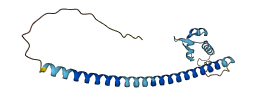
Descriptions
The autoinhibited protein was predicted that may have potential autoinhibitory elements via cis-regPred.
Autoinhibitory domains (AIDs)
Target domain |
|
Relief mechanism |
|
Assay |
cis-regPred |
Accessory elements
No accessory elements
Autoinhibited structure

Activated structure
3 structures for P45870
| Entry ID | Method | Resolution | Chain | Position | Source |
|---|---|---|---|---|---|
| 5I41 | X-ray | 180 A | B | 1-66 | PDB |
| 5I44 | X-ray | 262 A | A/B/D/E/F/G/H/I/J/K | 1-66 | PDB |
| AF-P45870-F1 | Predicted | AlphaFoldDB |
No variants for P45870
| Variant ID(s) | Position | Change | Description | Diseaes Association | Provenance |
|---|---|---|---|---|---|
| No variants for P45870 | |||||
No associated diseases with P45870
1 regional properties for P45870
| Type | Name | Position | InterPro Accession |
|---|---|---|---|
| domain | MerR-type HTH domain | 1 - 63 | IPR000551 |
1 GO annotations of cellular component
| Name | Definition |
|---|---|
| cytoplasm | The contents of a cell excluding the plasma membrane and nucleus, but including other subcellular structures. |
1 GO annotations of molecular function
| Name | Definition |
|---|---|
| double-stranded DNA binding | Binding to double-stranded DNA. |
6 GO annotations of biological process
| Name | Definition |
|---|---|
| asymmetric cell division | The asymmetric division of cells to produce two daughter cells with different developmental potentials. It is of fundamental significance for the generation of cell diversity. |
| cell cycle | The progression of biochemical and morphological phases and events that occur in a cell during successive cell replication or nuclear replication events. Canonically, the cell cycle comprises the replication and segregation of genetic material followed by the division of the cell, but in endocycles or syncytial cells nuclear replication or nuclear division may not be followed by cell division. |
| chromosome condensation | The progressive compaction of dispersed interphase chromatin into threadlike chromosomes prior to mitotic or meiotic nuclear division, or during apoptosis, in eukaryotic cells. |
| chromosome segregation | The process in which genetic material, in the form of chromosomes, is organized into specific structures and then physically separated and apportioned to two or more sets. In eukaryotes, chromosome segregation begins with the condensation of chromosomes, includes chromosome separation, and ends when chromosomes have completed movement to the spindle poles. |
| regulation of DNA-templated transcription | Any process that modulates the frequency, rate or extent of cellular DNA-templated transcription. |
| sporulation resulting in formation of a cellular spore | The process in which a relatively unspecialized cell acquires the specialized features of a cellular spore, a cell form that can be used for dissemination, for survival of adverse conditions because of its heat and dessication resistance, and/or for reproduction. |
No homologous proteins in AiPD
| UniProt AC | Gene Name | Protein Name | Species | Evidence Code |
|---|---|---|---|---|
| No homologous proteins | ||||
| 10 | 20 | 30 | 40 | 50 | 60 |
| MNTNMVASEL | GVSAKTVQRW | VKQLNLPAER | NELGHYSFTA | EDVKVLKSVQ | KQISEGTAIQ |
| 70 | 80 | 90 | 100 | 110 | 120 |
| DIHLPKSAKK | RTGFLVQKTS | SDTERRIEQL | EQKLDTLLQQ | RQDESELMAR | MSELERQLKQ |
| 130 | 140 | 150 | 160 | 170 | 180 |
| KADEGVSYQL | LQHRREIDDI | LADLQSLTSQ | MKEFTAHSIP | ETAAASEKTK | TRKKPLLSLF |
| KFQT |