P44604
Gene name |
narQ (HI_0267) |
Protein name |
Sensor protein NarQ homolog |
Names |
|
Species |
Haemophilus influenzae (strain ATCC 51907 / DSM 11121 / KW20 / Rd) |
KEGG Pathway |
hin:HI_0267 |
EC number |
2.7.13.3: Protein-histidine kinases |
Protein Class |
|
Descriptions
The autoinhibited protein was predicted that may have potential autoinhibitory elements via cis-regPred.
Autoinhibitory domains (AIDs)
Target domain |
|
Relief mechanism |
|
Assay |
cis-regPred |
Accessory elements
No accessory elements
Autoinhibited structure

Activated structure
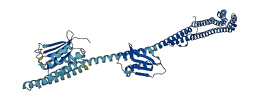
1 structures for P44604
| Entry ID | Method | Resolution | Chain | Position | Source |
|---|---|---|---|---|---|
| AF-P44604-F1 | Predicted | AlphaFoldDB |
No variants for P44604
| Variant ID(s) | Position | Change | Description | Diseaes Association | Provenance |
|---|---|---|---|---|---|
| No variants for P44604 | |||||
No associated diseases with P44604
1 regional properties for P44604
| Type | Name | Position | InterPro Accession |
|---|---|---|---|
| conserved_site | Mrp, conserved site | 184 - 200 | IPR000808 |
Functions
| Description | ||
|---|---|---|
| EC Number | 2.7.13.3 | Protein-histidine kinases |
| Subcellular Localization |
|
|
| PANTHER Family | ||
| PANTHER Subfamily | ||
| PANTHER Protein Class | ||
| PANTHER Pathway Category | No pathway information available | |
2 GO annotations of cellular component
| Name | Definition |
|---|---|
| integral component of membrane | The component of a membrane consisting of the gene products and protein complexes having at least some part of their peptide sequence embedded in the hydrophobic region of the membrane. |
| plasma membrane | The membrane surrounding a cell that separates the cell from its external environment. It consists of a phospholipid bilayer and associated proteins. |
3 GO annotations of molecular function
| Name | Definition |
|---|---|
| ATP binding | Binding to ATP, adenosine 5'-triphosphate, a universally important coenzyme and enzyme regulator. |
| phosphorelay sensor kinase activity | Catalysis of the phosphorylation of a histidine residue in response to detection of an extracellular signal such as a chemical ligand or change in environment, to initiate a change in cell state or activity. The two-component sensor is a histidine kinase that autophosphorylates a histidine residue in its active site. The phosphate is then transferred to an aspartate residue in a downstream response regulator, to trigger a response. |
| protein dimerization activity | The formation of a protein dimer, a macromolecular structure consists of two noncovalently associated identical or nonidentical subunits. |
No GO annotations of biological process
| Name | Definition |
|---|---|
| No GO annotations for biological process |
No homologous proteins in AiPD
| UniProt AC | Gene Name | Protein Name | Species | Evidence Code |
|---|---|---|---|---|
| No homologous proteins | ||||
| 10 | 20 | 30 | 40 | 50 | 60 |
| MYTKGSVSTR | IAKYLFIILI | VAGVISSLSL | AIMSSNKYDA | EAINISGSLR | MQSYRLLYEM |
| 70 | 80 | 90 | 100 | 110 | 120 |
| QEQPESVETN | LRRYHISLHS | SALLEVQNQF | FTPNVLKHSY | QNILQRWTNM | EKYARQQDVK |
| 130 | 140 | 150 | 160 | 170 | 180 |
| NYSKQLTDYV | ADVDYFVFEL | QRFSEQKWIL | GVSVLGFAML | LILLMVSYVI | WYTNREVVKP |
| 190 | 200 | 210 | 220 | 230 | 240 |
| LHLMTKASMQ | VQMRQFNHIP | LDTRKQNELG | TLARVFTQMS | TELGQLYSRL | EEAVNEKTQK |
| 250 | 260 | 270 | 280 | 290 | 300 |
| LRQTNRTLST | LYQSAQLLNT | NTINDKILNQ | VLNYIFISDH | LNFVKVEVMG | AEHWDITLGK |
| 310 | 320 | 330 | 340 | 350 | 360 |
| QDANNELQIE | TLSVDNEELG | VLSWQAGLPC | PDPRIMQNLA | QMLARALYFH | KNLRQKEQLL |
| 370 | 380 | 390 | 400 | 410 | 420 |
| LMEERSIIAR | ELHDSLAQVL | SFLQIQLTLL | KHNLKKEDEQ | SKEKSLAIIA | NFEQALSGGY |
| 430 | 440 | 450 | 460 | 470 | 480 |
| AQLRELLATF | RLTIQEANLQ | LALKQVIDSL | RSQTTMQMNV | NCQLPSQSLN | PQQLVHVLQI |
| 490 | 500 | 510 | 520 | 530 | 540 |
| VREATTNAIK | HSQGTVIEIS | ARINAEGEYE | ILVEDDGVGI | PNLEEPEGHY | GLNIMAERCR |
| 550 | 560 | ||||
| QLNAQLHIHR | REQGGTQVKI | TLPHTLY |