P44516
Gene name |
htpG |
Protein name |
Chaperone protein HtpG |
Names |
Heat shock protein HtpG, High temperature protein G |
Species |
Haemophilus influenzae (strain ATCC 51907 / DSM 11121 / KW20 / Rd) |
KEGG Pathway |
hin:HI_0104 |
EC number |
|
Protein Class |
|
Descriptions
The autoinhibited protein was predicted that may have potential autoinhibitory elements via cis-regPred.
Autoinhibitory domains (AIDs)
Target domain |
|
Relief mechanism |
|
Assay |
cis-regPred |
Accessory elements
No accessory elements
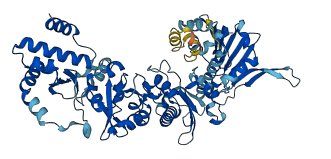
Autoinhibited structure

Activated structure
1 structures for P44516
| Entry ID | Method | Resolution | Chain | Position | Source |
|---|---|---|---|---|---|
| AF-P44516-F1 | Predicted | AlphaFoldDB |
No variants for P44516
| Variant ID(s) | Position | Change | Description | Diseaes Association | Provenance |
|---|---|---|---|---|---|
| No variants for P44516 | |||||
No associated diseases with P44516
1 GO annotations of cellular component
| Name | Definition |
|---|---|
| cytosol | The part of the cytoplasm that does not contain organelles but which does contain other particulate matter, such as protein complexes. |
4 GO annotations of molecular function
| Name | Definition |
|---|---|
| ATP binding | Binding to ATP, adenosine 5'-triphosphate, a universally important coenzyme and enzyme regulator. |
| ATP hydrolysis activity | Catalysis of the reaction: ATP + H2O = ADP + H+ phosphate. ATP hydrolysis is used in some reactions as an energy source, for example to catalyze a reaction or drive transport against a concentration gradient. |
| ATP-dependent protein folding chaperone | Binding to a protein or a protein-containing complex to assist the protein folding process, driven by ATP hydrolysis. |
| unfolded protein binding | Binding to an unfolded protein. |
3 GO annotations of biological process
| Name | Definition |
|---|---|
| cellular response to DNA damage stimulus | Any process that results in a change in state or activity of a cell (in terms of movement, secretion, enzyme production, gene expression, etc.) as a result of a stimulus indicating damage to its DNA from environmental insults or errors during metabolism. |
| protein folding | The process of assisting in the covalent and noncovalent assembly of single chain polypeptides or multisubunit complexes into the correct tertiary structure. |
| response to heat | Any process that results in a change in state or activity of a cell or an organism (in terms of movement, secretion, enzyme production, gene expression, etc.) as a result of a heat stimulus, a temperature stimulus above the optimal temperature for that organism. |
No homologous proteins in AiPD
| UniProt AC | Gene Name | Protein Name | Species | Evidence Code |
|---|---|---|---|---|
| No homologous proteins | ||||
| 10 | 20 | 30 | 40 | 50 | 60 |
| MSQNQETRGF | QSEVKQLLQL | MIHSLYSNKE | IFLRELISNA | SDAADKLRFK | ALSNPALYEG |
| 70 | 80 | 90 | 100 | 110 | 120 |
| DGDLRVRVSF | DADKGTITIS | DNGIGMTREQ | VIDHLGTIAK | SGTKEFLTAL | GQDQAKNSQL |
| 130 | 140 | 150 | 160 | 170 | 180 |
| IGQFGVGFYS | AFIVADKVTV | KTRAAGEEAD | KAVLWESAGE | GEYSVADIEK | KSRGTDVILH |
| 190 | 200 | 210 | 220 | 230 | 240 |
| LREDEKEFLN | EWRLREIIGK | YSDHIGLPVE | MLTKEYDDEG | KECGEKWEKI | NKSDALWTRS |
| 250 | 260 | 270 | 280 | 290 | 300 |
| KNDVSDEEYK | AFYKHLSHDF | VDPVTWAHNK | VEGNQAYTSL | LYVPAKAPWD | LFNREHKHGL |
| 310 | 320 | 330 | 340 | 350 | 360 |
| KLYVQRVFIM | DDAEQFIPNY | LRFMRGLIDS | NDLPLNVSRE | ILQDNKITAA | LRKALTKRSL |
| 370 | 380 | 390 | 400 | 410 | 420 |
| QMLEKLAKDD | AEKYLQFWKE | FGLVLKEGPA | EDFANKETVA | KLLRFASTHN | DGSEQTVSLE |
| 430 | 440 | 450 | 460 | 470 | 480 |
| DYILRMKEGQ | KAIYYITADS | YVAAKNSPHL | ELFNKKGIEV | LLLSDRIDEW | MLSYLTEFDG |
| 490 | 500 | 510 | 520 | 530 | 540 |
| KQLQSITKAD | LDLGDLADKE | SETQKQQDEA | FGSFIERVKN | LLGERVKTVR | LTHNLTDTPA |
| 550 | 560 | 570 | 580 | 590 | 600 |
| VVSTDNDQMT | TQMAKLFAAA | GQPVPEVKYT | FELNPEHHLV | KKVADIADET | EFADWVELLL |
| 610 | 620 | ||||
| EQAMLAERGS | LENPAAFIKR | INKLLG |