P42841
Gene name |
PFS2 (YNL317W, N0348) |
Protein name |
Polyadenylation factor subunit 2 |
Names |
|
Species |
Saccharomyces cerevisiae (strain ATCC 204508 / S288c) (Baker's yeast) |
KEGG Pathway |
sce:YNL317W |
EC number |
|
Protein Class |
|
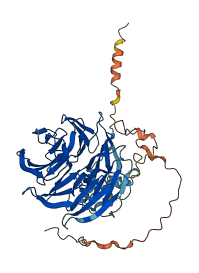
Descriptions
The autoinhibited protein was predicted that may have potential autoinhibitory elements via cis-regPred.
Autoinhibitory domains (AIDs)
Target domain |
|
Relief mechanism |
|
Assay |
cis-regPred |
Accessory elements
No accessory elements
Autoinhibited structure

Activated structure
5 structures for P42841
| Entry ID | Method | Resolution | Chain | Position | Source |
|---|---|---|---|---|---|
| 6EOJ | EM | 355 A | D | 1-465 | PDB |
| 7ZGP | EM | 270 A | D | 1-465 | PDB |
| 7ZGQ | EM | 280 A | D | 1-465 | PDB |
| 7ZGR | EM | 260 A | D | 1-465 | PDB |
| AF-P42841-F1 | Predicted | AlphaFoldDB |
3 variants for P42841
| Variant ID(s) | Position | Change | Description | Diseaes Association | Provenance |
|---|---|---|---|---|---|
| s14-41440 | 275 | N>H | No | SGRP | |
| s14-41899 | 428 | L>F | No | SGRP | |
| s14-41966 | 450 | G>D | No | SGRP |
No associated diseases with P42841
5 regional properties for P42841
| Type | Name | Position | InterPro Accession |
|---|---|---|---|
| repeat | WD40 repeat | 89 - 121 | IPR001680-1 |
| repeat | WD40 repeat | 124 - 163 | IPR001680-2 |
| repeat | WD40 repeat | 165 - 290 | IPR001680-3 |
| repeat | WD40 repeat | 294 - 333 | IPR001680-4 |
| repeat | WD40 repeat | 338 - 378 | IPR001680-5 |
2 GO annotations of cellular component
| Name | Definition |
|---|---|
| mRNA cleavage and polyadenylation specificity factor complex | A multisubunit complex that binds to the canonical AAUAAA hexamer and to U-rich upstream sequence elements on the pre-mRNA, thereby stimulating the otherwise weakly active and nonspecific polymerase to elongate efficiently RNAs containing a poly(A) signal. |
| nucleus | A membrane-bounded organelle of eukaryotic cells in which chromosomes are housed and replicated. In most cells, the nucleus contains all of the cell's chromosomes except the organellar chromosomes, and is the site of RNA synthesis and processing. In some species, or in specialized cell types, RNA metabolism or DNA replication may be absent. |
No GO annotations of molecular function
| Name | Definition |
|---|---|
| No GO annotations for molecular function |
3 GO annotations of biological process
| Name | Definition |
|---|---|
| mRNA polyadenylation | The enzymatic addition of a sequence of 40-200 adenylyl residues at the 3' end of a eukaryotic mRNA primary transcript. |
| pre-mRNA cleavage required for polyadenylation | The targeted, endonucleolytic cleavage of a pre-mRNA, required for polyadenylation of the 3' end. This cleavage is directed by binding sites near the 3' end of the mRNA and leaves a 3' hydoxyl end which then becomes a target for adenylation. |
| termination of RNA polymerase II transcription, poly(A)-coupled | An RNA polymerase II transcription termination process in which cleavage and polyadenylylation of the mRNA 3' end are coupled to transcription termination. |
No homologous proteins in AiPD
| UniProt AC | Gene Name | Protein Name | Species | Evidence Code |
|---|---|---|---|---|
| No homologous proteins | ||||
| 10 | 20 | 30 | 40 | 50 | 60 |
| MDGHNQNQYQ | NQNQIQQSQQ | PPLKKYVTQR | RSVDVSSPYI | NLYYNRRHGL | PNLVVEPETS |
| 70 | 80 | 90 | 100 | 110 | 120 |
| YTIDIMPPNA | YRGRDRVINL | PSKFTHLSSN | KVKHVIPAIQ | WTPEGRRLVV | ATYSGEFSLW |
| 130 | 140 | 150 | 160 | 170 | 180 |
| NASSFTFETL | MQAHDSAVTT | MKYSHDSDWM | ISGDADGMIK | IWQPNFSMVK | EIDAAHTESI |
| 190 | 200 | 210 | 220 | 230 | 240 |
| RDMAFSSNDS | KFVTCSDDNI | LKIWNFSNGK | QERVLSGHHW | DVKSCDWHPE | MGLIASASKD |
| 250 | 260 | 270 | 280 | 290 | 300 |
| NLVKLWDPRS | GNCISSILKF | KHTVLKTRFQ | PTKGNLLMAI | SKDKSCRVFD | IRYSMKELMC |
| 310 | 320 | 330 | 340 | 350 | 360 |
| VRDETDYMTL | EWHPINESMF | TLACYDGSLK | HFDLLQNLNE | PILTIPYAHD | KCITSLSYNP |
| 370 | 380 | 390 | 400 | 410 | 420 |
| VGHIFATAAK | DRTIRFWTRA | RPIDPNAYDD | PTYNNKKING | WFFGINNDIN | AVREKSEFGA |
| 430 | 440 | 450 | 460 | ||
| APPPPATLEP | HALPNMNGFI | NKKPRQEIPG | IDSNIKSSTL | PGLSI |