P42656
Gene name |
rad24 |
Protein name |
Checkpoint signal transducer rad24 |
Names |
|
Species |
Schizosaccharomyces pombe (strain 972 / ATCC 24843) (Fission yeast) |
KEGG Pathway |
spo:SPAC8E11.02c |
EC number |
|
Protein Class |
|
Descriptions
The autoinhibited protein was predicted that may have potential autoinhibitory elements via cis-regPred.
Autoinhibitory domains (AIDs)
Target domain |
|
Relief mechanism |
|
Assay |
cis-regPred |
Accessory elements
No accessory elements
Autoinhibited structure

Activated structure
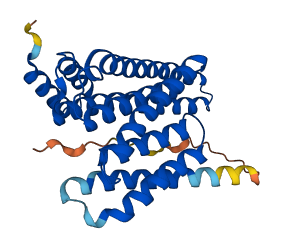
1 structures for P42656
| Entry ID | Method | Resolution | Chain | Position | Source |
|---|---|---|---|---|---|
| AF-P42656-F1 | Predicted | AlphaFoldDB |
1 variants for P42656
| Variant ID(s) | Position | Change | Description | Diseaes Association | Provenance |
|---|---|---|---|---|---|
| I_3385249_G_A | 192 | R>H | No | Jeffares_SNPs |
No associated diseases with P42656
3 regional properties for P42656
| Type | Name | Position | InterPro Accession |
|---|---|---|---|
| conserved_site | 14-3-3 protein, conserved site | 44 - 54 | IPR023409-1 |
| conserved_site | 14-3-3 protein, conserved site | 216 - 235 | IPR023409-2 |
| domain | 14-3-3 domain | 6 - 247 | IPR023410 |
9 GO annotations of cellular component
| Name | Definition |
|---|---|
| cell division site | The eventual plane of cell division (also known as cell cleavage or cytokinesis) in a dividing cell. In Eukaryotes, the cleavage apparatus, composed of septin structures and the actomyosin contractile ring, forms along this plane, and the mitotic, or meiotic, spindle is aligned perpendicular to the division plane. In bacteria, the cell division site is generally located at mid-cell and is the site at which the cytoskeletal structure, the Z-ring, assembles. |
| cytoplasm | The contents of a cell excluding the plasma membrane and nucleus, but including other subcellular structures. |
| cytosol | The part of the cytoplasm that does not contain organelles but which does contain other particulate matter, such as protein complexes. |
| mitotic actomyosin contractile ring, distal actin filament layer | The region of the mitotic actomyosin ring containing actin filaments and cross linkers, myosin motors, and connections to the plasma membrane through the intermediate layer. It is further from the plasma membrane than the intermediate layer which it is adjacent to. |
| mitotic spindle | A spindle that forms as part of mitosis. Mitotic and meiotic spindles contain distinctive complements of proteins associated with microtubules. |
| mitotic spindle midzone | The area in the center of the anaphase spindle consisting of microtubules, microtubule bundling factors and kinesin motors where the spindle microtubules from opposite poles overlap in an antiparallel manner. |
| mitotic spindle pole body | The microtubule organizing center that forms as part of the mitotic cell cycle; functionally homologous to the animal cell centrosome. |
| nucleus | A membrane-bounded organelle of eukaryotic cells in which chromosomes are housed and replicated. In most cells, the nucleus contains all of the cell's chromosomes except the organellar chromosomes, and is the site of RNA synthesis and processing. In some species, or in specialized cell types, RNA metabolism or DNA replication may be absent. |
| plasma membrane | The membrane surrounding a cell that separates the cell from its external environment. It consists of a phospholipid bilayer and associated proteins. |
2 GO annotations of molecular function
| Name | Definition |
|---|---|
| phosphoserine residue binding | Binding to a phosphorylated serine residue within a protein. |
| protein sequestering activity | Binding to a protein to prevent it from interacting with other partners or to inhibit its localization to the area of the cell or complex where it is active. |
10 GO annotations of biological process
| Name | Definition |
|---|---|
| cytoplasmic sequestering of protein | The selective interaction of a protein with specific molecules in the cytoplasm, thereby inhibiting its transport into other areas of the cell. |
| meiotic cell cycle | Progression through the phases of the meiotic cell cycle, in which canonically a cell replicates to produce four offspring with half the chromosomal content of the progenitor cell via two nuclear divisions. |
| mitotic cytokinesis checkpoint signaling | A signaling process that contributes to a mitotic cell cycle checkpoint that detects a defect in cytokinesis and prevents further rounds of nuclear division until cytokinesis is completed. |
| mitotic DNA replication checkpoint signaling | A signal transduction process that contributes to a mitotic DNA replication checkpoint. |
| mitotic G2 DNA damage checkpoint signaling | A mitotic cell cycle checkpoint that detects and negatively regulates progression through the G2/M transition of the cell cycle in response to DNA damage. |
| negative regulation of induction of conjugation with cellular fusion | Any process that stops, prevents, or reduces the frequency or rate of initiation of conjugation with cellular fusion. |
| positive regulation of septation initiation signaling | Any process that activates or increases the frequency, rate or extent of septation initiation signaling. |
| protein localization | Any process in which a protein is transported to, or maintained in, a specific location. |
| regulation of mitotic cell cycle | Any process that modulates the rate or extent of progress through the mitotic cell cycle. |
| signal transduction | The cellular process in which a signal is conveyed to trigger a change in the activity or state of a cell. Signal transduction begins with reception of a signal (e.g. a ligand binding to a receptor or receptor activation by a stimulus such as light), or for signal transduction in the absence of ligand, signal-withdrawal or the activity of a constitutively active receptor. Signal transduction ends with regulation of a downstream cellular process, e.g. regulation of transcription or regulation of a metabolic process. Signal transduction covers signaling from receptors located on the surface of the cell and signaling via molecules located within the cell. For signaling between cells, signal transduction is restricted to events at and within the receiving cell. |
No homologous proteins in AiPD
| UniProt AC | Gene Name | Protein Name | Species | Evidence Code |
|---|---|---|---|---|
| No homologous proteins | ||||
| 10 | 20 | 30 | 40 | 50 | 60 |
| MSTTSREDAV | YLAKLAEQAE | RYEGMVENMK | SVASTDQELT | VEERNLLSVA | YKNVIGARRA |
| 70 | 80 | 90 | 100 | 110 | 120 |
| SWRIVSSIEQ | KEESKGNTAQ | VELIKEYRQK | IEQELDTICQ | DILTVLEKHL | IPNAASAESK |
| 130 | 140 | 150 | 160 | 170 | 180 |
| VFYYKMKGDY | YRYLAEFAVG | EKRQHSADQS | LEGYKAASEI | ATAELAPTHP | IRLGLALNFS |
| 190 | 200 | 210 | 220 | 230 | 240 |
| VFYYEILNSP | DRACYLAKQA | FDEAISELDS | LSEESYKDST | LIMQLLRDNL | TLWTSDAEYS |
| 250 | 260 | ||||
| AAAAGGNTEG | AQENAPSNAP | EGEAEPKADA |