P42528
Gene name |
arpC (aclA, act, DDB_G0283755) |
Protein name |
Actin-related protein 3 |
Names |
Actin-like protein 3, Actin-related protein C |
Species |
Dictyostelium discoideum (Slime mold) |
KEGG Pathway |
ddi:DDB_G0283755 |
EC number |
|
Protein Class |
|
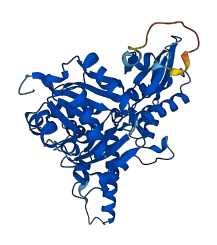
Descriptions
The autoinhibited protein was predicted that may have potential autoinhibitory elements via cis-regPred.
Autoinhibitory domains (AIDs)
Target domain |
|
Relief mechanism |
|
Assay |
cis-regPred |
Accessory elements
No accessory elements
Autoinhibited structure

Activated structure
1 structures for P42528
| Entry ID | Method | Resolution | Chain | Position | Source |
|---|---|---|---|---|---|
| AF-P42528-F1 | Predicted | AlphaFoldDB |
No variants for P42528
| Variant ID(s) | Position | Change | Description | Diseaes Association | Provenance |
|---|---|---|---|---|---|
| No variants for P42528 | |||||
No associated diseases with P42528
1 regional properties for P42528
| Type | Name | Position | InterPro Accession |
|---|---|---|---|
| conserved_site | Actin/actin-like conserved site | 112 - 124 | IPR020902 |
19 GO annotations of cellular component
| Name | Definition |
|---|---|
| actin cytoskeleton | The part of the cytoskeleton (the internal framework of a cell) composed of actin and associated proteins. Includes actin cytoskeleton-associated complexes. |
| Arp2/3 protein complex | A stable protein complex that contains two actin-related proteins, Arp2 and Arp3, and five novel proteins (ARPC1-5), and functions in the nucleation of branched actin filaments. |
| cell leading edge | The area of a motile cell closest to the direction of movement. |
| cell pole | Either of two different areas at opposite ends of an axis of a cell. |
| cell projection | A prolongation or process extending from a cell, e.g. a flagellum or axon. |
| clathrin-coated pit | A part of the endomembrane system in the form of an invagination of a membrane upon which a clathrin coat forms, and that can be converted by vesicle budding into a clathrin-coated vesicle. Coated pits form on the plasma membrane, where they are involved in receptor-mediated selective transport of many proteins and other macromolecules across the cell membrane, in the trans-Golgi network, and on some endosomes. |
| cortical actin cytoskeleton | The portion of the actin cytoskeleton, comprising filamentous actin and associated proteins, that lies just beneath the plasma membrane. |
| cytosol | The part of the cytoplasm that does not contain organelles but which does contain other particulate matter, such as protein complexes. |
| filopodium | Thin, stiff, actin-based protrusion extended by the leading edge of a motile cell such as a crawling fibroblast or amoeba, or an axonal or dendritic growth cone, or a dendritic shaft. |
| lamellipodium | A thin sheetlike process extended by the leading edge of a migrating cell or extending cell process; contains a dense meshwork of actin filaments. |
| leading edge of lamellipodium | That part of the lamellipodium which represents the distal part of the structure. |
| macropinocytic cup | A cell projection that forms at the site of macropinocytosis, a form of endocytosis that results in the uptake of relatively large amounts of extracellular fluid. The macropinocytic cup membrane selectively excludes certain proteins, such as H36 or PM4C4 in Dictyostelium, and the underlying cytoskeleton is enriched in F-actin and coronin. |
| mitochondrion | A semiautonomous, self replicating organelle that occurs in varying numbers, shapes, and sizes in the cytoplasm of virtually all eukaryotic cells. It is notably the site of tissue respiration. |
| phagocytic cup | An invagination of the cell membrane formed by an actin dependent process during phagocytosis. Following internalization it is converted into a phagosome. |
| phagocytic cup lip | The tip or margin of the progressing circular lamella that engulfs a particle during phagocytosis. When the two lips of the cup fuse it is converted into a phagosome. |
| phagocytic vesicle | A membrane-bounded intracellular vesicle that arises from the ingestion of particulate material by phagocytosis. |
| phagocytic vesicle membrane | The lipid bilayer surrounding a phagocytic vesicle. |
| post-lysosomal vacuole | A membrane-bounded intracellular vesicle formed late in the endocytic pathway when the pH in the vacuole becomes neutral prior to exocytosis. |
| pseudopodium | A temporary protrusion or retractile process of a cell, associated with flowing movements of the protoplasm, and serving for locomotion and feeding. |
2 GO annotations of molecular function
| Name | Definition |
|---|---|
| actin filament binding | Binding to an actin filament, also known as F-actin, a helical filamentous polymer of globular G-actin subunits. |
| ATP binding | Binding to ATP, adenosine 5'-triphosphate, a universally important coenzyme and enzyme regulator. |
8 GO annotations of biological process
| Name | Definition |
|---|---|
| actin filament polymerization | Assembly of actin filaments by the addition of actin monomers to a filament. |
| actin nucleation | The initial step in the formation of an actin filament, in which actin monomers combine to form a new filament. Nucleation is slow relative to the subsequent addition of more monomers to extend the filament. |
| Arp2/3 complex-mediated actin nucleation | The actin nucleation process in which actin monomers combine to form a new branch on the side of an existing actin filament; mediated by the Arp2/3 protein complex and its interaction with other proteins. |
| exocytosis | A process of secretion by a cell that results in the release of intracellular molecules (e.g. hormones, matrix proteins) contained within a membrane-bounded vesicle. Exocytosis can occur either by full fusion, when the vesicle collapses into the plasma membrane, or by a kiss-and-run mechanism that involves the formation of a transient contact, a pore, between a granule (for exemple of chromaffin cells) and the plasma membrane. The latter process most of the time leads to only partial secretion of the granule content. Exocytosis begins with steps that prepare vesicles for fusion with the membrane (tethering and docking) and ends when molecules are secreted from the cell. |
| phagocytosis | A vesicle-mediated transport process that results in the engulfment of external particulate material by phagocytes and their delivery to the lysosome. The particles are initially contained within phagocytic vacuoles (phagosomes), which then fuse with primary lysosomes to effect digestion of the particles. |
| positive regulation of actin filament polymerization | Any process that activates or increases the frequency, rate or extent of actin polymerization. |
| response to bacterium | Any process that results in a change in state or activity of a cell or an organism (in terms of movement, secretion, enzyme production, gene expression, etc.) as a result of a stimulus from a bacterium. |
| response to mercury ion | Any process that results in a change in state or activity of a cell or an organism (in terms of movement, secretion, enzyme production, gene expression, etc.) as a result of a mercury ion stimulus. |
No homologous proteins in AiPD
| UniProt AC | Gene Name | Protein Name | Species | Evidence Code |
|---|---|---|---|---|
| No homologous proteins | ||||
| 10 | 20 | 30 | 40 | 50 | 60 |
| MNPASGLPAV | VIDNGTGYTK | MGYAGNNDPS | FIIPTTIATQ | SSKGKQTAAS | QKKGVEDLDF |
| 70 | 80 | 90 | 100 | 110 | 120 |
| FIGDEAIANS | KTYDMTNPVK | HGQIENWTHM | EQYWEHCVFK | YLRCEPEDHY | FLLTEPPLNA |
| 130 | 140 | 150 | 160 | 170 | 180 |
| PENREFTAEI | MFETFNVPGL | YIAVQAVLAL | AASWTSKNAE | KTLTGTVIDS | GDGVTHVIPI |
| 190 | 200 | 210 | 220 | 230 | 240 |
| SEGYVIGSSI | KHIPIAGRDI | SSYVQQIMRE | REPNIPPAES | LEIAKRVKEQ | YSYVCPDIVK |
| 250 | 260 | 270 | 280 | 290 | 300 |
| EFGKYDSEPD | KWIKTINAQD | SVTKKPFSYD | VGYERFLGPE | LFFNPEIASS | DYLTPLPKVV |
| 310 | 320 | 330 | 340 | 350 | 360 |
| DDTIQSCPID | CRRGLYKNIV | LSGGSTMFKD | FGKRLQRDVK | RSVDYRIKRS | EELSGGKIKA |
| 370 | 380 | 390 | 400 | 410 | |
| VPLAVNVISH | NMQRYAVWFG | GSMLASTPEF | YNVCHTKAQY | DEIGPSICRF | NTVIGGIN |