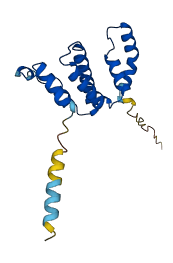
| astrocyte activation |
A change in morphology and behavior of an astrocyte resulting from exposure to a cytokine, chemokine, cellular ligand, or soluble factor. |
| defense response to virus |
Reactions triggered in response to the presence of a virus that act to protect the cell or organism. |
| extrinsic apoptotic signaling pathway |
The series of molecular signals in which a signal is conveyed from the cell surface to trigger the apoptotic death of a cell. The pathway starts with either a ligand binding to a cell surface receptor, or a ligand being withdrawn from a cell surface receptor (e.g. in the case of signaling by dependence receptors), and ends when the execution phase of apoptosis is triggered. |
| interferon-gamma-mediated signaling pathway |
The series of molecular signals initiated by interferon-gamma binding to its receptor on the surface of a target cell, and ending with the regulation of a downstream cellular process, e.g. transcription. Interferon gamma is the only member of the type II interferon found so far. |
| macrophage activation involved in immune response |
A change in morphology and behavior of a macrophage resulting from exposure to a cytokine, chemokine, cellular ligand, or soluble factor, leading to the initiation or perpetuation of an immune response. |
| macrophage differentiation |
The process in which a relatively unspecialized monocyte acquires the specialized features of a macrophage. |
| microglial cell activation |
The change in morphology and behavior of a microglial cell resulting from exposure to a cytokine, chemokine, cellular ligand, or soluble factor. |
| negative regulation of DNA-templated transcription |
Any process that stops, prevents, or reduces the frequency, rate or extent of cellular DNA-templated transcription. |
| negative regulation of interleukin-17 production |
Any process that stops, prevents, or reduces the frequency, rate, or extent of production of any member of the interleukin-17 family of cytokines. |
| negative regulation of smooth muscle cell proliferation |
Any process that stops, prevents or reduces the rate or extent of smooth muscle cell proliferation. |
| negative regulation of tau-protein kinase activity |
Any process that stops, prevents or reduces the frequency, rate or extent of tau-protein kinase activity. |
| positive regulation of amyloid-beta formation |
Any process that activates or increases the frequency, rate or extent of amyloid-beta formation. |
| positive regulation of autophagy |
Any process that activates, maintains or increases the rate of autophagy. Autophagy is the process in which cells digest parts of their own cytoplasm. |
| positive regulation of calcidiol 1-monooxygenase activity |
Any process that increases the rate, frequency or extent of calcidiol 1-monooxygenase activity. Calcidiol 1-monooxygenase activity is the catalysis of the reaction: calcidiol + NADPH + H+ + O2 = calcitriol + NADP+ + H2O. |
| positive regulation of CD4-positive, CD25-positive, alpha-beta regulatory T cell differentiation involved in immune response |
Any process that activates or increases the frequency, rate or extent of differentiation of CD4-positive, CD25-positive, alpha-beta regulatory T cells as part of an immune response. |
| positive regulation of chemokine production |
Any process that activates or increases the frequency, rate, or extent of chemokine production. |
| positive regulation of core promoter binding |
Any process that activates or increases the frequency, rate or extent of core promoter binding. |
| positive regulation of epithelial cell migration |
Any process that activates or increases the frequency, rate or extent of epithelial cell migration. |
| positive regulation of fructose 1,6-bisphosphate 1-phosphatase activity |
Any process that increases the rate, frequency or extent of fructose 1,6-bisphosphate 1-phosphatase activity. Fructose 1,6-bisphosphate 1-phosphatase activity is the catalysis of the reaction: D-fructose 1,6-bisphosphate + H2O = D-fructose 6-phosphate + phosphate. |
| positive regulation of fructose 1,6-bisphosphate metabolic process |
Any process that increases the rate, frequency or extent of fructose 1,6-bisphosphate metabolism. Fructose 1,6-bisphosphate metabolism is the chemical reactions and pathways involving fructose 1,6-bisphosphate, also known as FBP. The D enantiomer is a metabolic intermediate in glycolysis and gluconeogenesis. |
| positive regulation of inflammatory response |
Any process that activates or increases the frequency, rate or extent of the inflammatory response. |
| positive regulation of interleukin-12 production |
Any process that activates or increases the frequency, rate, or extent of interleukin-12 production. |
| positive regulation of interleukin-23 production |
Any process that activates or increases the frequency, rate, or extent of interleukin-23 production. |
| positive regulation of interleukin-6 production |
Any process that activates or increases the frequency, rate, or extent of interleukin-6 production. |
| positive regulation of killing of cells of another organism |
Any process that activates or increases the frequency, rate or extent of the killing by an organism of cells in another organism. |
| positive regulation of membrane protein ectodomain proteolysis |
Any process that activates or increases the frequency, rate or extent of membrane protein ectodomain peptidolysis. |
| positive regulation of neurogenesis |
Any process that activates or increases the frequency, rate or extent of neurogenesis, the generation of cells within the nervous system. |
| positive regulation of neuron death |
Any process that activates or increases the frequency, rate or extent of neuron death. |
| positive regulation of nitric oxide biosynthetic process |
Any process that activates or increases the frequency, rate or extent of the chemical reactions and pathways resulting in the formation of nitric oxide. |
| positive regulation of osteoclast differentiation |
Any process that activates or increases the frequency, rate or extent of osteoclast differentiation. |
| positive regulation of peptidyl-serine phosphorylation of STAT protein |
Any process that activates or increases the frequency, rate or extent of the phosphorylation of a serine residue of a STAT (Signal Transducer and Activator of Transcription) protein. |
| positive regulation of protein deacetylation |
Any process that increases the rate, frequency, or extent of protein deacetylation, the removal of an acetyl group from a protein amino acid. An acetyl group is CH3CO-, derived from acetic |
| positive regulation of protein import into nucleus |
Any process that activates or increases the frequency, rate or extent of movement of proteins from the cytoplasm into the nucleus. |
| positive regulation of protein serine/threonine kinase activity |
Any process that increases the rate, frequency, or extent of protein serine/threonine kinase activity. |
| positive regulation of protein-containing complex assembly |
Any process that activates or increases the frequency, rate or extent of protein complex assembly. |
| positive regulation of smooth muscle cell apoptotic process |
Any process that activates or increases the frequency, rate, or extent of smooth muscle cell apoptotic process. |
| positive regulation of tumor necrosis factor (ligand) superfamily member 11 production |
Any process that activates or increases the frequency, rate or extent of tumor necrosis factor (ligand) superfamily member 11 production. |
| positive regulation of tyrosine phosphorylation of STAT protein |
Any process that activates or increases the frequency, rate or extent of the introduction of a phosphate group to a tyrosine residue of a STAT (Signal Transducer and Activator of Transcription) protein. |
| positive regulation of vitamin D biosynthetic process |
Any process that increases the rate, frequency or extent of a vitamin D biosynthetic process. Vitamin D biosynthesis is the chemical reactions and pathways resulting in the formation of vitamin D, any of a group of related, fat-soluble compounds that are derived from delta-5,7 steroids and play a central role in calcium metabolism. Specific forms of vitamin D include calciferol (ergocalciferol; vitamin D2) and cholecalciferol (calciol; vitamin D3). |
| regulation of insulin secretion |
Any process that modulates the frequency, rate or extent of the regulated release of insulin. |
| regulation of protein ADP-ribosylation |
Any process that modulates the frequency, rate or extent of protein ADP-ribosylation. Protein ADP-ribosylation is the transfer, from NAD, of ADP-ribose to protein amino acids. |