P42118
Gene name |
dntt (tdt) |
Protein name |
DNA nucleotidylexotransferase |
Names |
Terminal addition enzyme, Terminal deoxynucleotidyltransferase, TDT, Terminal transferase |
Species |
Xenopus laevis (African clawed frog) |
KEGG Pathway |
xla:378525 |
EC number |
2.7.7.31: Nucleotidyltransferases |
Protein Class |
|
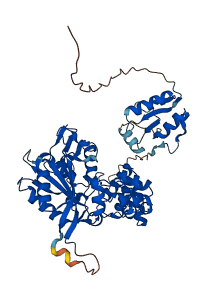
Descriptions
The autoinhibited protein was predicted that may have potential autoinhibitory elements via cis-regPred.
Autoinhibitory domains (AIDs)
Target domain |
|
Relief mechanism |
|
Assay |
cis-regPred |
Accessory elements
No accessory elements
Autoinhibited structure

Activated structure
1 structures for P42118
| Entry ID | Method | Resolution | Chain | Position | Source |
|---|---|---|---|---|---|
| AF-P42118-F1 | Predicted | AlphaFoldDB |
No variants for P42118
| Variant ID(s) | Position | Change | Description | Diseaes Association | Provenance |
|---|---|---|---|---|---|
| No variants for P42118 | |||||
No associated diseases with P42118
7 regional properties for P42118
| Type | Name | Position | InterPro Accession |
|---|---|---|---|
| domain | BRCT domain | 27 - 124 | IPR001357 |
| domain | DNA-directed DNA polymerase X | 159 - 506 | IPR002054 |
| domain | DNA polymerase beta-like, N-terminal domain | 163 - 226 | IPR010996 |
| domain | DNA polymerase lambda, fingers domain | 246 - 295 | IPR018944 |
| binding_site | DNA polymerase family X, binding site | 328 - 347 | IPR019843 |
| domain | DNA polymerase beta, palm domain | 300 - 369 | IPR028207 |
| domain | DNA polymerase beta, thumb domain | 443 - 506 | IPR029398 |
Functions
| Description | ||
|---|---|---|
| EC Number | 2.7.7.31 | Nucleotidyltransferases |
| Subcellular Localization |
|
|
| PANTHER Family | ||
| PANTHER Subfamily | ||
| PANTHER Protein Class | ||
| PANTHER Pathway Category | No pathway information available | |
1 GO annotations of cellular component
| Name | Definition |
|---|---|
| nucleus | A membrane-bounded organelle of eukaryotic cells in which chromosomes are housed and replicated. In most cells, the nucleus contains all of the cell's chromosomes except the organellar chromosomes, and is the site of RNA synthesis and processing. In some species, or in specialized cell types, RNA metabolism or DNA replication may be absent. |
4 GO annotations of molecular function
| Name | Definition |
|---|---|
| DNA binding | Any molecular function by which a gene product interacts selectively and non-covalently with DNA (deoxyribonucleic acid). |
| DNA nucleotidylexotransferase activity | Catalysis of the reaction: deoxynucleoside triphosphate + DNA(n) = diphosphate + DNA(n+1). |
| DNA-directed DNA polymerase activity | Catalysis of the reaction: deoxynucleoside triphosphate + DNA(n) = diphosphate + DNA(n+1); the synthesis of DNA from deoxyribonucleotide triphosphates in the presence of a DNA template and a 3'hydroxyl group. |
| metal ion binding | Binding to a metal ion. |
3 GO annotations of biological process
| Name | Definition |
|---|---|
| DNA metabolic process | Any cellular metabolic process involving deoxyribonucleic acid. This is one of the two main types of nucleic acid, consisting of a long, unbranched macromolecule formed from one, or more commonly, two, strands of linked deoxyribonucleotides. |
| DNA modification | The covalent alteration of one or more nucleotide sites in DNA, resulting in a change in its properties. |
| DNA repair | The process of restoring DNA after damage. Genomes are subject to damage by chemical and physical agents in the environment (e.g. UV and ionizing radiations, chemical mutagens, fungal and bacterial toxins, etc.) and by free radicals or alkylating agents endogenously generated in metabolism. DNA is also damaged because of errors during its replication. A variety of different DNA repair pathways have been reported that include direct reversal, base excision repair, nucleotide excision repair, photoreactivation, bypass, double-strand break repair pathway, and mismatch repair pathway. |
No homologous proteins in AiPD
| UniProt AC | Gene Name | Protein Name | Species | Evidence Code |
|---|---|---|---|---|
| No homologous proteins | ||||
| 10 | 20 | 30 | 40 | 50 | 60 |
| MNPLSQSALV | PLRKKAKMAP | ISQSFCQHNV | KFKEIVLFLV | ERKMGSSRRT | FLMELARKRG |
| 70 | 80 | 90 | 100 | 110 | 120 |
| FQTEIELSDS | VTHIVAENNS | GAEVLEWLQS | KKLGFTVKTH | ILDISWFTEC | MEAGRPVEIQ |
| 130 | 140 | 150 | 160 | 170 | 180 |
| NRHLLPVQQD | CSANFNPPLS | SSCVQVSQYA | CQRCTTLQDT | NRIFTDAFDI | LAEHFEFCEN |
| 190 | 200 | 210 | 220 | 230 | 240 |
| KGRTVAFLRA | SSLIKSLPFP | ITAMKELEGL | PWLGDQMKGI | IEEILEEGKS | YKVLEVMNEE |
| 250 | 260 | 270 | 280 | 290 | 300 |
| RYKSFKQFTS | VFGVGLKTSD | KWFRMGFRTL | EEIKNEKELK | LTKMQKCGLL | YYEDITSYVS |
| 310 | 320 | 330 | 340 | 350 | 360 |
| RAEAETTEQL | IKSIVWKFVP | DAIVTLTGGF | RRGKKKGHDV | DILITCARKG | KEKNILHNTM |
| 370 | 380 | 390 | 400 | 410 | 420 |
| SVLKNRGLLL | FYNIIESTFD | ETKLPSRHVD | ALDHFQKCFT | ILKLPKRQMD | IGNIIDPHEC |
| 430 | 440 | 450 | 460 | 470 | 480 |
| ERKNWKAVRL | DLVITPYEQY | PYALLGWTGS | RQFERDLRRY | ATHEKRMMLD | NHGLYDKTKN |
| 490 | 500 | ||||
| NFLKANNEED | IFKQLGLDYL | EPWERNA |