P42063
Gene name |
appC (BSU11400) |
Protein name |
Oligopeptide transport system permease protein AppC |
Names |
|
Species |
Bacillus subtilis (strain 168) |
KEGG Pathway |
bsu:BSU11400 |
EC number |
|
Protein Class |
|
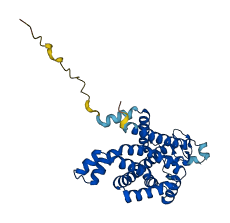
Descriptions
The autoinhibited protein was predicted that may have potential autoinhibitory elements via cis-regPred.
Autoinhibitory domains (AIDs)
Target domain |
|
Relief mechanism |
|
Assay |
cis-regPred |
Accessory elements
No accessory elements
Autoinhibited structure

Activated structure
1 structures for P42063
| Entry ID | Method | Resolution | Chain | Position | Source |
|---|---|---|---|---|---|
| AF-P42063-F1 | Predicted | AlphaFoldDB |
No variants for P42063
| Variant ID(s) | Position | Change | Description | Diseaes Association | Provenance |
|---|---|---|---|---|---|
| No variants for P42063 | |||||
No associated diseases with P42063
2 GO annotations of cellular component
| Name | Definition |
|---|---|
| integral component of membrane | The component of a membrane consisting of the gene products and protein complexes having at least some part of their peptide sequence embedded in the hydrophobic region of the membrane. |
| plasma membrane | The membrane surrounding a cell that separates the cell from its external environment. It consists of a phospholipid bilayer and associated proteins. |
No GO annotations of molecular function
| Name | Definition |
|---|---|
| No GO annotations for molecular function |
5 GO annotations of biological process
| Name | Definition |
|---|---|
| establishment of competence for transformation | The process in which a naturally transformable bacterium acquires the ability to take up exogenous DNA. This term should be applied only to naturally transformable bacteria, and should not be used in the context of artificially induced bacterial transformation. |
| peptide transport | The directed movement of peptides, compounds of two or more amino acids where the alpha carboxyl group of one is bound to the alpha amino group of another, into, out of or within a cell, or between cells, by means of some agent such as a transporter or pore. |
| protein transport | The directed movement of proteins into, out of or within a cell, or between cells, by means of some agent such as a transporter or pore. |
| sporulation resulting in formation of a cellular spore | The process in which a relatively unspecialized cell acquires the specialized features of a cellular spore, a cell form that can be used for dissemination, for survival of adverse conditions because of its heat and dessication resistance, and/or for reproduction. |
| transmembrane transport | The process in which a solute is transported across a lipid bilayer, from one side of a membrane to the other. |
No homologous proteins in AiPD
| UniProt AC | Gene Name | Protein Name | Species | Evidence Code |
|---|---|---|---|---|
| No homologous proteins | ||||
| 10 | 20 | 30 | 40 | 50 | 60 |
| MSELQTTPSP | EIRLKENISK | KPETMTKIFW | EKFSKNKLAI | LGAVILFIII | MSAVFAPLIA |
| 70 | 80 | 90 | 100 | 110 | 120 |
| PYPQEQQSLL | DKYKAPGLEH | LMGTDKFGRD | IFSRILYGAR | VSLLVGFASV | VGSILIGTVL |
| 130 | 140 | 150 | 160 | 170 | 180 |
| GALAGYFRGI | VDAVIMRVVD | IVLSIPDIFL | LITLVTIFKP | GVDKLILIFC | LTGWTTTARL |
| 190 | 200 | 210 | 220 | 230 | 240 |
| VRGEFLSLRS | REYVLAAKTI | GTKTHKIIFS | HILPNALGPI | IVSATLKVGS | VILAESALSY |
| 250 | 260 | 270 | 280 | 290 | 300 |
| LGFGIQPPIA | SWGNMLQDAQ | NFTVMIQAWW | YPLFPGLFIL | MTVLCFNFVG | DGLRDALDPK |
| NIK |