P41800
Gene name |
MMM1 |
Protein name |
Maintenance of mitochondrial morphology protein 1 |
Names |
Mitochondrial outer membrane protein MMM1, Yeast mitochondrial escape protein 6 |
Species |
Saccharomyces cerevisiae (strain ATCC 204508 / S288c) (Baker's yeast) |
KEGG Pathway |
sce:YLL006W |
EC number |
|
Protein Class |
|
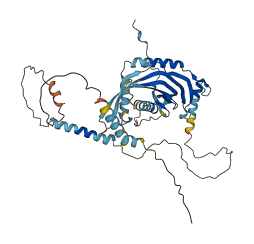
Descriptions
The autoinhibited protein was predicted that may have potential autoinhibitory elements via cis-regPred.
Autoinhibitory domains (AIDs)
Target domain |
|
Relief mechanism |
|
Assay |
cis-regPred |
Accessory elements
No accessory elements
Autoinhibited structure

Activated structure
1 structures for P41800
| Entry ID | Method | Resolution | Chain | Position | Source |
|---|---|---|---|---|---|
| AF-P41800-F1 | Predicted | AlphaFoldDB |
6 variants for P41800
| Variant ID(s) | Position | Change | Description | Diseaes Association | Provenance |
|---|---|---|---|---|---|
| s12-136880 | 99 | Q>P | No | SGRP | |
| s12-136964 | 127 | K>I | No | SGRP | |
| s12-136970 | 129 | K>R | No | SGRP | |
| s12-137312 | 243 | T>N | No | SGRP | |
| s12-137515 | 311 | V>I | No | SGRP | |
| s12-137821 | 413 | P>S | No | SGRP |
No associated diseases with P41800
Functions
6 GO annotations of cellular component
| Name | Definition |
|---|---|
| endoplasmic reticulum | The irregular network of unit membranes, visible only by electron microscopy, that occurs in the cytoplasm of many eukaryotic cells. The membranes form a complex meshwork of tubular channels, which are often expanded into slitlike cavities called cisternae. The ER takes two forms, rough (or granular), with ribosomes adhering to the outer surface, and smooth (with no ribosomes attached). |
| ERMES complex | A protein complex that links the endoplasmic reticulum with mitochondria and may have a role in promoting exchange of calcium and phospholipids between the two organelles. |
| integral component of endoplasmic reticulum membrane | The component of the endoplasmic reticulum membrane consisting of the gene products and protein complexes having at least some part of their peptide sequence embedded in the hydrophobic region of the membrane. |
| mitochondrial outer membrane | The outer, i.e. cytoplasm-facing, lipid bilayer of the mitochondrial envelope. |
| mitochondrion | A semiautonomous, self replicating organelle that occurs in varying numbers, shapes, and sizes in the cytoplasm of virtually all eukaryotic cells. It is notably the site of tissue respiration. |
| outer mitochondrial membrane protein complex | Any protein complex that is part of the outer mitochondrial membrane. |
1 GO annotations of molecular function
| Name | Definition |
|---|---|
| lipid binding | Binding to a lipid. |
9 GO annotations of biological process
| Name | Definition |
|---|---|
| aminophospholipid transport | The directed movement of aminophospholipids into, out of or within a cell, or between cells, by means of some agent such as a transporter or pore. Aminophospholipids contain phosphoric acid as a mono- or diester and an amino (NH2) group. |
| intermembrane lipid transfer | The transport of lipids between membranes in which a lipid molecule is transported through an aqueous phase from the outer leaflet of a donor membrane to the outer leaflet of an acceptor membrane. This process does not require metabolic energy and can be either spontaneous or mediated by lipid transfer proteins (LTPs). |
| mitochondrial genome maintenance | The maintenance of the structure and integrity of the mitochondrial genome; includes replication and segregation of the mitochondrial chromosome. |
| mitochondrial outer membrane translocase complex assembly | The aggregation, arrangement and bonding together of a set of components to form a mitochondrial outer membrane translocase complex. |
| mitochondrion organization | A process that is carried out at the cellular level which results in the assembly, arrangement of constituent parts, or disassembly of a mitochondrion; includes mitochondrial morphogenesis and distribution, and replication of the mitochondrial genome as well as synthesis of new mitochondrial components. |
| mitochondrion-endoplasmic reticulum membrane tethering | The attachment of a mitochondrion and an endoplasmic reticulum via molecular tethers that physically bridge their respective membranes and attach them to each other. The tethering may facilitate exchange of metabolites between the organelles. |
| phospholipid homeostasis | Any process involved in the maintenance of an internal steady state of phospholipid within an organism or cell. |
| phospholipid transport | The directed movement of phospholipids into, out of or within a cell, or between cells, by means of some agent such as a transporter or pore. Phospholipids are any lipids containing phosphoric acid as a mono- or diester. |
| protein insertion into mitochondrial outer membrane | The process comprising the insertion of proteins from outside the organelle into the mitochondrial outer membrane, mediated by large outer membrane translocase complexes. |
| 10 | 20 | 30 | 40 | 50 | 60 |
| MTDSENESTE | TDSLMTFDDY | ISKELPEHLQ | RLIMENLKGS | TTNDLKQTSN | NSEFNVSKNG |
| 70 | 80 | 90 | 100 | 110 | 120 |
| SFKGLDDAIQ | ALQMQSVLHP | SSLGSLATSS | KFSGWSFAQG | FFVGQLSIVL | LFIFFLKFFI |
| 130 | 140 | 150 | 160 | 170 | 180 |
| FSDEPSKSKN | PKPAASRHRS | KFKEYPFISR | EFLTSLVRKG | AKQHYELNEE | AENEHLQELA |
| 190 | 200 | 210 | 220 | 230 | 240 |
| LILEKTYYNV | DVHPAESLDW | FNVLVAQIIQ | QFRSEAWHRD | NILHSLNDFI | GRKSPDLPEY |
| 250 | 260 | 270 | 280 | 290 | 300 |
| LDTIKITELD | TGDDFPIFSN | CRIQYSPNSG | NKKLEAKIDI | DLNDHLTLGV | ETKLLLNYPK |
| 310 | 320 | 330 | 340 | 350 | 360 |
| PGIAALPINL | VVSIVRFQAC | LTVSLTNAEE | FASTSNGSSS | ENGMEGNSGY | FLMFSFSPEY |
| 370 | 380 | 390 | 400 | 410 | 420 |
| RMEFEIKSLI | GSRSKLENIP | KIGSVIEYQI | KKWFVERCVE | PRFQFVRLPS | MWPRSKNTRE |
| EKPTEL |